 by
by Classification of Hazardous Areas
Why Hazardous Area Classification Matters More Than You Think
Walk into a normal electrical workshop and a small spark may be nothing more than a brief flash.
Walk into a refinery, chemical plant, fuel terminal, gas-processing facility, or another location where flammable substances may be released—and that same spark could have a very different outcome.
It could ignite a flammable atmosphere.
That is why hazardous area classification is such an important part of electrical safety, process safety, and EHS management.
Hazardous area classification provides a systematic way to identify locations where flammable gases, vapors, liquids, mists, or combustible dusts may be present and where special precautions are required to prevent ignition.
The purpose isn’t simply to put a label on an area.
The real objective is to answer three critical questions:
What hazardous substance could be present?
How frequently and for how long could an explosive atmosphere exist?
What type of equipment and controls are appropriate for that environment?
Once these questions are understood, decisions about electrical equipment, instrumentation, maintenance, permits, inspection, and emergency controls become much clearer.
In this article, we’ll explore hazardous area classification in a practical and easy-to-understand way.
What Is a Hazardous Area?
A hazardous area is a location where a flammable or combustible substance may be present in a quantity or concentration that requires special precautions to prevent ignition.
Depending on the industry, these substances can include:
- Flammable gases
- Flammable vapors
- Flammable liquids
- Combustible dust
- Flammable mists
- Combustible fibers
- Other materials capable of forming an ignitable atmosphere
Typical examples include:
- Petroleum refineries
- Oil and gas facilities
- Chemical plants
- Pharmaceutical plants
- Paint manufacturing facilities
- Solvent storage areas
- Fuel stations
- Gas-processing plants
- LPG facilities
- Tank farms
- Grain-processing facilities
- Powder-handling plants
- Certain wastewater facilities
However, not every location within these facilities is hazardous.
A control room may have completely different requirements from a tank filling point.
That difference is where hazardous area classification becomes important.
What Is Hazardous Area Classification?
Hazardous area classification is the process of identifying and categorizing areas where an explosive atmosphere could occur.
The classification generally considers:
- The type of flammable substance
- The likelihood of its release
- The frequency and duration of the hazardous atmosphere
- The characteristics of the substance
- Ventilation
- The physical characteristics of the location
- Potential sources of ignition
The classification then helps determine what precautions and equipment are suitable.
For example, an area where flammable gas is continuously present requires considerably more stringent controls than an area where a flammable atmosphere is only expected occasionally under abnormal conditions.
Why Is Hazardous Area Classification Necessary?
Imagine a maintenance technician needs to install a new electrical junction box near a fuel-storage tank.
Without hazardous-area classification, someone might select a standard junction box simply because it meets the voltage and current requirements.
Electrically, it may work perfectly.
From an explosion-safety perspective, however, it may be completely unsuitable.
The classification process helps prevent this mistake.
It influences the selection of:
- Motors
- Lighting
- Junction boxes
- Switches
- Sensors
- Cable glands
- Control equipment
- Portable equipment
- Instrumentation
- Communication equipment
- Electrical enclosures
It also affects maintenance and inspection practices.
In simple terms:
Hazardous area classification helps determine where ignition risks must be controlled and what type of equipment can safely be installed there.
The Two Major Classification Approaches
You may encounter two major systems when working with hazardous locations.
1. Zone Classification System
The Zone system is widely used internationally and is associated with standards such as the IEC hazardous-area framework.
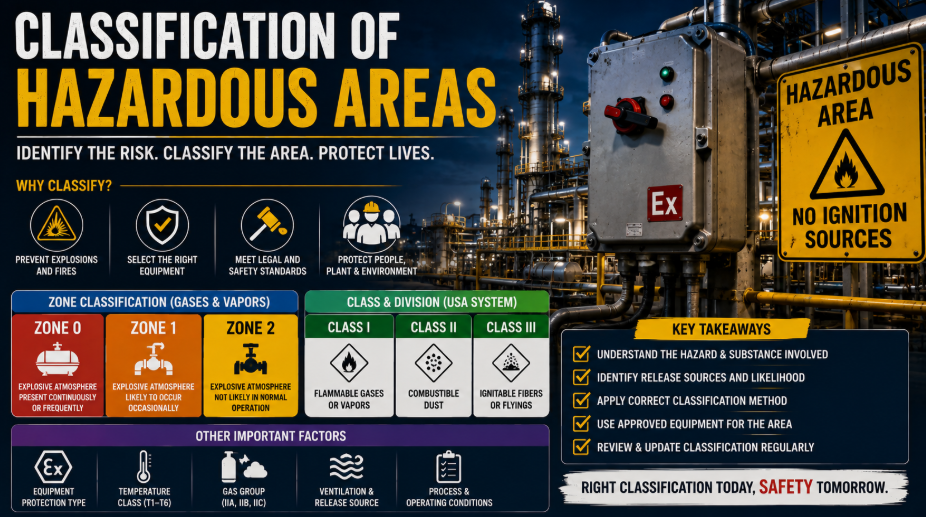
For gases and vapors, the commonly encountered zones are:
- Zone 0
- Zone 1
- Zone 2
For combustible dust, corresponding classifications commonly include:
- Zone 20
- Zone 21
- Zone 22
2. Class and Division System
Another approach, particularly associated with North American electrical codes, uses:
- Class I
- Class II
- Class III
combined with:
- Division 1
- Division 2
The terminology differs, but the fundamental safety objective is similar:
Identify the probability of a hazardous atmosphere and select appropriate protection against ignition.
Understanding Zone 0
What Is Zone 0?
Zone 0 refers to an area where an explosive gas or vapor atmosphere is present continuously, for long periods, or frequently under normal operating conditions, according to the applicable classification framework.
This represents one of the highest levels of hazardous-area exposure for gas/vapor atmospheres.
Examples may include certain locations:
- Inside process equipment
- Inside tanks
- Inside vessels
- Inside pipelines
- Around continuously exposed internal spaces
The exact boundary depends on the process and engineering assessment.
Zone 0 does not mean that an explosion is occurring.
It means the potential for an explosive atmosphere to exist is sufficiently frequent that the area requires the highest level of control.
Understanding Zone 1
What Is Zone 1?
Zone 1 generally refers to an area where an explosive gas or vapor atmosphere is likely to occur occasionally during normal operation.
Examples can include areas around:
- Tank vents
- Pump seals
- Filling points
- Sampling points
- Process equipment
- Connections where releases can occur during normal operations
Again, the actual classification depends on the facility’s hazardous-area study.
Zone 1 is therefore a location where the possibility of an explosive atmosphere must be actively considered during normal operations.
Understanding Zone 2
What Is Zone 2?
Zone 2 generally refers to an area where an explosive gas or vapor atmosphere is not likely to occur during normal operation, but if it does occur, it is expected to exist only for a short period.
This can occur around equipment where leakage is not expected during normal operation but could occur under abnormal conditions.
Examples may include areas around:
- Flanges
- Valves
- Connections
- Process equipment
- Ventilation openings
The boundaries must be established through a proper hazardous-area assessment rather than assumed from generic examples.
Zone 0 vs Zone 1 vs Zone 2
A simple way to understand the concept is:
| Classification | Basic Meaning |
|---|---|
| Zone 0 | Explosive atmosphere present continuously, for long periods, or frequently |
| Zone 1 | Explosive atmosphere likely to occur occasionally during normal operation |
| Zone 2 | Explosive atmosphere not likely during normal operation, but possible for a short duration |
The important point is that Zone 2 is still hazardous.
Workers sometimes make the mistake of thinking:
“It’s only Zone 2, so normal electrical equipment should be fine.”
That is incorrect.
The equipment must still be suitable for the classified location.
Hazardous Area Classification for Combustible Dust
Gas and vapor aren’t the only hazards.
Some industrial processes produce combustible dust that can form an explosive atmosphere.
Examples include certain:
- Grain dusts
- Flour dusts
- Sugar dusts
- Coal dusts
- Wood dusts
- Pharmaceutical powders
- Chemical powders
- Metal dusts
For these environments, the Zone system commonly uses:
Zone 20
An explosive dust atmosphere is present continuously, for long periods, or frequently.
Zone 21
An explosive dust atmosphere is likely to occur occasionally during normal operation.
Zone 22
An explosive dust atmosphere is not likely during normal operation but may occur for a short period under abnormal conditions.
Combustible dust introduces another concern: dust accumulation.
A layer of combustible dust can potentially become hazardous even if the surrounding air does not appear dusty.
The Class and Division System
Some facilities and equipment specifications use the Class/Division approach.
The Classes identify the type of hazardous material.
Class I
Locations where flammable gases, vapors, or liquids may be present.
Examples can include:
- Petroleum facilities
- Gas plants
- Chemical plants
- Fuel storage areas
Class II
Locations where combustible dust may be present.
Examples can include certain:
- Grain facilities
- Food-processing plants
- Powder-processing facilities
- Chemical processing areas
Class III
Locations where ignitable fibers or flyings may be present.
Examples can include certain:
- Textile operations
- Fiber-processing facilities
- Wood-processing environments
Division 1 and Division 2
Within the Class/Division system, the Division indicates the likelihood of the hazardous material being present.
Division 1
Generally indicates that the hazardous substance may be present under normal operating conditions or may frequently exist because of maintenance, repair, leakage, or process operations.
Division 2
Generally indicates that the hazardous substance is normally contained but could become present under abnormal conditions, such as accidental release or equipment failure.
A simple way to remember it:
Division 1 = greater likelihood
Division 2 = lower likelihood, but still hazardous
The exact definitions and application should always be taken from the applicable code or standard.
Gas Groups: Why Not All Gases Are the Same
Knowing that an area contains flammable gas isn’t enough.
Different gases have different ignition characteristics.
Therefore, hazardous-area equipment may also be classified according to gas groups.
Common gas groups under IEC-based systems include:
- IIA
- IIB
- IIC
IIC represents particularly demanding gas-group conditions compared with IIA and IIB.
Examples of substances may be associated with different groups depending on the applicable standard and classification.
This matters because equipment suitable for one gas group isn’t automatically suitable for every other group.
Temperature Class: Another Important Factor
Another important concept is temperature class.
Electrical equipment can become hot during operation.
If its surface temperature becomes high enough, it could potentially ignite a surrounding flammable atmosphere.
Temperature classifications are therefore used to establish maximum surface-temperature limits.
Common IEC temperature classes include:
- T1
- T2
- T3
- T4
- T5
- T6
The general principle is:
Higher T-number = lower permitted maximum surface temperature.
For example, T6 represents a more restrictive maximum surface-temperature requirement than T1.
This is why selecting hazardous-area equipment involves more than asking whether a device is “explosion-proof.”
The equipment must be appropriate for the specific substance and temperature requirements of the area.
What Is an Ignition Source?
Hazardous area classification is fundamentally about controlling ignition sources.
Potential ignition sources include:
- Electrical sparks
- Electrical arcs
- Hot surfaces
- Open flames
- Welding
- Grinding
- Static discharge
- Lightning
- Hot work
- Friction
- Mechanical sparks
- Overheated equipment
Electrical equipment is particularly important because switches, motors, relays, connectors, and other components can potentially produce sparks or hot surfaces.
This is why ordinary electrical equipment cannot simply be installed wherever a flammable substance exists.
Explosion Protection Concepts
Once a hazardous area has been classified, suitable equipment and protection methods can be selected.
Different explosion-protection concepts are used depending on the application.
Some commonly encountered concepts include:
Flameproof/Explosion-Proof Enclosures
Equipment is designed to withstand an internal explosion and prevent flame transmission to the surrounding atmosphere, according to the applicable certification requirements.
Intrinsic Safety
The electrical energy within a circuit is limited so that sparks or thermal effects cannot ignite the specified hazardous atmosphere under defined conditions.
This concept is particularly common in instrumentation.
Increased Safety
Equipment is designed with additional measures to reduce the possibility of excessive temperature, sparks, or arcs occurring under specified operating conditions.
Pressurization
Protective gas or clean air is maintained at a controlled pressure inside an enclosure to prevent hazardous external atmosphere from entering.
Encapsulation
Potential ignition sources are enclosed in a protective compound or material to prevent contact with the surrounding hazardous atmosphere.
These are only examples.
The appropriate protection method depends on the equipment, hazardous atmosphere, classification, certification, and applicable standards.
Hazardous Area Classification and Electrical Equipment
One of the biggest practical benefits of classification is guiding equipment selection.
Before installing equipment, engineers and technicians may need to consider:
- Area classification
- Gas/dust group
- Temperature class
- Equipment protection concept
- Equipment certification
- Ambient temperature
- Voltage
- Current
- Environmental conditions
- IP/ingress protection
- Installation requirements
For example, a motor used in an ordinary office environment and a motor used near a hydrocarbon process may perform the same mechanical function.
But their electrical construction and certification requirements can be very different.
Hazardous Area Classification Drawings
Hazardous-area classification is commonly represented through engineering drawings.
These drawings may show:
- Classified boundaries
- Zone numbers
- Equipment locations
- Release sources
- Distances
- Elevations
- Gas or dust groups
- Relevant notes
These drawings are extremely important during:
- Equipment installation
- Electrical design
- Maintenance
- Modification
- Inspection
- Permit preparation
Workers should not rely solely on memory.
If a task involves classified areas, the latest approved hazardous-area documentation should be consulted.
Sources of Hazardous Atmospheres
To classify an area, it is important to understand where a flammable substance could be released.
Potential release sources include:
- Flanges
- Valves
- Pump seals
- Compressor seals
- Sampling points
- Drain points
- Vents
- Tank openings
- Loading connections
- Unloading points
- Instrument connections
- Pipe joints
- Process equipment
The classification process evaluates the likelihood and characteristics of releases from these sources.
Ventilation Can Affect Classification
Ventilation plays an important role in hazardous-area assessment.
Good ventilation can reduce the accumulation of flammable gases or vapors.
Poor ventilation can allow hazardous concentrations to remain longer.
Factors that may be considered include:
- Natural ventilation
- Mechanical ventilation
- Air movement
- Enclosed spaces
- Building configuration
- Gas density
- Release rate
- Release location
For example, heavier-than-air vapors may accumulate in low areas.
Therefore, a classification assessment should consider not just the release point but also where the released material could travel or accumulate.
Hazardous Area Does Not Mean “No Work Allowed”
A common misconception is that classified areas are places where workers cannot perform maintenance.
That’s not necessarily true.
Maintenance can often be performed, but it must be carefully controlled.
Depending on the task, controls may include:
- Permit-to-work
- Electrical isolation
- Lockout/tagout
- Gas testing
- Continuous atmospheric monitoring
- Approved equipment
- Restricted access
- Fire protection
- Appropriate PPE
- Competent personnel
- Emergency arrangements
The objective is to control the conditions that could lead to ignition.
Electrical Maintenance in Hazardous Areas
Electrical maintenance deserves particular attention.
Before starting work, workers should understand:
Where is the classified boundary?
What type of atmosphere could exist?
What equipment is being worked on?
Is the equipment energized?
Has it been properly isolated?
Could the work itself create a spark?
Is gas testing required?
Is the equipment approved for the location?
What happens if atmospheric conditions change?
These questions should be addressed before tools are opened and work begins.
Portable Equipment in Hazardous Areas
Portable electrical equipment can introduce additional risk because workers may move it between classified and non-classified locations.
Examples include:
- Drills
- Grinders
- Inspection lamps
- Cameras
- Radios
- Measuring instruments
- Laptops
- Mobile devices
- Extension cables
A device that is perfectly acceptable in an office may be completely inappropriate inside a hazardous area.
Portable equipment should therefore be controlled through the site’s hazardous-area equipment requirements.
Where specialized equipment is required, workers should verify its suitability before bringing it into the area.
Hazardous Area Classification and Hot Work
Electrical work sometimes overlaps with hot work.
For example:
A technician may need to drill or grind near hydrocarbon equipment.
The activity could produce sparks.
Even if the electrical equipment itself is appropriately selected, the activity may create an ignition source.
This is why hot work is normally subject to strict controls.
Depending on the work and site requirements, controls may include:
- Hot-work permit
- Gas testing
- Continuous monitoring
- Equipment isolation
- Fire watch
- Fire extinguishers
- Removal of combustible materials
- Barricading
- Process shutdown
Never assume that an area is safe for hot work merely because no gas is detected at one moment.
Common Mistakes in Hazardous Area Classification
Mistake 1: Treating Every Part of a Plant as Hazardous
Not every location has the same level of risk.
Classification should be based on engineering assessment rather than assumptions.
Mistake 2: Treating Zone 2 as a Normal Area
Zone 2 is still a hazardous classification.
Equipment must remain suitable for the classified location.
Mistake 3: Ignoring Gas Groups
Different gases have different ignition characteristics.
Equipment must be appropriate for the relevant gas group.
Mistake 4: Ignoring Temperature Class
An electrically functional device can still be unsuitable if its surface temperature could ignite the surrounding atmosphere.
Mistake 5: Using Ordinary Portable Equipment
A normal drill or inspection lamp should not automatically be taken into a classified area.
Mistake 6: Modifying Certified Equipment
Unauthorized modifications can compromise the equipment’s protection characteristics.
Mistake 7: Assuming Classification Never Changes
Plant modifications, process changes, new equipment, ventilation changes, or changes in materials can affect hazardous-area classification.
What Happens When a Plant Changes?
Hazardous-area classification is not necessarily a one-time exercise.
Suppose a facility:
- Adds a new tank
- Changes a solvent
- Increases process pressure
- Changes ventilation
- Adds a new loading station
- Modifies piping
- Changes operating conditions
The original hazardous-area assessment may need to be reviewed.
This is why Management of Change (MOC) is important.
A seemingly small process modification can change the location or extent of a hazardous area.
Role of EHS Professionals
EHS professionals play an important supporting role in hazardous-area management.
Their responsibilities may include:
Risk Assessment
Identifying potential fire, explosion, electrical, and process hazards.
Permit Management
Ensuring appropriate permit systems are used for hazardous work.
Training
Helping workers understand hazardous-area classifications and safe work practices.
Equipment Control
Preventing unauthorized electrical or ignition-producing equipment from entering classified locations.
Inspection
Supporting inspections and audits of hazardous-area installations and work practices.
Emergency Preparedness
Ensuring workers understand alarms, evacuation procedures, emergency shutdowns, and response arrangements.
However, hazardous-area classification itself is a technical engineering activity and should be performed or approved by suitably competent personnel in accordance with the applicable standards.
Simple Way to Remember Hazardous Area Zones
A useful memory aid is:
Zone 0
Continuous / frequent presence
Zone 1
Likely occasionally during normal operation
Zone 2
Unlikely normally, but possible briefly
For combustible dust:
Zone 20
Continuous/frequent combustible dust atmosphere
Zone 21
Likely occasionally during normal operation
Zone 22
Unlikely normally, but possible briefly
The exact definitions should always be checked against the applicable standard being used for the project.
Practical Hazardous Area Checklist
Before electrical work begins in a classified area, ask:
Area
- Is the area classification known?
- Is the latest hazardous-area drawing available?
- Is the hazardous substance identified?
- Are release sources known?
Equipment
- Is the equipment approved for the location?
- Is the gas/dust group appropriate?
- Is the temperature classification suitable?
- Is the protection concept appropriate?
- Are certification markings intact?
Work
- Is a Permit-to-Work required?
- Has electrical isolation been completed?
- Has LOTO been applied where required?
- Has absence of voltage been verified?
- Is gas testing required?
- Are ignition sources controlled?
Personnel
- Are workers trained?
- Are they competent for the task?
- Do they understand the hazardous-area classification?
- Is the required PPE available?
Emergency
- Are emergency procedures known?
- Is communication available?
- Are escape routes clear?
- Is emergency response equipment available?
If a critical control is missing, the safest decision is simple:
STOP THE WORK AND RESOLVE THE ISSUE BEFORE PROCEEDING.
Hazardous Area Classification: The Bigger Picture
Hazardous-area classification should never be viewed as an isolated electrical requirement.
It sits at the intersection of:
Process Safety
Electrical Safety
Fire Safety
EHS
Engineering
Maintenance
Operations
A classification drawing may appear to be an engineering document, but its impact reaches almost every part of the organization.
Operations use it to understand hazardous locations.
Engineering uses it to select equipment.
Electrical teams use it during installation and maintenance.
Procurement uses it to specify suitable equipment.
EHS uses it when evaluating work activities and permits.
Maintenance uses it when planning repairs.
This is why everyone working in a hazardous facility should have at least a basic understanding of what the classifications mean.
Final Thoughts: Classification Is the First Line of Defense
Hazardous-area classification may initially appear complicated.
There are zones, classes, divisions, gas groups, dust groups, temperature classes, equipment protection concepts, certification markings, and technical standards.
But the fundamental idea is straightforward.
Identify where an explosive atmosphere could exist.
Understand how frequently it could occur.
Understand what substance is involved.
Control potential ignition sources.
Select equipment suitable for the classified location.
And most importantly, never treat classification as merely a label on a drawing.
It is a safety barrier.
A correct classification helps prevent ordinary electrical equipment from becoming an ignition source in a potentially explosive environment.
For workers, one principle is worth remembering:
The safest electrical equipment is not simply equipment that works—it is equipment that is suitable for the environment in which it is being used.
A hazardous area may look completely normal.
There may be no visible flame, no smoke, and no obvious warning.
The danger may be invisible.
That is precisely why classification, competent engineering, appropriate equipment, atmospheric monitoring, electrical isolation, and disciplined work practices are so important.
Understand the area. Understand the atmosphere. Control the ignition source. Work only when the necessary controls are in place.
That’s the foundation of hazardous-area safety.
Frequently Asked Questions
What is hazardous area classification?
Hazardous area classification is the process of identifying locations where flammable gases, vapors, mists, or combustible dusts may create an explosion hazard and determining the appropriate level of protection required.
What are Zone 0, Zone 1 and Zone 2?
For gas and vapor atmospheres, Zone 0 represents the highest frequency of an explosive atmosphere, Zone 1 represents an atmosphere likely to occur occasionally during normal operation, and Zone 2 represents an atmosphere not likely during normal operation but possible for a short duration.
What are Zones 20, 21 and 22?
These classifications are commonly used for combustible dust atmospheres. Zone 20 represents the highest frequency, followed by Zone 21 and then Zone 22.
What is Class I?
In the Class/Division system, Class I refers to locations where flammable gases, vapors, or liquids may be present.
What is the difference between Division 1 and Division 2?
Broadly, Division 1 represents locations where the hazardous material may be present under normal conditions or frequently due to maintenance or process operations, while Division 2 represents locations where the material is normally contained but could become hazardous under abnormal conditions.
What is a gas group?
A gas group categorizes flammable gases according to characteristics relevant to explosion protection and equipment suitability. IEC-based systems commonly use groups such as IIA, IIB, and IIC.
What is a temperature class?
Temperature class specifies the maximum surface-temperature limitation of suitable equipment so that it does not become an ignition source for the relevant hazardous atmosphere.
Can normal electrical equipment be used in a hazardous area?
Not automatically. Equipment must be appropriately selected, certified or approved, and suitable for the particular hazardous location and applicable requirements.
Does hazardous-area classification apply only to electrical equipment?
No. Although electrical equipment is a major concern, hazardous-area management also involves other potential ignition sources, including hot work, static electricity, hot surfaces, mechanical sparks, and other sources.
Can hazardous-area classification change?
Yes. Process modifications, changes in materials, equipment, ventilation, operating conditions, or plant layout can potentially affect the classification. Appropriate engineering review and Management of Change processes should be used.
Important Safety Note
This article is intended for general EHS and electrical-safety awareness. Hazardous-area classification is a technical engineering activity, and the terminology and requirements can differ depending on the applicable regulatory framework and standards.
For facilities in India, hazardous-area classification and equipment selection should be established using the applicable Indian regulations, relevant BIS/Indian Standards, adopted IEC requirements, equipment certification requirements, manufacturer instructions, and competent engineering advice.
Do not use generic examples of Zone, Class, Division, gas group, or temperature class as a substitute for the approved hazardous-area classification for a specific facility.
Always refer to the latest approved hazardous-area drawings, engineering documentation, applicable standards, and site procedures before carrying out work in a classified location.
🔁 Readers also enjoyed these blog posts:
- Safety Management’s Role: The Unsung Hero Behind Every Successful Organization
- Safety Management and Its Responsibilities: Protecting People, Preventing Hazards, and Promoting a Culture of Care
- Benchmarking for Safety Performance: A Key to Continuous Improvement
“Start Your Website Journey Today – Exclusive Hostinger Discounts!”