 by
by Difference Between Air Distribution and Air Conditioning: A Complete Guide for Better Ventilation and Heat Control
Have you ever walked into a shopping mall where every corner feels equally cool and comfortable? Or entered a warehouse where the air feels fresh despite the massive size of the building? Behind these comfortable environments lies a carefully designed HVAC system, where air distribution and air conditioning work together.
Although many people use these terms interchangeably, they are not the same.
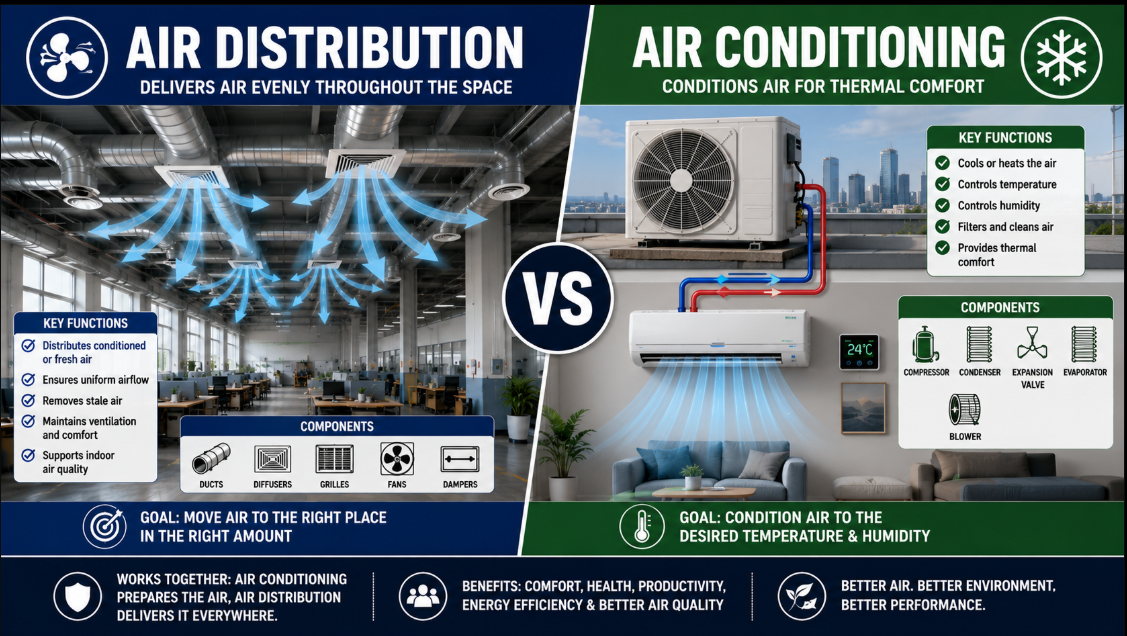
Air distribution focuses on moving and delivering air evenly throughout a building, while air conditioning focuses on cooling, heating, dehumidifying, and conditioning the air before it reaches occupied spaces.
Think of it this way: if air conditioning is the “chef” preparing the air, air distribution is the “delivery service” that ensures every room receives it efficiently.
Understanding the difference is essential for engineers, facility managers, safety professionals, and anyone interested in creating healthier, more energy-efficient indoor environments.
In this guide, we’ll explore how air distribution and air conditioning differ, where each system is used, their advantages and limitations, and why both are critical for workplace comfort and safety.
Why Indoor Air Management Matters
Indoor environments affect employee health, comfort, and productivity every day.
Poor air management can lead to:
- Uneven temperatures
- Poor indoor air quality
- Heat stress
- Employee discomfort
- Increased energy costs
- Equipment overheating
- Moisture problems
- Mold growth
A well-designed HVAC system solves these problems through proper air conditioning and effective air distribution.
What Is Air Distribution?
Air distribution is the process of delivering conditioned or fresh air evenly throughout a building using ducts, diffusers, grilles, registers, fans, and air handling equipment.
Its main purpose is air movement and airflow balance.
Air distribution does not change the temperature of the air. Instead, it ensures that air reaches every occupied space efficiently.
Without proper distribution, even the most powerful air conditioner cannot provide consistent comfort.
How Air Distribution Works
A typical air distribution system includes:
- Air ducts
- Supply diffusers
- Return air grilles
- Dampers
- Fans
- Air handling units (AHUs)
- Variable Air Volume (VAV) boxes
Once air has been cooled, heated, or filtered, these components transport it to different rooms while returning stale air for recirculation or exhaust.
Objectives of Air Distribution
A good air distribution system aims to:
- Deliver air uniformly
- Prevent hot and cold spots
- Maintain proper airflow
- Improve ventilation
- Reduce drafts
- Enhance indoor comfort
- Support indoor air quality
- Improve HVAC efficiency
Common Applications of Air Distribution
Air distribution systems are used in:
- Office buildings
- Shopping malls
- Hospitals
- Schools
- Hotels
- Factories
- Warehouses
- Airports
- Data centers
- Commercial buildings
Advantages of Air Distribution
Uniform Airflow
Proper duct design ensures that every room receives the required amount of air.
Better Indoor Air Quality
Even air circulation helps remove stale air and distribute fresh air effectively.
Improved Energy Efficiency
Balanced airflow reduces unnecessary HVAC operation and saves energy.
Enhanced Occupant Comfort
Consistent airflow minimizes temperature variations and drafts.
Supports Large Buildings
Air distribution makes it possible to condition large spaces efficiently.
Limitations of Air Distribution
Despite its importance, air distribution has limitations.
- Does not cool or heat air by itself.
- Requires careful duct design.
- Air leakage from ducts can reduce efficiency.
- Needs regular cleaning and maintenance.
- Improper balancing can create uncomfortable airflow patterns.
What Is Air Conditioning?
Air conditioning is the process of treating indoor air to achieve desired temperature, humidity, cleanliness, and comfort.
Unlike air distribution, air conditioning actively changes the condition of the air.
Modern air conditioning systems cool, dehumidify, filter, and sometimes heat the air before sending it through the air distribution network.
How Air Conditioning Works
Air conditioners use a refrigeration cycle involving:
- Compressor
- Condenser
- Expansion valve
- Evaporator coil
- Refrigerant
- Indoor blower
Warm indoor air passes over the cold evaporator coil, where heat is removed. The cooled and dehumidified air is then supplied to occupied spaces.
Objectives of Air Conditioning
Air conditioning systems are designed to:
- Cool indoor air
- Control humidity
- Remove excess heat
- Filter airborne particles
- Improve thermal comfort
- Protect sensitive equipment
- Enhance productivity
Applications of Air Conditioning
Air conditioning is commonly used in:
- Residential homes
- Offices
- Hospitals
- Hotels
- Laboratories
- Pharmaceutical plants
- Data centers
- Restaurants
- Shopping malls
- Manufacturing facilities
Advantages of Air Conditioning
Excellent Temperature Control
Maintains a stable indoor temperature regardless of outdoor conditions.
Humidity Reduction
Removes excess moisture, improving comfort and preventing mold growth.
Air Filtration
Captures dust, pollen, and other airborne particles.
Better Comfort
Keeps occupants comfortable during hot weather.
Equipment Protection
Essential for electronic equipment and temperature-sensitive processes.
Limitations of Air Conditioning
Air conditioning systems also have drawbacks.
- Higher energy consumption
- Regular maintenance required
- Refrigerant leaks can affect performance
- Installation costs are relatively high
- Fresh air supply may be limited without dedicated ventilation
Difference Between Air Distribution and Air Conditioning
Although both are parts of an HVAC system, their functions are different.
| Feature | Air Distribution | Air Conditioning |
|---|---|---|
| Primary Purpose | Deliver air evenly | Condition the air |
| Temperature Control | No | Yes |
| Humidity Control | No | Yes |
| Air Movement | Yes | Limited (through blower) |
| Cooling Function | No | Yes |
| Heating Function | No | Yes (in many systems) |
| Air Filtration | Minimal | Yes |
| Main Components | Ducts, diffusers, fans | Compressor, condenser, evaporator |
| Energy Consumption | Lower | Higher |
| Main Goal | Airflow management | Thermal comfort |
How They Work Together
Air distribution and air conditioning are complementary systems.
For example:
- The air conditioner cools and dehumidifies indoor air.
- The air handling unit pushes the conditioned air into ducts.
- The air distribution system delivers the air evenly through diffusers.
- Return air is collected and sent back for reconditioning.
Without proper air distribution, conditioned air may never reach all occupied areas. Likewise, without air conditioning, the distribution system would simply circulate untreated air.
Role in Workplace Safety
Air Distribution
- Prevents stagnant air.
- Ensures fresh air reaches all occupied areas.
- Reduces localized heat buildup.
- Supports ventilation effectiveness.
- Improves indoor air quality.
Air Conditioning
- Reduces heat stress.
- Controls humidity.
- Improves worker comfort.
- Protects heat-sensitive equipment.
- Supports productivity in hot climates.
Together, these systems create safer and healthier work environments.
Common Mistakes in HVAC Design
Many buildings experience comfort issues because of poor HVAC design.
Common mistakes include:
- Undersized ductwork
- Blocked supply or return vents
- Poor air balancing
- Dirty filters
- Inadequate fresh air ventilation
- Incorrect thermostat placement
- Neglecting regular maintenance
Addressing these issues can significantly improve HVAC performance.
Best Practices for Efficient Air Management
To maximize system performance:
- Design ducts for balanced airflow.
- Clean filters regularly.
- Inspect ducts for leaks.
- Balance supply and return air.
- Monitor indoor air quality.
- Maintain proper humidity levels.
- Use programmable thermostats.
- Schedule preventive HVAC maintenance.
These measures improve comfort while reducing energy costs.
Frequently Asked Questions (FAQs)
Is air distribution the same as air conditioning?
No. Air distribution moves air throughout a building, while air conditioning changes the temperature and humidity of the air.
Can air distribution cool a room?
No. Air distribution only delivers air. Cooling is performed by the air conditioning system.
Which system consumes more energy?
Air conditioning generally consumes more energy because it uses compressors and refrigeration equipment.
Can a building have air distribution without air conditioning?
Yes. Some buildings distribute fresh or heated air without mechanical cooling.
Why is air distribution important?
Proper air distribution ensures that conditioned air reaches every occupied space, improving comfort and indoor air quality.
Real-World Example
Imagine a large corporate office.
The central air conditioning plant cools the air to a comfortable temperature of 22°C.
However, without properly designed ducts and diffusers, employees near the vents may feel too cold while those farther away remain warm.
A balanced air distribution system ensures that every workstation receives the right amount of conditioned air, creating a consistently comfortable environment throughout the building.
Final Thoughts
Although they are closely connected, air distribution and air conditioning perform distinct yet equally important roles in modern HVAC systems.
Air conditioning prepares the air by cooling, heating, dehumidifying, and filtering it to create a comfortable indoor climate. Air distribution then takes over, ensuring that this conditioned air is delivered evenly and efficiently to every part of the building. Without proper distribution, even the most advanced air conditioning system cannot provide consistent comfort. Likewise, without air conditioning, the distribution system would simply move untreated air.
For homes, offices, hospitals, factories, and commercial facilities, the best indoor environments are created when both systems work together as part of an integrated HVAC strategy. This combination improves indoor air quality, enhances thermal comfort, reduces energy consumption, protects equipment, and supports workplace health and safety.
By understanding the difference between air distribution and air conditioning, building owners and facility managers can make informed decisions that lead to healthier occupants, more efficient operations, and long-term cost savings.
🔁 Readers also enjoyed these blog posts:
- Safety Management’s Role: The Unsung Hero Behind Every Successful Organization
- Safety Management and Its Responsibilities: Protecting People, Preventing Hazards, and Promoting a Culture of Care
- Benchmarking for Safety Performance: A Key to Continuous Improvement
“Start Your Website Journey Today – Exclusive Hostinger Discounts!”

Turn Any Idea into Viral,
Jaw-Dropping AI Videos in Seconds!