 by
by Introduction: Why Lockout and Tag-out Matters
Imagine a maintenance technician working inside a machine.
The machine has been switched off. The technician has already informed the operator. Everything looks quiet.
Suddenly, the machine starts.
It may take only a few seconds for a rotating shaft, moving conveyor, hydraulic cylinder, electrical motor, or pressurized system to cause a catastrophic injury.
This is exactly the type of situation that Lockout and Tag-out (LOTO) is designed to prevent.
Lockout/Tagout is a systematic method of controlling hazardous energy before maintenance, servicing, cleaning, inspection, repair, or other work is performed on machinery and equipment.
The basic idea is simple:
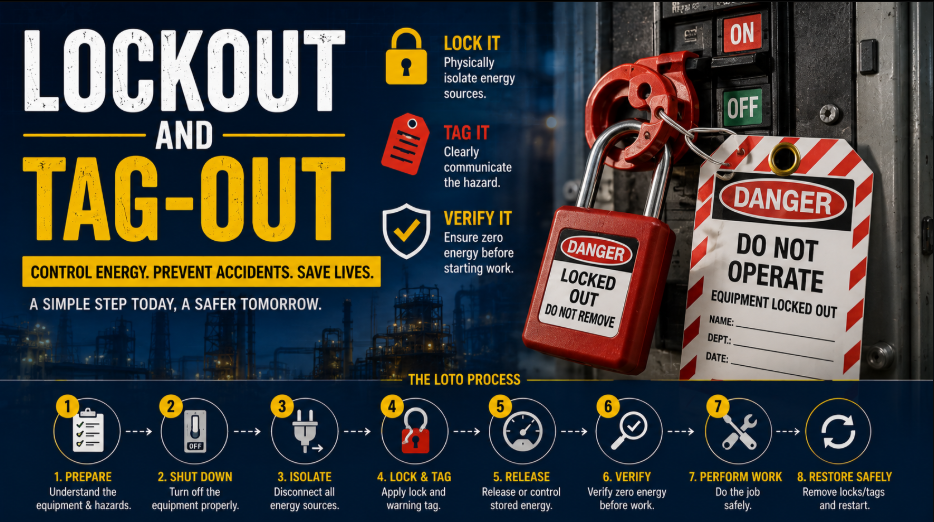
Shut it down. Isolate the energy. Lock it. Tag it. Release stored energy. Verify it is safe. Then start the work.
The concept may sound straightforward, but effective LOTO requires much more than putting a padlock on a switch.
Hazardous energy can come from electricity, mechanical movement, hydraulic pressure, pneumatic pressure, steam, chemicals, gravity, thermal energy, or stored energy. OSHA identifies unexpected startup or release of stored energy during servicing and maintenance as a significant source of serious and fatal workplace injuries.
A good LOTO program therefore protects people by making sure hazardous energy is identified, isolated, controlled, and verified.
What Is Lockout and Tag-out?
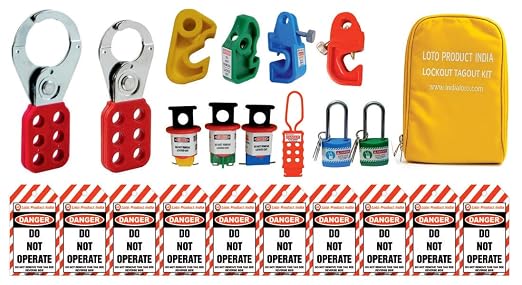
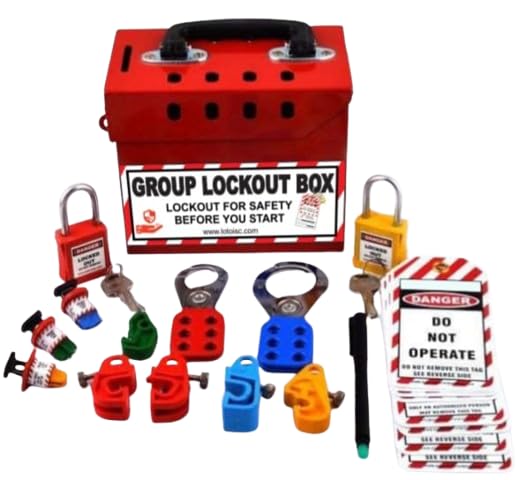
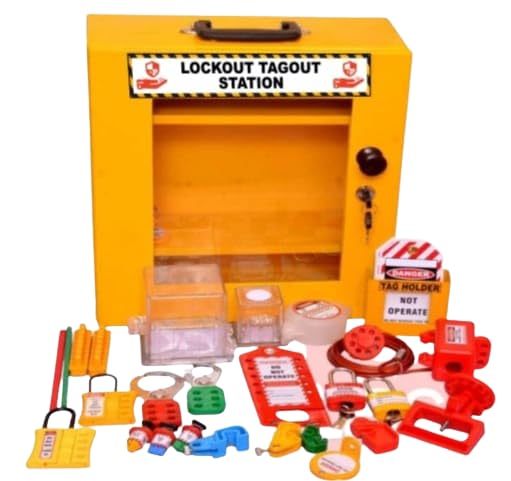
Lockout means physically securing an energy-isolating device in a safe position using a lock so that the equipment cannot be energized or operated.
Tag-out means attaching a prominent warning tag to an energy-isolating device to communicate that the equipment must not be operated.
Under OSHA’s hazardous-energy standard, lockout and tagout are used to prevent unexpected energization, startup, or release of stored energy during covered servicing and maintenance activities.
A lock physically restrains the energy-isolating device.
A tag communicates the warning.
This distinction is important.
A tag is fundamentally a warning device. It does not provide the same physical restraint as a lock. OSHA specifically recognizes this limitation and requires additional protections when tagout is used in situations where lockout is feasible.
In simple terms:
Lock = physical control
Tag = warning
Lock + Tag = stronger energy-control system
What Is Hazardous Energy?
Many people associate LOTO only with electricity.
That is a mistake.
Hazardous energy can exist in many forms.
Common types include:
- Electrical energy
- Mechanical energy
- Hydraulic energy
- Pneumatic energy
- Chemical energy
- Thermal energy
- Gravitational energy
- Pressurized energy
- Stored spring energy
- Rotational energy
- Potential energy
- Residual or accumulated energy
Consider a machine powered by an electric motor.
Switching off the motor may remove electrical power, but the machine could still contain:
- Rotational energy
- Stored pressure
- Gravity-related energy
- Compressed air
- Hydraulic pressure
- A loaded spring
- A raised component that could fall
Therefore, turning off the main electrical supply does not automatically make every machine safe.
The objective of LOTO is to control all hazardous energy sources that could injure a worker.
Why Is Lockout/Tagout Necessary?
Maintenance work often requires people to enter areas that are normally protected during machine operation.
Guards may need to be removed.
Panels may need to be opened.
Machines may need to be cleaned or unjammed.
Components may need to be replaced.
These activities create opportunities for workers to come into contact with energy that would normally remain isolated from them.
According to OSHA, injuries resulting from uncontrolled hazardous energy can include electrocution, burns, crushing, cutting, amputations, fractures, and other serious injuries.
LOTO helps prevent these incidents by creating a deliberate barrier between the worker and hazardous energy.
Instead of relying on:
“I switched it off.”
the worker follows a controlled process:
Identify → Shut down → Isolate → Lock → Release → Verify → Work
That difference can save a life.
The Basic Lockout/Tagout Procedure
A good LOTO procedure should be specific to the equipment and workplace.
However, the overall process generally follows a sequence of steps.
1. Prepare for Shutdown
Before touching the machine, understand what you are about to isolate.
Identify:
- The equipment
- All energy sources
- Energy-isolating devices
- Type of energy
- Magnitude of energy
- Potential hazards
- Stored energy
- Required locks and tags
- Required PPE
- Authorized personnel
Look at the equipment’s energy-control procedure, drawings, manuals, or other relevant information where applicable.
This is where many LOTO failures begin.
If you do not know where the energy comes from, you cannot effectively isolate it.
OSHA’s prescribed sequence begins with preparation and requires the authorized employee to understand the type and magnitude of energy and the means of controlling it.
2. Notify Affected Employees
People who operate or work around the equipment should know that it is going to be shut down.
For example:
“The production line will be unavailable while maintenance work is being performed.”
This prevents someone from trying to restart the machine because they assume it has simply stopped unexpectedly.
Affected employees should understand:
- What equipment is being isolated
- Why it is being isolated
- Who is performing the maintenance
- That they must not attempt to restart the equipment
Communication is a simple control, but it prevents confusion during maintenance.
3. Shut Down the Equipment
The equipment should be shut down using the normal operating procedure.
This may involve:
- Pressing the stop button
- Turning off a machine
- Closing an operating valve
- Stopping a process
- Disconnecting equipment according to its established procedure
The shutdown should be controlled and orderly.
An uncontrolled shutdown can create additional hazards.
For example, suddenly stopping a machine may cause a load to shift, pressure to change, or material to fall.
The goal is not simply to make the machine stop.
The goal is to bring it to a safe shutdown condition.
4. Isolate All Energy Sources
This is the heart of the LOTO process.
Locate every energy-isolating device associated with the equipment.
Examples include:
- Circuit breakers
- Disconnect switches
- Isolation valves
- Hydraulic valves
- Pneumatic valves
- Mechanical disconnects
- Blanking devices
- Line blinds
- Other physical isolation mechanisms
Simply pressing an emergency stop is generally not the same as isolating the energy source.
An emergency stop may stop movement, but it may not physically disconnect the energy.
The correct isolation method depends on the equipment and its energy sources.
5. Apply Locks and Tags
Once the energy-isolating devices are placed in the safe position, authorized employees apply their locks and tags according to the site’s procedure.
A proper lockout device should:
- Be identifiable
- Be durable
- Be suitable for the environment
- Be used only for energy control
- Prevent unauthorized operation
- Clearly identify the person applying it where required
OSHA requires lockout/tagout devices to be standardized, durable, substantial, and identifiable within the scope of its standard.
The tag should clearly communicate the hazard.
Typical warnings include:
DO NOT OPERATE
DO NOT START
DO NOT ENERGIZE
LOCKED OUT
The key principle is personal control.
A worker performing the maintenance should not simply assume that someone else will protect the isolation.
6. Release or Control Stored Energy
This step is often overlooked.
Even after the main energy source has been isolated, dangerous energy may remain stored.
Examples include:
Electrical
- Capacitors
- Batteries
- UPS systems
- Residual electrical energy
Mechanical
- Rotating components
- Flywheels
- Springs
- Suspended loads
Hydraulic
- Pressurized fluid
- Accumulators
- Elevated cylinders
Pneumatic
- Compressed air
- Pressurized lines
Thermal
- Hot surfaces
- Steam
- Heated fluids
Gravitational
- Raised machine components
- Suspended loads
- Elevated platforms
Stored energy must be released, blocked, restrained, grounded, discharged, or otherwise controlled according to the equipment-specific procedure.
Zero energy does not happen automatically.
It must be deliberately achieved.
7. Verify Isolation
This may be the most important step in the entire LOTO process.
After isolation and control of stored energy, the authorized employee must verify that the equipment is actually safe to work on.
Depending on the equipment, verification may involve:
- Attempting a normal start from the controls
- Checking electrical test points with appropriate instruments
- Confirming pressure has dropped
- Checking hydraulic gauges
- Confirming valves are isolated
- Checking mechanical movement
- Inspecting the equipment for residual energy
The exact verification method must match the hazard.
For electrical systems, appropriate testing equipment and electrical safety procedures should be used by qualified personnel where required.
After attempting the start or performing the applicable test, controls should be returned to the OFF or neutral position.
The important lesson is:
Do not assume isolation. Prove it.
OSHA’s LOTO procedure specifically includes verification as part of the energy-control process before servicing begins.
8. Perform the Maintenance Work
Only after the energy has been isolated, locked/tagged, stored energy controlled, and isolation verified should the maintenance activity begin.
During the job, workers should continue to monitor conditions.
If the scope changes, stop and reassess.
For example, suppose a maintenance job originally involved replacing a motor but later requires opening a hydraulic system.
The energy-control requirements may change.
Do not continue using yesterday’s isolation plan simply because the job has already started.
Change in work = reassess the hazard.
9. Restore the Equipment Safely
LOTO does not end when the repair is finished.
The restoration phase is equally important.
Before removing locks and re-energizing the equipment:
- Inspect the work area.
- Confirm the repair is complete.
- Remove tools and loose materials.
- Reinstall guards and protective devices.
- Confirm all workers are safely positioned.
- Check that machine components are properly assembled.
- Notify affected employees.
- Ensure everyone is clear of the hazard.
- Remove locks and tags according to the established procedure.
- Restore energy.
- Test the equipment safely.
OSHA requires affected employees to be notified before lockout/tagout devices are applied and after they are removed.
Never rush the restoration stage.
A machine can be just as dangerous when it is being restarted as when it was being shut down.
Personal Locks: Why They Matter
One of the most important principles of LOTO is that workers must maintain control over their own protection.
A personal lock identifies the person responsible for the isolation.
This becomes especially important during maintenance involving several workers.
For example, imagine five technicians working on the same machine.
If only one lock is applied, what happens if that person removes the lock while the other four are still working?
This is why group LOTO procedures commonly use systems such as:
- Group lock boxes
- Multiple-lock hasps
- Personal locks
- Authorized employee locks
Each worker should be protected according to the organization’s approved group-lockout procedure.
The exact process must be defined in the workplace’s written energy-control program.
Group Lockout/Tagout
Large maintenance activities may involve several people, contractors, departments, or shifts.
Group LOTO requires careful coordination.
A strong group procedure should establish:
- Who is responsible for the isolation
- Who verifies the isolation
- How each worker applies personal protection
- How shift changes are handled
- How contractors are coordinated
- How locks are removed
- How communication is maintained
No worker should lose protection simply because the job involves multiple people.
Shift Changes and LOTO
Shift changes can create a dangerous gap in protection.
Imagine a technician locks out a machine at 6:00 PM and leaves at 6:00 AM.
A second technician arrives to continue the repair.
What happens to the first technician’s lock?
The answer should already be defined by the organization’s procedure.
A proper shift-change process ensures that hazardous energy remains controlled continuously.
The outgoing worker should not simply remove a lock and expect the incoming worker to apply theirs afterward.
There should be a controlled transfer of protection.
Contractor Safety and LOTO
Many workplaces use contractors for:
- Electrical maintenance
- Mechanical repairs
- Equipment installation
- Shutdown projects
- Plant modifications
- Preventive maintenance
Contractor LOTO activities must be coordinated with the host employer’s energy-control program.
Before work begins, both parties should understand:
- Which equipment is being isolated
- Who controls the isolation
- Which procedures apply
- How locks and tags will be managed
- Who is authorized
- How communication will occur
- How the equipment will be returned to service
A contractor should never assume that the host site’s isolation process is identical to their previous workplace.
Common LOTO Mistakes to Avoid
Even companies with LOTO procedures can experience failures when workers treat the process as a formality.
Here are some of the most common mistakes.
“The machine is switched off, so it’s safe.”
Wrong.
Off does not necessarily mean isolated.
“I’ll just remove the guard quickly.”
Removing a guard can expose a worker to hazardous energy.
If the task falls within the scope of energy-control requirements, the appropriate procedure must be followed.
“Someone else already locked it out.”
Never assume someone else’s lock provides your personal protection unless the site’s approved group LOTO procedure specifically establishes that protection.
“There is no electricity, so we don’t need LOTO.”
LOTO is not only about electricity.
Hydraulic, pneumatic, mechanical, thermal, chemical, gravitational, and stored energy can also injure workers.
“It’s only going to take five minutes.”
Short jobs can still cause serious injuries.
The length of the job does not make hazardous energy disappear.
“We have done this many times.”
Familiarity can actually increase risk when it leads to complacency.
Every job should be evaluated based on its actual hazards.
What Makes an Effective LOTO Program?
A successful LOTO program is more than a box containing locks and tags.
OSHA identifies three core components of an effective hazardous-energy control program:
- Energy-control procedures
- Employee training
- Periodic inspections
Written procedures
Equipment-specific procedures should identify the energy sources, isolation points, shutdown methods, stored-energy controls, verification methods, and restoration process as appropriate.
Training
Workers should understand their role in the energy-control process.
This includes understanding who is authorized to apply locks, who is affected by the shutdown, and what actions are prohibited.
Periodic inspections
Procedures should be reviewed periodically to verify that they are being followed correctly and remain effective.
LOTO is not a “train once and forget” activity.
Equipment changes.
Processes change.
People change.
Energy-control procedures must keep up.
Authorized, Affected and Other Employees
A good LOTO program should clearly distinguish worker roles.
Authorized Employees
These employees perform servicing or maintenance and are responsible for applying the energy-control procedures.
They need to understand:
- Energy sources
- Energy magnitude
- Isolation methods
- Lockout devices
- Stored-energy hazards
- Verification methods
Affected Employees
These are generally employees who operate or work with the equipment being serviced or work in the area where the energy-control procedure is used.
They need to understand:
- Why equipment is locked out
- That they must not attempt to restart it
- The meaning of locks and tags
Other Employees
Other people who may work in or pass through the area should also understand the basic prohibition against interfering with locked or tagged equipment.
OSHA requires training appropriate to employee roles and emphasizes that employees must understand the purpose and function of the energy-control program.
LOTO and Electrical Safety
For electrical maintenance, LOTO is an essential part of energy isolation—but it should not be confused with the complete electrical safety process.
Electrical work may also require:
- Electrical risk assessment
- Qualified personnel
- Appropriate test equipment
- Verification of absence of voltage
- Electrical PPE
- Arc-flash assessment
- Shock protection
- Grounding practices
- Barricades and boundaries
- Safe approach distances
- Applicable electrical standards
A lock on a breaker is important.
But the worker must also understand what that breaker controls, whether other sources exist, whether backfeed is possible, and how absence of hazardous voltage will be verified.
LOTO Checklist for the Workplace
Before starting maintenance, ask:
Preparation
- Have all hazardous energy sources been identified?
- Is the correct equipment identified?
- Is the equipment-specific procedure available?
- Are authorized workers identified?
- Have affected employees been informed?
Shutdown
- Has the equipment been shut down correctly?
- Have all energy-isolating devices been identified?
- Have the energy sources been isolated?
Lockout/Tagout
- Have appropriate locks been applied?
- Have warning tags been applied?
- Are locks and tags identifiable?
- Is group LOTO being managed correctly where applicable?
Stored Energy
- Has electrical energy been discharged where required?
- Has pressure been released?
- Have moving parts stopped?
- Have suspended components been secured?
- Have springs or other stored-energy devices been controlled?
Verification
- Has isolation been verified?
- Has an appropriate try/test procedure been completed?
- Is the equipment confirmed safe before work begins?
Restoration
- Is the maintenance complete?
- Are tools removed?
- Are guards restored?
- Are workers clear?
- Have affected employees been notified?
- Are locks and tags removed according to procedure?
- Is re-energization controlled?
The Golden Rule of LOTO
If there is one principle that every worker should remember, it is this:
Never work on equipment simply because someone says it is switched off. Work only after hazardous energy has been properly isolated, controlled, and verified according to the applicable procedure.
LOTO creates a deliberate pause between energy and human contact.
That pause is extremely valuable.
It gives workers a chance to identify hazards, isolate them, verify the isolation, and prevent someone else from accidentally restoring the energy.
Final Thoughts: Lock It. Tag It. Verify It.
Lockout/Tagout is sometimes viewed as paperwork, an inconvenience, or an extra step that slows down maintenance.
It should be viewed differently.
LOTO is a life-protection system.
A machine can be repaired.
A production line can be restarted.
A maintenance job can wait a few more minutes.
A person who suffers a catastrophic injury because hazardous energy was not controlled may never get that opportunity.
The most effective LOTO culture is one where workers do not ask:
“Can we skip the lockout just this once?”
Instead, they ask:
“What energy could hurt me, and how do I know it is completely controlled?”
That is the mindset that prevents accidents.
Remember the sequence:
IDENTIFY → NOTIFY → SHUT DOWN → ISOLATE → LOCK & TAG → RELEASE STORED ENERGY → VERIFY → PERFORM WORK → RESTORE SAFELY
When these steps become part of everyday maintenance culture, LOTO stops being a checklist and becomes a habit.
And in EHS, that is exactly what we want—safe work to become normal work.
Lock it. Tag it. Verify it. Then work.
Frequently Asked Questions About Lockout/Tagout
What does LOTO stand for?
LOTO stands for Lockout/Tagout. It is a hazardous-energy control method used to prevent unexpected startup, energization, or release of hazardous energy during servicing and maintenance.
Is LOTO only for electrical equipment?
No. LOTO can apply to electrical, mechanical, hydraulic, pneumatic, chemical, thermal, gravitational, and other hazardous energy sources.
What is the difference between lockout and tagout?
Lockout physically prevents operation of an energy-isolating device using a lock. Tagout places a warning device on the isolation point to indicate that it must not be operated. A tag does not provide the same physical restraint as a lock.
Is switching off a machine enough?
No. Switching off a machine does not necessarily isolate all hazardous energy. The appropriate energy-isolation procedure should be followed, including controlling stored energy and verifying isolation.
Who should apply a LOTO lock?
LOTO locks should be applied by appropriately trained and authorized personnel according to the organization’s energy-control procedure and applicable requirements.
What happens if multiple workers are performing maintenance?
A group LOTO procedure should be used where appropriate. Each worker should receive the protection specified by the approved group energy-control procedure, often through personal locks and a group lockout system.
Does LOTO apply to contractors?
Yes, hazardous-energy control must be appropriately coordinated whenever contractors perform servicing or maintenance that exposes them to hazardous energy. The host employer and contractor should establish clear responsibilities and communication before work begins.
Important Safety Note
This article is intended for general EHS and workplace-safety education. LOTO requirements can vary depending on the country, industry, equipment, electrical system, and applicable legislation or standards. Organizations should develop and implement equipment-specific energy-control procedures that meet the requirements applicable to their workplace. For example, OSHA’s 29 CFR 1910.147 provides a detailed hazardous-energy control framework for covered U.S. general-industry activities.
For workplaces in India, LOTO procedures should be aligned with applicable Indian legislation, electrical-safety requirements, company procedures, and relevant standards rather than copied directly from a foreign regulation.
🔁 Readers also enjoyed these blog posts:
- Safety Management’s Role: The Unsung Hero Behind Every Successful Organization
- Safety Management and Its Responsibilities: Protecting People, Preventing Hazards, and Promoting a Culture of Care
- Benchmarking for Safety Performance: A Key to Continuous Improvement
“Start Your Website Journey Today – Exclusive Hostinger Discounts!”