 by
by Toxic Effect of Chemicals Increases as Temperature Increases: Is This Statement Really True?
Temperature can change the behavior of chemicals in surprising ways.
A chemical that appears relatively stable under one set of conditions may evaporate more rapidly when heated. A liquid chemical may produce more vapor. A reaction may become faster. Certain substances may break down into other compounds. Even the way a chemical enters the human body can change with temperature.
This leads to an important EHS question:
“Does the toxic effect of a chemical increase as temperature increases?”
The short answer is:
It can, and often does, but the statement is not universally true for every chemical.
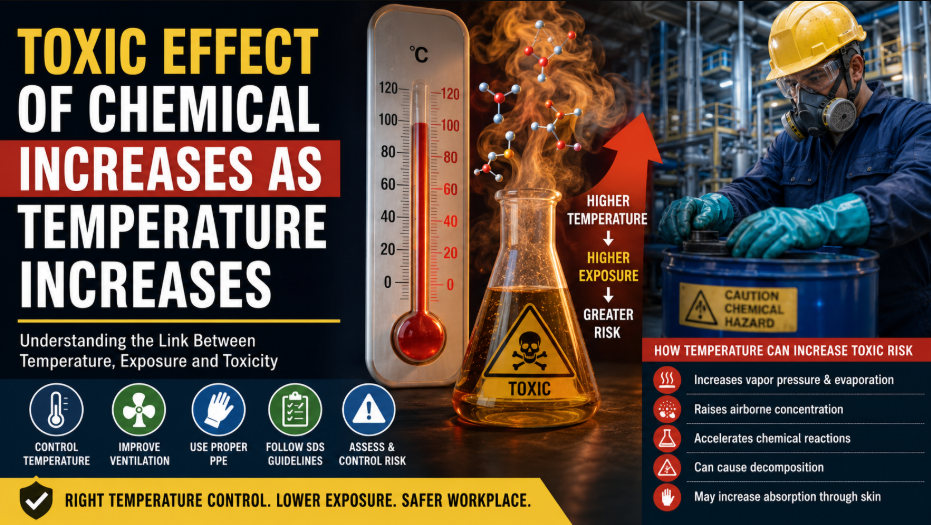
Higher temperature does not automatically make every chemical intrinsically more toxic. However, temperature can significantly increase exposure, and increased exposure can result in greater health effects.
This distinction is extremely important for anyone working in Environment, Health and Safety (EHS), occupational health, industrial hygiene or chemical process safety.
Let’s break it down.
What Does the Statement Actually Mean?
The statement “toxic effect of chemicals increases as temperature increases” can be understood in two different ways.
Meaning 1: The chemical becomes intrinsically more toxic
This means the chemical itself becomes biologically more harmful simply because its temperature has increased.
This is not always true.
Meaning 2: The worker’s exposure to the chemical increases
This can happen quite commonly.
When temperature increases, some chemicals:
- Evaporate faster
- Produce more vapor
- Have higher vapor pressure
- Spread more readily through air
- May penetrate certain materials differently
- May react or decompose more rapidly
As a result, a person may inhale or otherwise encounter a larger amount of the substance.
Therefore, a more accurate EHS statement is:
Increasing temperature can increase the toxic risk of many chemicals by increasing their volatility, airborne concentration, reaction rate, or absorption, although the effect depends on the chemical and exposure conditions.
That is a much more scientifically reliable way of looking at the issue.
Why Does Temperature Matter in Chemical Exposure?
Imagine a container of a volatile liquid sitting in a cool room.
Some molecules escape from the liquid surface and enter the air. Now imagine that the temperature rises.
More molecules may have enough energy to escape from the liquid into the surrounding air.
The result can be:
Higher temperature → Greater evaporation → More vapor in the surrounding environment → Potentially greater inhalation exposure
This is one of the most important reasons temperature matters in workplace chemical safety.
1. Higher Temperature Can Increase Vapor Pressure
One of the key concepts connecting temperature and chemical exposure is vapor pressure.
Vapor pressure describes the tendency of a substance to enter the vapor phase.
For many volatile liquids, vapor pressure increases as temperature increases.
That means a warmer container of a volatile chemical can release more vapor into the surrounding air than the same container at a lower temperature.
For example, consider a volatile solvent used in an industrial process.
At a lower temperature:
Liquid solvent → relatively lower evaporation → lower vapor generation
At a higher temperature:
Liquid solvent → increased evaporation → higher vapor generation
If ventilation does not adequately remove the vapor, the concentration in the breathing zone may increase.
This can increase the potential for inhalation exposure.
2. More Vapor Can Mean Greater Inhalation Exposure
The human respiratory system can be an important route of occupational exposure.
If a chemical is volatile, increased evaporation can result in more of the substance entering the air.
Workers may then inhale the chemical.
Potential effects depend on the specific substance and the concentration and duration of exposure.
Depending on the chemical, exposure may cause effects such as:
- Irritation
- Headache
- Dizziness
- Respiratory effects
- Central nervous system effects
- Organ toxicity
- Other acute or chronic health effects
The exact hazard must always be determined from reliable chemical safety information, such as the Safety Data Sheet (SDS) and applicable occupational exposure limits.
3. Temperature Can Increase the Rate of Chemical Reactions
Temperature can also affect the rate of chemical reactions.
As temperature rises, many chemical reactions occur more rapidly.
This principle is particularly important in industrial processes.
A chemical may react with:
- Oxygen
- Water
- Other chemicals
- Surfaces
- Contaminants
- Process materials
If a reaction produces a hazardous gas, vapor or decomposition product, higher temperature may increase the rate at which that hazardous material is generated.
For example:
Higher temperature → Faster reaction → Greater generation of hazardous product → Potentially greater exposure
This is one reason process temperature is an important parameter in chemical manufacturing and process safety.
4. Some Chemicals Can Decompose When Heated
Heat does not merely cause evaporation.
Certain chemicals can undergo thermal decomposition when exposed to sufficiently high temperatures.
The original chemical may break down into other substances.
Some decomposition products can be hazardous.
This means that the safety question should not simply be:
“Is the original chemical toxic?”
It should also be:
“What happens to this chemical when it is heated?”
A substance may have different hazards under normal storage conditions compared with conditions involving heating, fire or thermal processing.
This information should be obtained from the relevant SDS, manufacturer information and process hazard assessment.
5. Temperature Can Affect Absorption
Temperature can also influence how some chemicals interact with the body.
For example, skin absorption can be affected by environmental and physiological conditions.
Warm conditions may increase:
- Skin temperature
- Sweating
- Skin blood flow
These factors can potentially influence the absorption of certain chemicals through the skin.
However, the extent of this effect depends heavily on the chemical, formulation, concentration, duration of contact and condition of the skin.
Therefore, it would be incorrect to assume that every chemical becomes more readily absorbed simply because the temperature rises.
6. Heat Can Increase the Importance of Chemical Exposure Controls
There is another practical issue that EHS professionals must consider.
Workers are often exposed to heat and chemicals at the same time.
For example, imagine an industrial process involving a volatile solvent in a hot production area.
The combination can create a more challenging exposure situation:
High temperature → Increased solvent evaporation
At the same time:
High temperature → Greater worker heat strain and potentially increased physiological stress
The overall workplace risk therefore needs to be evaluated rather than looking at chemical toxicity in isolation.
This is particularly important in:
- Chemical plants
- Paint manufacturing
- Printing facilities
- Refineries
- Laboratories
- Pharmaceutical manufacturing
- Manufacturing plants
- Storage areas
- Solvent-handling operations
Does Temperature Make Every Chemical More Toxic?
No.
This is the most important qualification to the statement.
There is no universal rule saying:
Higher temperature = higher toxicity for every chemical.
Different chemicals behave differently.
Temperature can affect:
- Vapor pressure
- Solubility
- Reaction rate
- Decomposition
- Stability
- Absorption
- Physical state
- Concentration in air
But the biological toxicity of the substance does not necessarily increase simply because the temperature rises.
Sometimes the major change is actually in exposure, not intrinsic toxicity.
This distinction is crucial.
Toxicity vs. Exposure: What Is the Difference?
These two concepts are often confused.
Toxicity
Toxicity refers to the inherent ability of a substance to cause harm under particular conditions of exposure.
Exposure
Exposure refers to contact with the substance.
Exposure depends on factors such as:
- Concentration
- Duration
- Frequency
- Route of entry
- Work practices
- Ventilation
- Personal protective equipment
- Physical properties of the chemical
A chemical does not necessarily become intrinsically more toxic just because it is hotter.
But if higher temperature causes workers to be exposed to a greater concentration, the risk of harmful effects can increase.
This is the key idea.
An Easy Example
Consider a volatile cleaning solvent.
At a lower temperature
The solvent evaporates relatively slowly.
The workplace ventilation is able to remove the generated vapor effectively.
Worker exposure remains relatively low.
At a higher temperature
The solvent evaporates more rapidly.
More vapor enters the workplace air.
If ventilation remains unchanged, the concentration around the worker may increase.
The worker could therefore receive a greater dose.
So the important chain is:
Temperature increases → Evaporation increases → Airborne concentration may increase → Exposure may increase → Risk of adverse effects may increase
This is why temperature can be an important factor in chemical safety.
The Role of Ventilation
Ventilation can strongly influence what happens after a chemical becomes airborne.
Suppose heating causes a volatile substance to evaporate faster.
If the workplace has effective ventilation:
More vapor generated → Vapor effectively removed → Exposure controlled
But if ventilation is inadequate:
More vapor generated → Vapor accumulates → Higher potential exposure
This is why temperature and ventilation should sometimes be evaluated together during workplace risk assessments.
A change in process temperature can potentially change the required performance of an existing ventilation system.
What About Storage of Chemicals?
Temperature is also important during chemical storage.
Chemical storage areas should be maintained according to the manufacturer’s recommendations and applicable regulations.
Uncontrolled temperature increases can potentially contribute to:
- Increased vapor generation
- Pressure buildup
- Chemical degradation
- Container deterioration
- Increased fire risk
- Formation of hazardous decomposition products
For this reason, chemical storage should consider both temperature control and compatibility.
Containers should also be protected from inappropriate heat sources and direct sunlight where required by the chemical’s storage instructions.
Temperature and Flammability: Another Important EHS Connection
Temperature can affect chemical safety in another major way: flammability.
For flammable liquids, increasing temperature can increase vapor generation.
More vapor can potentially result in a flammable atmosphere if the concentration reaches the appropriate range and an ignition source is present.
This creates a combined concern:
Higher temperature → More vapor → Potentially greater flammable atmosphere risk
Therefore, temperature control, ventilation, ignition-source control and appropriate storage practices are important elements of fire and process safety.
Importantly, toxicity and flammability are separate hazards. A chemical can be toxic, flammable, both, or neither, depending on its properties.
Does Heating Always Increase Evaporation?
For many volatile liquids, evaporation increases as temperature increases.
However, the actual behavior depends on the substance and the surrounding conditions.
Factors include:
- Vapor pressure
- Surface area
- Air movement
- Ambient pressure
- Temperature
- Concentration
- Container design
A covered container and an open container, for example, will not behave in the same way.
Therefore, EHS assessments should focus on the specific chemical and process, rather than relying solely on general assumptions.
How Should EHS Professionals Manage Temperature-Related Chemical Risks?
A practical approach is to look at the entire exposure scenario.
1. Identify the chemical
Know exactly what substance is being used.
Check:
- Chemical name
- Hazard classification
- SDS
- Exposure limits
- Physical properties
- Storage requirements
2. Check temperature limits
Determine whether the chemical has recommended:
- Storage temperature
- Operating temperature
- Maximum temperature
- Heating restrictions
3. Evaluate volatility
For volatile substances, consider whether increased temperature could increase vapor generation.
4. Assess ventilation
Determine whether the ventilation system can adequately control emissions under actual operating conditions.
5. Control the source
Where practical, reduce unnecessary heating and prevent avoidable releases.
6. Use appropriate engineering controls
Examples include:
- Local exhaust ventilation
- Enclosed processes
- Closed transfer systems
- Temperature controls
- Automated dosing
- Process isolation
7. Consider PPE
PPE should be selected based on the identified hazard and exposure route.
Depending on the chemical and task, controls may include:
- Chemical-resistant gloves
- Protective clothing
- Eye or face protection
- Respiratory protection where appropriately assessed and required
PPE should not be treated as a substitute for effective engineering controls when engineering controls are feasible.
Why the SDS Is So Important
When dealing with temperature-related chemical hazards, assumptions can be dangerous.
The Safety Data Sheet provides important information about:
- Hazard identification
- Handling and storage
- Exposure controls
- Physical and chemical properties
- Stability and reactivity
- Toxicological information
- Fire-fighting measures
- Accidental release measures
The sections concerning stability and reactivity, handling and storage, exposure controls, and toxicological information can be particularly useful when evaluating temperature-related risks.
Always use the SDS for the specific product rather than relying on general information about a chemical family.
A Simple EHS Formula to Remember
A useful way to remember the concept is:
Higher temperature does not always mean higher toxicity.
But:
Higher temperature can mean higher exposure.
And:
Higher exposure can mean higher health risk.
Therefore:
Temperature → Chemical behavior → Exposure → Dose → Potential health effect
This chain provides a much better understanding than simply memorizing the statement that toxicity increases with temperature.
Is the Statement True or False?
Let’s return to the original statement:
“Toxic effect of chemical increases as temperature increases.”
Verdict: Partly true, but scientifically incomplete.
Temperature can increase the potential toxic effect of many chemicals indirectly by increasing exposure.
For volatile chemicals, higher temperatures can increase vapor pressure and evaporation, potentially increasing airborne concentrations.
For reactive chemicals, higher temperatures may increase reaction rates.
For some substances, heating can cause decomposition and generate hazardous products.
Temperature can also influence certain exposure routes, including skin absorption.
However, it is incorrect to say that the intrinsic toxicity of every chemical automatically increases with temperature.
The most accurate EHS conclusion is:
“Increasing temperature can increase the potential health risk from many chemicals by changing their physical or chemical behavior and increasing exposure, but the effect is chemical-specific and does not mean that every chemical becomes intrinsically more toxic at higher temperatures.”
Key Takeaways
Here are the main points to remember:
- Higher temperature can increase the evaporation of many volatile chemicals.
- Increased evaporation can lead to greater airborne exposure.
- Vapor pressure generally increases with temperature for many volatile liquids.
- Higher temperatures can accelerate some chemical reactions.
- Certain chemicals can undergo thermal decomposition and produce hazardous substances.
- Temperature may influence the absorption of some chemicals through the skin.
- Higher temperature does not automatically make every chemical intrinsically more toxic.
- The main EHS concern is often the increase in exposure, rather than a simple increase in toxicity.
- Ventilation becomes especially important when temperature increases the generation of airborne contaminants.
- Chemical storage and process temperatures should follow the manufacturer’s recommendations and applicable requirements.
- The SDS should always be consulted for chemical-specific hazards and temperature limitations.
Frequently Asked Questions
Does heat make toxic chemicals more dangerous?
It can. Heat may increase evaporation, vapor generation, reaction rates or decomposition for certain chemicals, potentially increasing exposure. However, heat does not automatically make every chemical intrinsically more toxic.
Why does temperature increase chemical exposure?
For many volatile substances, increasing temperature increases vapor pressure and evaporation. This can increase the amount of chemical present in workplace air.
Does higher temperature always increase toxicity?
No. The relationship is chemical-specific. Higher temperature may increase exposure without necessarily changing the chemical’s inherent toxicity.
Why is ventilation important when handling chemicals at high temperatures?
If heating increases the amount of chemical vapor released, effective ventilation can help remove contaminants and reduce worker exposure.
Can heating a chemical produce new toxic substances?
Yes. Some substances can thermally decompose or react at elevated temperatures and produce hazardous gases, vapors or other products.
Is temperature an important factor in chemical risk assessment?
Yes. Temperature can influence the physical and chemical behavior of a substance and therefore should be considered whenever chemicals are heated, processed, stored or used under elevated-temperature conditions.
What should workers check before heating a chemical?
They should follow the applicable workplace procedures and consult the product’s SDS and manufacturer’s information for temperature limits, stability, reactivity, storage requirements and exposure controls.
Final Conclusion
The statement “toxic effect of chemicals increases as temperature increases” contains an important EHS lesson, but it needs to be interpreted carefully.
Temperature can change the behavior of chemicals. For many volatile substances, higher temperatures can increase evaporation and vapor pressure. For reactive substances, temperature can accelerate chemical reactions. Some chemicals may also decompose when heated and produce hazardous substances.
These changes can increase worker exposure and, consequently, the potential for harmful health effects.
But there is an important distinction:
A chemical becoming more available for exposure is not necessarily the same thing as the chemical becoming intrinsically more toxic.
That distinction is essential when performing a workplace chemical risk assessment.
From an EHS perspective, the safest approach is to consider the complete chain:
Temperature → Chemical properties → Emission → Exposure → Dose → Health risk
This is why temperature should never be treated as an isolated factor when evaluating chemical hazards.
If a chemical is heated, ask the right questions:
Does its vapor pressure increase? Can it evaporate faster? Can the reaction rate increase? Can it decompose? Can ventilation control the additional emissions? Can workers’ exposure increase?
Those questions turn a simple statement into a meaningful chemical-safety assessment.
The bottom line:
Higher temperature does not universally make chemicals more toxic, but it can increase the potential for harmful effects by increasing chemical emissions, changing chemical behavior and increasing worker exposure.
For EHS professionals, that distinction is the real key to understanding temperature and chemical toxicity.
🔁 Readers also enjoyed these blog posts:
- Safety Management’s Role: The Unsung Hero Behind Every Successful Organization
- Safety Management and Its Responsibilities: Protecting People, Preventing Hazards, and Promoting a Culture of Care
- Benchmarking for Safety Performance: A Key to Continuous Improvement
“Start Your Website Journey Today – Exclusive Hostinger Discounts!”

Turn Any Idea into Viral,
Jaw-Dropping AI Videos in Seconds!