 by
by Introduction
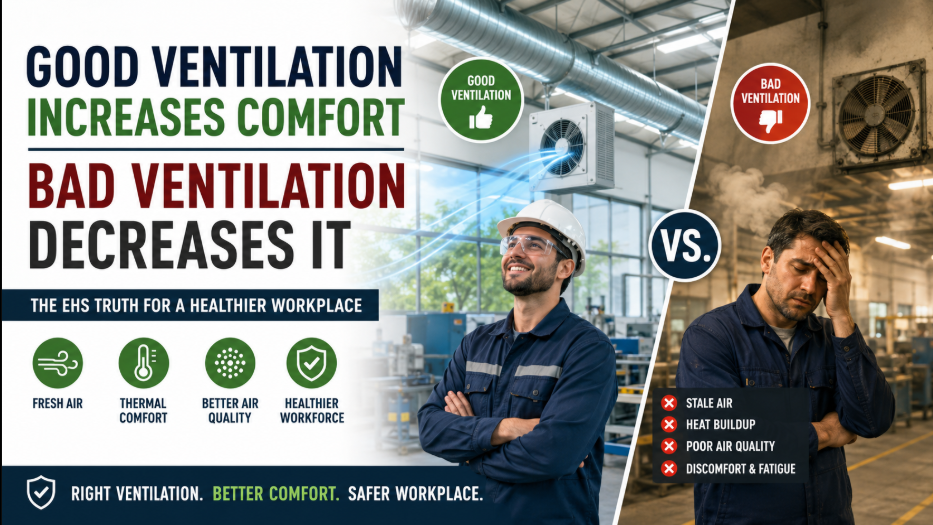
“Good ventilation increases comfort and bad ventilation decreases it.”
At first glance, this statement seems almost too obvious to need an explanation. Nobody enjoys sitting in a room where the air feels stale, stuffy, hot or unpleasant. On the other hand, a workplace with fresh, appropriately moving air generally feels more comfortable.
But from an Environment, Health and Safety (EHS) perspective, there is more to ventilation than simply opening a window or increasing airflow.
Ventilation affects several conditions that determine how comfortable people feel, including temperature, humidity, air movement and indoor air quality. In workplaces, appropriate ventilation can also help control contaminants, remove excess heat and moisture, and improve the overall working environment.
However, there is an important catch:
More ventilation does not automatically mean more comfort.
If ventilation is poorly designed, excessive air movement can create drafts, cold discomfort or uneven conditions. Similarly, bringing in hot outdoor air during a very hot day may not improve comfort.
So, is the statement “Good ventilation increases comfort and bad ventilation decreases it” true?
The answer is: Yes, generally true, but with an important qualification.
Good ventilation can improve comfort when it is properly designed, adequately controlled and suitable for the conditions of the space. Poor ventilation can reduce comfort by allowing heat, humidity, odors and contaminants to accumulate or by creating uncomfortable drafts.
Let’s explore the science behind this statement.
What Is Ventilation?
Ventilation is the process of supplying outdoor air to a space and removing indoor air.
It can occur naturally or mechanically.
Natural ventilation
Natural ventilation uses natural forces such as:
- Wind
- Temperature differences
- Open windows
- Doors
- Louvers
- Ventilation openings
For example, opening windows on opposite sides of a building can allow air to enter from one side and leave from the other, creating cross-ventilation.
Mechanical ventilation
Mechanical ventilation uses equipment such as:
- Exhaust fans
- Supply fans
- Air handling systems
- Ventilation ducts
- Local exhaust ventilation systems
In an industrial workplace, mechanical ventilation may be necessary when natural airflow is insufficient.
The goal is not simply to move air around. The goal is to provide appropriate air movement and air exchange for the particular space and activity.
What Does “Comfort” Mean in a Workplace?
Comfort is more than simply saying, “The room feels nice.”
In occupational health and safety, thermal comfort refers to a person’s perception that the thermal environment is satisfactory.
Several factors influence thermal comfort.
Environmental factors include:
- Air temperature
- Humidity
- Air movement
- Radiant temperature
Personal factors include:
- Clothing
- Physical activity
- Individual differences
This is why two workers standing in the same room may have different opinions about whether the workplace feels comfortable.
One person may say, “It’s too hot,” while another says, “It’s fine.”
Ventilation interacts with several of these factors, particularly air movement, temperature and humidity.
How Does Good Ventilation Increase Comfort?
Good ventilation can improve comfort in several ways.
1. It Removes Excess Heat
People continuously produce body heat.
In a workplace with machinery, furnaces, ovens, boilers or other heat-generating equipment, the environment may become even hotter.
If this heat is not removed, indoor temperatures can rise.
Proper ventilation can help remove heated air and replace it with cooler air when outdoor conditions permit.
For example, consider a workshop containing several heat-producing machines.
Without adequate ventilation:
Heat generated → Heat accumulates → Indoor temperature rises → Workers feel uncomfortable
With appropriate ventilation:
Heat generated → Heated air removed → Fresh air supplied → Heat buildup reduced
This can make the workplace more comfortable.
2. Ventilation Provides Air Movement
Air movement is an important component of thermal comfort.
When air moves across the skin, it can increase heat loss from the body through convection and evaporation.
This can be particularly useful in warm working environments.
A worker may therefore feel more comfortable when there is appropriate air movement compared with completely stagnant air.
But there is a limit.
Too little air movement
Can result in:
- Stuffy conditions
- Poor heat dissipation
- Increased perception of heat
- A stagnant feeling
Too much air movement
Can result in:
- Drafts
- Localized discomfort
- Cold sensations
- Disturbance to workers
Therefore, the objective is appropriate air movement, not maximum airflow.
3. Good Ventilation Helps Control Humidity
Humidity can significantly affect how people experience heat.
When humidity is high, sweat does not evaporate as effectively from the skin.
This can make a warm environment feel even more uncomfortable.
Appropriate ventilation can help remove excess moisture generated by:
- Workers
- Washing processes
- Cooking
- Industrial processes
- Steam
- Wet operations
For example, a workplace with a wet industrial process may experience high humidity. Without adequate ventilation, moisture can accumulate and create an uncomfortable environment.
Proper ventilation can help control this moisture.
4. It Removes Stale and Unpleasant Air
Comfort is not only about temperature.
Air containing unpleasant odors, excessive carbon dioxide from occupancy, or other contaminants can make an indoor environment feel unpleasant.
Appropriate ventilation introduces outdoor air and removes indoor air.
This helps prevent the buildup of unwanted substances and odors.
For workers, the difference can be noticeable.
A poorly ventilated room may feel:
- Stale
- Heavy
- Stuffed
- Unpleasant
- Odorous
A properly ventilated space generally feels fresher.
5. Ventilation Can Improve Indoor Air Quality
One of the most important EHS roles of ventilation is controlling indoor air quality.
Depending on the workplace, contaminants may include:
- Dust
- Fumes
- Vapors
- Gases
- Smoke
- Mists
- Biological contaminants
General ventilation can help dilute and remove contaminants, while local exhaust ventilation (LEV) is often used to capture contaminants close to their source.
This distinction is important.
For example, if welding fumes are produced at a workstation, simply circulating air throughout the room may not be the best control strategy.
A properly designed local exhaust system can capture the contaminant near its point of generation.
From an EHS perspective, ventilation therefore contributes not only to comfort but also to hazard control.
What Happens When Ventilation Is Poor?
Poor ventilation can create an uncomfortable environment in several different ways.
1. Heat Builds Up
When warm air cannot escape, heat accumulates.
This is especially important in:
- Factories
- Workshops
- Kitchens
- Boiler rooms
- Manufacturing areas
- Enclosed warehouses
Workers may experience increasing thermal discomfort as the environment becomes hotter.
In sufficiently severe conditions, excessive heat exposure can become an occupational health concern, not merely a comfort issue.
2. Humidity Increases
Poor air exchange can allow moisture to accumulate.
High humidity can make warm conditions feel more oppressive because evaporation of sweat becomes less effective.
As a result, workers may feel hotter even when the measured air temperature has not changed dramatically.
3. Stagnant Air Develops
Stagnant air is one of the most common complaints associated with inadequate ventilation.
People often describe such spaces as:
“The air feels dead.”
This sensation is partly related to insufficient air movement and partly to the accumulation of heat, moisture, odors and indoor-generated contaminants.
4. Odors Accumulate
Poor ventilation can allow odors to remain in a space for longer periods.
Possible sources include:
- Chemicals
- Cleaning products
- Industrial processes
- Food preparation
- Waste
- Human occupancy
Even when an odor is not necessarily harmful at a particular concentration, its presence can significantly reduce perceived comfort.
5. Contaminants May Accumulate
This is where ventilation moves beyond comfort and into occupational safety.
If contaminants are generated faster than they are removed, their concentration may increase.
Depending on the substance and exposure level, this can create health risks.
Therefore, ventilation should be considered as part of a broader hierarchy of controls rather than merely a comfort feature.
Is More Ventilation Always Better?
This is one of the most important points to understand.
No.
Good ventilation does not mean maximum ventilation.
Imagine sitting directly beneath a powerful fan in a cool room. The air may technically be moving very well, but you might not consider the situation comfortable.
Similarly, excessive outdoor air entering a building during extremely hot or cold weather may not improve thermal comfort.
Therefore:
Good ventilation ≠ Maximum airflow
Instead:
Good ventilation = Appropriate airflow + effective contaminant removal + suitable thermal conditions
The ventilation system should match the building, process, climate, occupancy and work activity.
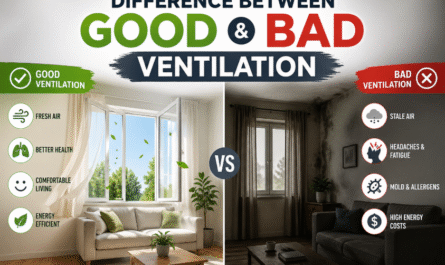
Good Ventilation vs. Bad Ventilation
| Good Ventilation | Poor Ventilation |
|---|---|
| Provides appropriate air movement | Stagnant or excessive air movement |
| Helps remove excess heat | Allows heat to accumulate |
| Helps control humidity | Allows moisture to build up |
| Removes stale air | Allows stale air to remain |
| Helps control odors | Odors accumulate |
| Can help control contaminants | Contaminants may accumulate |
| Supports thermal comfort | Can increase thermal discomfort |
| Designed according to workplace needs | Improvised or inadequate |
| Supports healthier workplace conditions | May contribute to poor indoor air quality |
Climatic Conditions Matter Too
Ventilation cannot be considered separately from the outdoor environment.
Imagine a factory located in a hot climate.
If windows are opened during the hottest part of the afternoon, the incoming outdoor air may itself be hot.
Simply increasing natural ventilation may therefore fail to provide the desired cooling effect.
On the other hand, during cooler periods, outdoor air may be very useful for removing accumulated heat.
This demonstrates an important EHS principle:
The effectiveness of ventilation depends on both the ventilation system and the conditions under which it operates.
Climate, outdoor temperature, humidity, wind conditions and solar heat gain can all influence the result.
Ventilation and Heat Stress
Ventilation also has an important relationship with heat stress.
Heat stress occurs when the body has difficulty maintaining its thermal balance because of environmental and work-related heat exposure.
Workplaces that may present significant heat exposure include:
- Foundries
- Steel plants
- Glass manufacturing
- Bakeries
- Kitchens
- Construction sites
- Boiler areas
- Warehouses
- Outdoor work locations
Ventilation can be one component of a heat-stress control strategy.
For example, ventilation may help:
- Remove hot air
- Increase air movement
- Reduce heat accumulation
- Improve worker comfort
However, ventilation should not be treated as the only heat-stress control.
Other measures may include:
- Engineering controls
- Isolation from radiant heat
- Work-rest arrangements
- Hydration
- Acclimatization
- Appropriate clothing
- Administrative controls
The exact control strategy should be based on the workplace conditions and applicable occupational safety requirements.
Natural Ventilation vs. Mechanical Ventilation
Both approaches can improve comfort when appropriately designed.
Natural ventilation
Advantages may include:
- Low operating energy requirements
- Simple design in suitable buildings
- Use of natural wind and temperature differences
However, its effectiveness can vary significantly with weather and building design.
Mechanical ventilation
Mechanical systems can provide more controlled airflow.
They can be designed to:
- Supply air
- Exhaust air
- Capture contaminants
- Control airflow direction
- Support temperature and humidity management
In industrial environments, mechanical ventilation is often essential where natural ventilation cannot provide adequate control.
The EHS Perspective: Ventilation Is More Than Comfort
From an EHS perspective, ventilation should be evaluated as an engineering control.
A good ventilation system should be designed around the actual hazard.
For example:
Dust-generating process → Dust capture system
Fume-generating process → Local exhaust ventilation
Heat-generating process → Heat removal and appropriate air movement
High-moisture process → Moisture removal
This is much more effective than simply installing a large fan and hoping for the best.
In fact, poorly positioned fans can sometimes spread contaminants from one area to another.
That is why ventilation design should consider:
- Source location
- Airflow direction
- Worker position
- Exhaust location
- Make-up air
- Building layout
- Process requirements
- Outdoor conditions
- Maintenance requirements
How Can Workplaces Improve Ventilation?
Organizations can take several practical steps.
1. Assess the existing conditions
Identify areas where workers complain about:
- Heat
- Stale air
- Odors
- Drafts
- Humidity
- Dust or fumes
2. Identify the source
Determine where heat, moisture or contaminants are being generated.
3. Use source control where possible
Capturing contaminants at their source is generally preferable to allowing them to spread throughout the workplace.
4. Maintain ventilation equipment
Fans, filters, ducts and exhaust systems require appropriate inspection and maintenance.
A ventilation system that was effective when installed may become less effective if components become dirty, damaged or blocked.
5. Avoid uncontrolled airflow
Air should move in a purposeful direction rather than simply being circulated randomly.
6. Monitor workplace conditions
Depending on the risk, monitoring may include:
- Temperature
- Humidity
- Air movement
- Indoor air contaminants
- Heat-stress indicators
The appropriate measurements depend on the hazard being assessed.
So, Is the Statement True or False?
Let’s return to the original statement:
“Good ventilation increases comfort and bad ventilation decreases it.”
Verdict: TRUE, with a qualification.
Good ventilation generally improves comfort because it can provide appropriate air movement, remove excess heat and moisture, reduce stale air and help maintain acceptable indoor air quality.
Poor ventilation can decrease comfort by allowing heat, humidity, odors and contaminants to accumulate and by creating stagnant conditions.
However, ventilation must be appropriate rather than excessive.
Too much airflow can create drafts, while bringing in unsuitable outdoor air can sometimes worsen thermal conditions.
Therefore, the more scientifically accurate statement would be:
“Properly designed and maintained ventilation generally improves thermal comfort and indoor air quality, while inadequate or poorly controlled ventilation can reduce comfort and contribute to unhealthy workplace conditions.”
That version captures the real EHS picture.
Key Takeaways
Before we wrap up, here are the main points to remember:
- Good ventilation generally improves comfort.
- Ventilation helps control air movement, heat, humidity and indoor air quality.
- Poor ventilation can lead to stagnant air, heat buildup, odors and contaminant accumulation.
- More airflow is not automatically better.
- Excessive airflow can create uncomfortable drafts.
- Ventilation can play an important role in heat-stress management.
- Industrial workplaces may require local exhaust ventilation to control contaminants at their source.
- Natural ventilation depends heavily on outdoor conditions.
- Mechanical ventilation provides greater control where natural ventilation is inadequate.
- Ventilation systems require proper design, inspection and maintenance.
- From an EHS perspective, ventilation is both a comfort measure and an engineering control.
Frequently Asked Questions
Does good ventilation make a room more comfortable?
Generally, yes. Appropriate ventilation can improve air movement, remove excess heat and moisture, and reduce stale or unpleasant air.
Can too much ventilation reduce comfort?
Yes. Excessive airflow can create drafts and discomfort. Ventilation should be appropriate for the occupants, activity and environmental conditions.
Does ventilation reduce heat stress?
Ventilation can be an important part of heat-stress control because it may remove hot air and increase beneficial air movement. However, it should be combined with other appropriate heat controls.
Is a fan the same as ventilation?
Not necessarily. A fan may move or circulate air without actually providing effective ventilation. True ventilation generally involves intentional movement of air into and/or out of a space.
Is natural ventilation always sufficient?
No. Natural ventilation depends on building design and outdoor conditions. Some workplaces require mechanical or local exhaust ventilation.
Why is ventilation important in industrial workplaces?
Industrial processes can generate heat, dust, fumes, vapors, gases and moisture. Properly designed ventilation can help control these hazards and improve workplace conditions.
Conclusion
The statement “Good ventilation increases comfort and bad ventilation decreases it” is fundamentally correct.
But the word “good” is doing a lot of work.
Good ventilation is not simply about having a powerful exhaust fan or opening every available window. It is about providing the right amount and direction of airflow for the specific workplace and its hazards.
Effective ventilation can help remove excess heat and moisture, improve air movement, control odors, dilute or capture contaminants, and create a more comfortable working environment.
Poor ventilation does the opposite. It can leave workers dealing with stagnant air, accumulated heat, high humidity, unpleasant odors and potentially elevated contaminant concentrations.
For EHS professionals, therefore, ventilation should be viewed as more than a comfort feature. It is an important engineering control that can influence both worker well-being and occupational risk.
The goal is simple: not the most air, but the right air, moving in the right way, at the right place.
🔁 Readers also enjoyed these blog posts:
- Safety Management’s Role: The Unsung Hero Behind Every Successful Organization
- Safety Management and Its Responsibilities: Protecting People, Preventing Hazards, and Promoting a Culture of Care
- Benchmarking for Safety Performance: A Key to Continuous Improvement
“Start Your Website Journey Today – Exclusive Hostinger Discounts!”

Turn Any Idea into Viral,
Jaw-Dropping AI Videos in Seconds!