 by
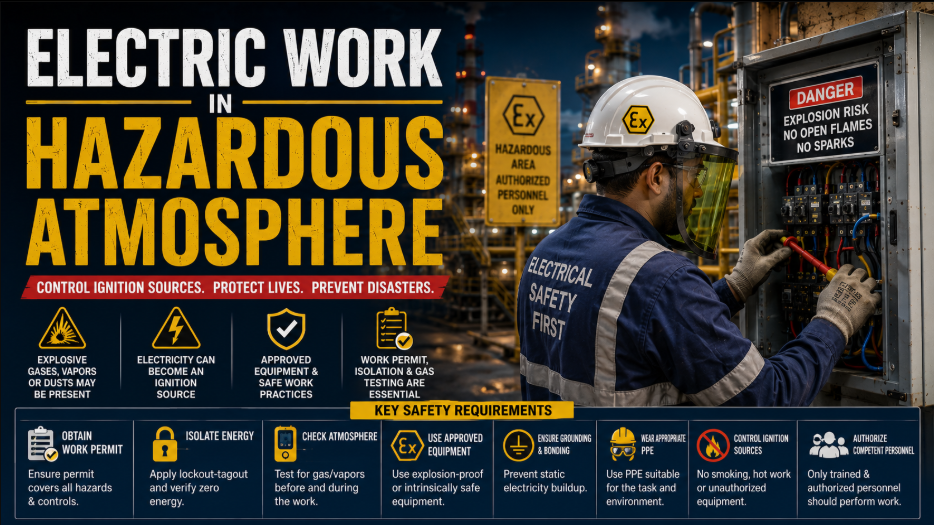
by ELECTRIC WORK IN HAZARDOUS ATMOSPHERE: ESSENTIAL SAFETY REQUIREMENTS AND PRECAUTIONS
Introduction: When Electricity Meets an Explosive Atmosphere
Electricity is essential to almost every modern industrial facility.
Motors, pumps, lighting systems, control panels, instrumentation, compressors, conveyors, heaters, sensors, and communication equipment all depend on electrical energy.
But what happens when electrical work has to be performed in an area where flammable gas, vapor, mist, or combustible dust may be present?
The risk changes completely.
In a normal workplace, a small electrical spark may simply be an electrical fault.
In a hazardous atmosphere, that same spark could become the ignition source for a fire, flash fire, explosion, or catastrophic industrial incident.
This is why electrical work in hazardous atmospheres requires much more than ordinary electrical safety precautions.
Workers must understand not only the electrical hazard but also the possibility of creating an ignition source.
The fundamental principle is:
In a hazardous atmosphere, every potential ignition source must be identified and effectively controlled.
This article explains the major hazards associated with electrical work in hazardous atmospheres, the precautions workers and supervisors should consider, and the role of EHS controls in preventing incidents.
What Is a Hazardous Atmosphere?
A hazardous atmosphere is an environment where the presence of flammable or combustible substances can create a risk of fire or explosion.
These substances may include:
- Flammable gases
- Flammable vapors
- Combustible dust
- Flammable mists
- Certain chemical vapors
- Combustible fibers or particles
Examples of industries where hazardous atmospheres may occur include:
- Oil and gas
- Petrochemical plants
- Refineries
- Chemical manufacturing
- Pharmaceutical manufacturing
- Paint manufacturing
- Solvent handling
- Fuel storage
- Gas processing
- Grain and food processing
- Powder processing
- Waste treatment
- Battery and chemical facilities
Importantly, a hazardous atmosphere does not necessarily mean that an explosion is happening.
It means that conditions may exist where ignition could occur if a flammable substance and an ignition source come together.
Why Is Electrical Work Dangerous in Hazardous Areas?
Electrical equipment can produce potential ignition sources in several ways.
For example:
- Electrical sparks
- Arcing
- Hot surfaces
- Switching operations
- Fault currents
- Static electricity
- Damaged wiring
- Loose electrical connections
- Overheated components
- Motors and other equipment
- Non-approved portable equipment
Even a seemingly insignificant spark can become dangerous if the atmosphere contains a flammable concentration of gas, vapor, or dust.
This creates a critical relationship:
Fuel + Oxygen + Ignition Source = Potential Fire/Explosion
Electrical safety in hazardous areas therefore focuses heavily on preventing the electrical system from becoming that ignition source.
1. Identify the Hazardous Area Before Starting Work
The first question should never be:
“What electrical tool do I need?”
The first question should be:
“What hazardous atmosphere could be present here?”
Before electrical work begins, workers should understand the hazardous-area classification applicable to the location and the substances that may be present.
Depending on the applicable classification system, hazardous locations may be categorized according to the likelihood and duration of an explosive atmosphere being present.
Different systems use different terminology, such as zones or classes/divisions.
The important point is that electrical equipment must be appropriate for the specific hazardous location.
Do not assume that equipment approved for one hazardous environment is automatically suitable for another.
2. Understand the Material Present
Knowing that an area is hazardous is only the beginning.
Workers should understand what makes the atmosphere hazardous.
Important information may include:
- Substance involved
- Flash point
- Flammability characteristics
- Vapor density
- Ignition temperature
- Explosion characteristics
- Dust properties
- Possible release points
- Normal operating conditions
- Abnormal conditions
For example, a gas may behave differently from a combustible dust.
A vapor may accumulate in low areas, while a lighter-than-air gas may behave differently depending on ventilation and process conditions.
Understanding the material helps determine the appropriate controls.
3. Use Equipment Approved for the Hazardous Location
One of the most important requirements is using electrical equipment specifically suitable for the hazardous environment.
Depending on the application and applicable standards, equipment may use different protection concepts, including:
- Explosion-proof/flameproof construction
- Intrinsic safety
- Increased safety
- Pressurization
- Encapsulation
- Protection by enclosure
- Other recognized explosion-protection methods
The terminology and certification requirements vary depending on the applicable standard and jurisdiction.
The key principle is simple:
Do not bring ordinary electrical equipment into a hazardous area unless it has been determined to be suitable for that specific application.
A normal electrical drill, inspection lamp, extension board, camera, mobile phone, or other device may potentially become an ignition source.
4. Verify Equipment Certification
Before using electrical equipment in a hazardous location, verify that it has the appropriate certification or approval for the environment.
Check relevant information such as:
- Equipment marking
- Protection concept
- Gas or dust group
- Temperature rating/class
- Area classification
- Certification requirements
- Manufacturer information
Never rely on statements such as:
“It is explosion-proof.”
The actual equipment marking and certification must be appropriate to the specific hazardous location.
A device designed for one hazardous environment may not be suitable for another.
5. Do Not Use Unauthorized Portable Electrical Equipment
Portable equipment deserves special attention because it is frequently moved between locations.
Workers may be tempted to carry:
- Portable drills
- Grinders
- Extension boards
- Inspection lamps
- Chargers
- Electrical meters
- Cameras
- Laptops
- Mobile devices
- Temporary lighting
into hazardous areas.
Before doing so, confirm that the equipment is approved and suitable for the location.
If it is not approved, do not use it.
Convenience should never determine whether equipment is allowed in a hazardous area.
6. Gas Testing Is a Critical Control
Where flammable gas or vapor may be present, appropriate atmospheric monitoring can be an essential control.
Depending on the work and site procedures, gas testing may be required:
- Before work
- During work
- At defined intervals
- Continuously
- After process conditions change
The appropriate monitoring frequency depends on the hazard assessment and work procedure.
Gas detectors must be:
- Suitable for the atmosphere
- Properly maintained
- Functionally checked as required
- Calibrated according to the applicable program
- Operated by trained personnel
A gas detector should not be treated as a magic device that makes hazardous work safe.
It is one layer of protection within a broader control system.
7. Follow the Permit-to-Work System
Electrical work in hazardous areas should be controlled through the organization’s Permit-to-Work (PTW) system where required.
The permit should establish the conditions under which the work can safely proceed.
Depending on the job, it may address:
- Location
- Equipment identification
- Nature of work
- Hazardous-area classification
- Electrical isolation
- Gas testing
- Required PPE
- Required tools
- Work boundaries
- Emergency arrangements
- Validity period
- Responsible personnel
- Required authorizations
A permit is not simply a piece of paper.
It is a communication and control mechanism.
If conditions change, work should stop and the permit should be reviewed or revalidated according to site procedures.
8. Apply Lockout/Tagout and Electrical Isolation
Before maintenance begins, hazardous electrical energy must be controlled.
Where applicable, the equipment should be:
Shut down → Isolated → Locked → Tagged → Verified
Workers must understand all possible sources of electrical energy.
These may include:
- Main power supply
- Auxiliary supply
- Control supply
- Emergency supply
- Generator supply
- UPS
- Battery systems
- Backfeed
- Stored electrical energy
Never assume that switching off one breaker has isolated the entire system.
The isolation must be appropriate to the equipment and task.
For electrical work, appropriately qualified personnel should verify the absence of hazardous voltage using suitable test equipment and procedures.
9. Beware of Stored Energy
Electrical isolation does not automatically eliminate all energy.
Equipment may contain:
- Capacitors
- Batteries
- UPS systems
- DC circuits
- Stored mechanical energy
- Pneumatic pressure
- Hydraulic pressure
- Thermal energy
A motor may be electrically isolated while a connected mechanical component remains capable of movement.
A capacitor may retain electrical energy after the supply has been disconnected.
Therefore, workers must consider all energy sources, not just the main electrical supply.
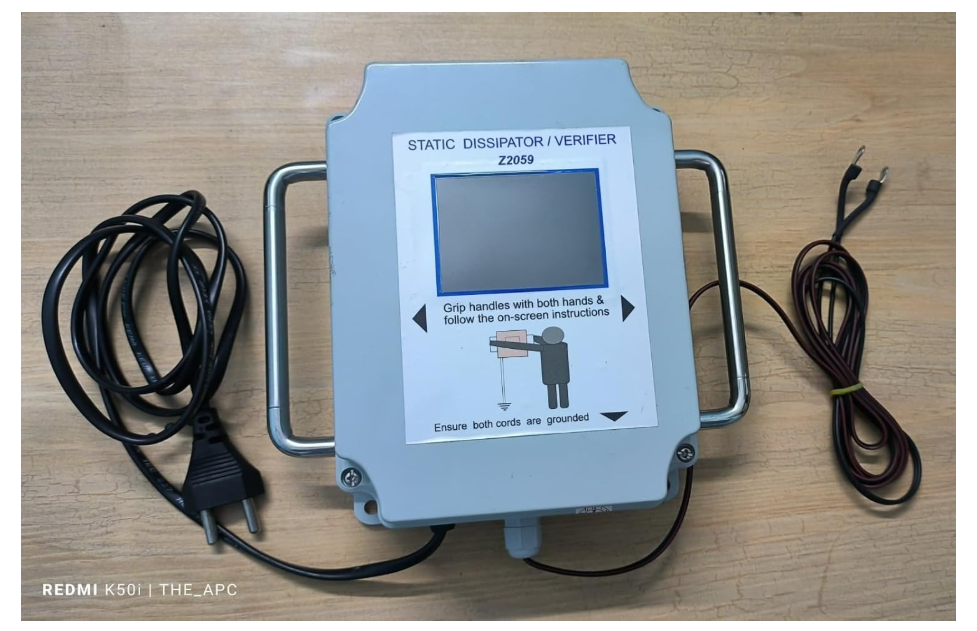
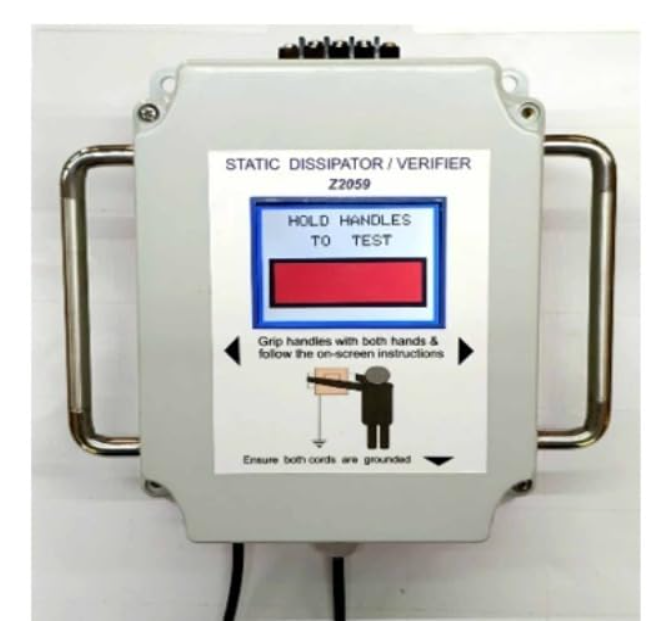
10. Control Static Electricity
Static electricity can become an ignition source in environments containing flammable gases, vapors, or combustible dust.
Potential sources include:
- Personnel
- Clothing
- Hoses
- Containers
- Process equipment
- Flowing liquids
- Non-conductive materials
Appropriate grounding and bonding systems can help control static accumulation where required.
Workers should follow site-specific requirements for:
- Grounding
- Bonding
- Antistatic equipment
- Conductive footwear
- Clothing
- Material transfer
Static electricity may be invisible, but its ignition potential should never be underestimated.

11. Avoid Unauthorized Electrical Modifications
Electrical modifications in hazardous locations require particular care.
Do not:
- Drill unauthorized holes in enclosures
- Replace approved cable glands with ordinary glands
- Modify equipment housings
- Bypass protection
- Replace components with non-approved alternatives
- Alter certified equipment
- Add temporary connections without authorization
An apparently minor modification can compromise the equipment’s explosion-protection characteristics.
For example, changing an approved cable-entry system with an unsuitable component could compromise the integrity of an enclosure.
Only approved components and methods should be used according to the equipment design and applicable requirements.
12. Inspect Cables and Connections
Electrical cables in hazardous areas should be maintained in good condition.
Inspect for:
- Damaged insulation
- Exposed conductors
- Cuts
- Abrasion
- Heat damage
- Chemical damage
- Loose connections
- Incorrect glands
- Poor termination
- Mechanical damage
Cable entries and glands are particularly important in explosion-protected installations.
A damaged cable should not simply be wrapped with ordinary tape and returned to service.
Defective equipment should be isolated from use and repaired through an approved process.
13. Keep Enclosures Properly Closed
Electrical panels and explosion-protected equipment rely on their construction and enclosure integrity to provide protection.
Therefore:
Never leave hazardous-area electrical enclosures improperly closed or incomplete.
After maintenance:
- Covers should be correctly installed.
- Fasteners should be properly secured.
- Cable entries should be correctly sealed.
- Gaskets or sealing arrangements should be maintained where applicable.
- Unused openings should be appropriately closed.
- Equipment should be restored according to its approved configuration.
A missing cover or incorrectly installed component can compromise protection.
14. Be Extremely Careful With Hot Work
Hot work includes activities capable of generating sufficient heat, sparks, or flame to ignite combustible materials.
Examples include:
- Welding
- Gas cutting
- Brazing
- Grinding
- Certain drilling operations
- Other spark-producing activities
In a hazardous atmosphere, these activities require strict control.
Where hot work is necessary, the applicable permit and gas-testing requirements should be followed.
Potential controls may include:
- Gas testing
- Removal of flammable materials
- Isolation of process equipment
- Fire watch
- Fire extinguishing equipment
- Continuous monitoring
- Barricading
- Ventilation
- Equipment inspection
If the hazard cannot be adequately controlled, the work should not proceed.
15. Grinding Is Not “Just Electrical Work”
Portable grinders deserve special attention.
A grinder can create:
- Electrical hazards
- Mechanical hazards
- Sparks
- Hot particles
- Noise
- Dust
- Fire hazards
In a hazardous atmosphere, sparks from a grinder can potentially ignite flammable material.
Therefore, grinding should never be started merely because a permit says electrical work is allowed.
The specific activity and ignition potential must be evaluated.
16. Ensure Adequate Ventilation
Ventilation can help prevent the accumulation of hazardous gases or vapors.
However, ventilation should be designed and managed based on the characteristics of the substance and process.
Workers should never assume:
“The area is open, so there can’t be any gas.”
Gas or vapor can accumulate in:
- Pits
- Trenches
- Drains
- Tanks
- Enclosures
- Low points
- Poorly ventilated spaces
Where the work involves confined spaces, additional confined-space requirements may apply.
17. Electrical Work in Confined Spaces Requires Extra Planning
A confined space can introduce several hazards simultaneously:
Electrical hazard + hazardous atmosphere + restricted access + rescue difficulty
Before entering such a space, the organization may need to address:
- Atmospheric testing
- Ventilation
- Isolation
- Permit requirements
- Communication
- Rescue arrangements
- Electrical equipment suitability
- Lighting
- PPE
Never assume that a confined space is safe simply because atmospheric testing was acceptable several hours earlier.
Conditions can change rapidly.
18. Use Appropriate PPE
PPE is an important final layer of protection.
Depending on the task and hazard assessment, workers may require:
- Safety helmet
- Safety glasses
- Face shield
- Flame-resistant or arc-rated clothing where applicable
- Electrical insulating gloves where appropriate
- Safety footwear
- Hearing protection
- Respiratory protection where required by the hazard assessment
- Other task-specific PPE
PPE must be selected according to the actual hazard.
Electrical PPE does not automatically protect against chemical exposure or gas inhalation.
Similarly, chemical-resistant PPE does not automatically provide electrical protection.
19. Control Unauthorized Personnel
Hazardous-area electrical work should have controlled access.
Use appropriate:
- Barricades
- Warning signs
- Restricted areas
- Permit boundaries
- Access controls
People who are not involved in the work may not understand the significance of the electrical equipment or atmospheric conditions.
Keeping unnecessary personnel away reduces exposure and prevents accidental interference.
20. Never Assume a “Safe Reading” Will Remain Safe
One of the most dangerous assumptions in hazardous-area work is:
“The gas detector showed zero, so we’re safe.”
Atmospheric conditions can change because of:
- Process releases
- Valve operation
- Ventilation failure
- Leaks
- Weather
- Nearby maintenance
- Tank or pipeline activity
- Changes in process conditions
Therefore, gas monitoring should follow the established requirements for the task.
If conditions change, stop work and reassess.
21. Use Competent and Authorized Personnel
Electrical work in hazardous areas should not be treated as an ordinary maintenance task.
Personnel should have the appropriate:
- Technical competence
- Electrical knowledge
- Hazardous-area awareness
- Equipment knowledge
- Permit training
- Isolation/LOTO knowledge
- Emergency-response awareness
Workers should understand the limitations of the equipment they are using.
Being an experienced electrician does not automatically mean a person is competent to work on every type of hazardous-area equipment.
Specialized equipment and installations may require specialized competence.
22. Emergency Preparedness Is Essential
Before work begins, workers should know:
- How to raise an alarm
- Emergency contact methods
- Emergency evacuation routes
- Assembly points
- Location of emergency shutdowns
- Fire protection arrangements
- Rescue arrangements
- Communication procedures
If gas is detected unexpectedly, workers should not remain in the area simply to finish the task.
The correct response should follow the site’s emergency procedure.
When the conditions become unsafe, stop work.
Common Mistakes During Electrical Work in Hazardous Areas
❌ Using ordinary electrical tools
A tool suitable for a normal workshop may not be suitable for a hazardous location.
❌ Ignoring hazardous-area classification
Different areas can have different risks and equipment requirements.
❌ Relying only on a gas detector
Atmospheric monitoring is an important control, but it does not replace proper equipment selection, isolation, and work procedures.
❌ Opening an electrical enclosure without authorization
Opening equipment can expose electrical energy and may compromise explosion protection.
❌ Using damaged cables
Cable damage can create both electrical and ignition hazards.
❌ Performing grinding without evaluating ignition risk
Grinding can produce sparks and hot particles.
❌ Bypassing equipment protection
This can defeat the safety characteristics of certified equipment.
❌ Assuming a previous permit still applies
A change in conditions or scope can make the original controls inadequate.
❌ Allowing untrained workers to perform specialized work
Competence must match the hazards and equipment involved.
Practical Checklist for Electrical Work in Hazardous Atmospheres
Before starting work, ask:
Area
- Has the hazardous area been identified?
- Is the area classification known?
- Are the substances that may be present understood?
- Have potential release sources been identified?
Equipment
- Is the electrical equipment approved for the location?
- Are certification markings appropriate?
- Is the equipment in good condition?
- Are cables and glands intact?
- Are enclosures properly closed?
Work Control
- Is a Permit-to-Work required?
- Has the correct permit been issued?
- Has the work scope been clearly defined?
- Are workers authorized and competent?
Isolation
- Have all energy sources been identified?
- Has the equipment been isolated?
- Has LOTO been applied where required?
- Has absence of hazardous voltage been verified?
- Has stored energy been controlled?
Atmosphere
- Has appropriate gas testing been completed?
- Is ongoing monitoring required?
- Is ventilation adequate?
- Could conditions change during the work?
Ignition Control
- Are spark-producing activities controlled?
- Is hot work separately authorized where required?
- Is static electricity controlled?
- Are unauthorized devices prohibited?
Emergency
- Are emergency procedures understood?
- Is communication available?
- Are evacuation routes known?
- Are rescue arrangements appropriate?
If any critical control is missing, the correct action is:
STOP – REVIEW – CONTROL – THEN START.
Role of the EHS Team
EHS professionals play a major role in ensuring that electrical work in hazardous atmospheres is properly controlled.
An effective EHS program may include:
Hazard Identification
Identify hazardous substances, electrical sources, ignition sources, and potential release scenarios.
Risk Assessment
Evaluate the likelihood and consequences of fire, explosion, electrical shock, and other hazards.
Permit-to-Work
Ensure the correct permit system is used for hazardous work.
Gas Testing
Establish appropriate atmospheric monitoring requirements.
Training
Ensure workers understand hazardous-area electrical safety and their responsibilities.
Equipment Control
Ensure only approved equipment enters designated hazardous areas.
Inspection
Inspect electrical installations, tools, cables, enclosures, and protective systems according to the applicable program.
Emergency Planning
Ensure workers know what to do if gas is detected, equipment fails, or an emergency occurs.
The Hierarchy of Controls Still Applies
Hazardous-area electrical safety should not depend entirely on PPE.
The Hierarchy of Controls provides a useful framework.
1. Elimination
Can the electrical work be avoided?
Can the equipment be repaired in a safe location after proper isolation?
2. Substitution
Can a safer process or technology be used?
3. Engineering Controls
Examples may include:
- Explosion-protected equipment
- Intrinsically safe systems
- Ventilation
- Gas detection
- Automatic shutdown
- Interlocks
- Grounding and bonding
4. Administrative Controls
Examples include:
- Permit-to-work
- Procedures
- Training
- Hazardous-area classification
- LOTO
- Inspection
- Restricted access
5. PPE
PPE provides an additional layer of protection against the remaining hazards.
The strongest safety programs use multiple layers of protection rather than depending on a single precaution.
The Golden Rules of Electrical Work in Hazardous Atmospheres
For worker training, remember these ten rules:
1. Know the Area
Understand the hazardous-area classification before starting work.
2. Know the Hazard
Understand the gases, vapors, dusts, or other combustible materials that may be present.
3. Use Approved Equipment
Never introduce unauthorized electrical equipment into hazardous areas.
4. Isolate Energy
Apply the appropriate electrical isolation and LOTO procedure.
5. Verify Before Touching
Do not assume equipment is de-energized.
6. Control Ignition Sources
Prevent sparks, arcs, hot surfaces, and static discharges.
7. Test the Atmosphere
Use appropriate gas detection and monitoring requirements.
8. Follow the Permit
Do not perform work outside the approved permit conditions.
9. Stop When Conditions Change
A safe job can become unsafe when process or atmospheric conditions change.
10. Never Take Shortcuts
In hazardous areas, a shortcut can become an ignition source.
Final Thoughts: Respect the Atmosphere as Much as the Electricity
Electrical work is already a high-risk activity.
Performing that work in an environment containing flammable gas, vapor, mist, or combustible dust introduces another dimension of risk.
The worker is no longer dealing with electricity alone.
They are managing the interaction between:
Electrical Energy + Flammable Material + Oxygen + Potential Ignition Source
That is why hazardous-area electrical work demands careful planning.
Before starting, ask:
Where is the hazardous area?
What material could be present?
What could ignite it?
Is the equipment approved for this location?
Has the electrical energy been isolated?
Has the atmosphere been tested?
What happens if conditions change?
These questions are not bureaucracy.
They are barriers between routine maintenance and a potentially catastrophic event.
The safest approach is straightforward:
Identify the hazardous atmosphere. Eliminate or control ignition sources. Use correctly approved equipment. Isolate hazardous energy. Monitor atmospheric conditions. Follow the permit. And stop work whenever the controls are no longer adequate.
Electrical work should never be rushed simply because production needs the equipment back online.
A few extra minutes spent checking an electrical installation can prevent an incident that could affect workers, equipment, the environment, and an entire facility.
In a hazardous atmosphere, safety isn’t just about preventing electric shock. It’s about preventing electricity from becoming the spark that starts a disaster.
Frequently Asked Questions
What is a hazardous atmosphere?
A hazardous atmosphere is an environment where flammable or combustible gases, vapors, mists, or dusts may exist at concentrations or under conditions where ignition and fire/explosion could occur.
Can normal electrical tools be used in hazardous areas?
Not automatically. Electrical equipment must be determined to be suitable and appropriately approved/certified for the specific hazardous location and application.
What is intrinsically safe equipment?
Intrinsic safety is an explosion-protection concept that limits electrical and thermal energy in equipment and circuits so that they cannot ignite a specified hazardous atmosphere under the applicable conditions.
Is gas testing enough before electrical work?
No. Gas testing is one safety control. Appropriate equipment, electrical isolation, work permits, ignition-source control, ventilation, competent personnel, and other measures may also be required.
Why is LOTO important in hazardous areas?
LOTO helps prevent unexpected energization or release of hazardous energy during maintenance. In hazardous areas, electrical isolation can also be an important part of controlling potential ignition sources.
Can a mobile phone be used in a hazardous area?
Only if its use is permitted by the site’s hazardous-area requirements and the device is suitable/approved for the specific environment where required. Ordinary consumer devices should not automatically be assumed safe.
What should I do if a gas detector alarms during electrical work?
Stop the work and follow the site’s emergency and hazardous-atmosphere procedure. Personnel should move to a safe location as required and notify the responsible personnel. Do not continue working simply because the alarm may be temporary.
Is PPE enough to protect workers in hazardous areas?
No. PPE is only one layer of protection. Engineering controls, hazardous-area equipment, isolation, gas monitoring, permits, procedures, training, and ignition-source control are also important.
Important Safety Note
This article is intended for general EHS and electrical-safety awareness. Requirements for hazardous-area electrical work vary according to the substance involved, hazardous-area classification, equipment, industry, jurisdiction, and applicable legislation and standards.
For workplaces in India, hazardous-area electrical work should be planned and executed in accordance with applicable Indian regulations, relevant BIS/Indian Standards, approved equipment certifications, manufacturer requirements, site-specific procedures, and competent technical advice.
Never use this article as a substitute for a site-specific hazardous-area assessment, electrical safety procedure, Permit-to-Work system, or competent professional evaluation.
🔁 Readers also enjoyed these blog posts:
- Safety Management’s Role: The Unsung Hero Behind Every Successful Organization
- Safety Management and Its Responsibilities: Protecting People, Preventing Hazards, and Promoting a Culture of Care
- Benchmarking for Safety Performance: A Key to Continuous Improvement
“Start Your Website Journey Today – Exclusive Hostinger Discounts!”