 by
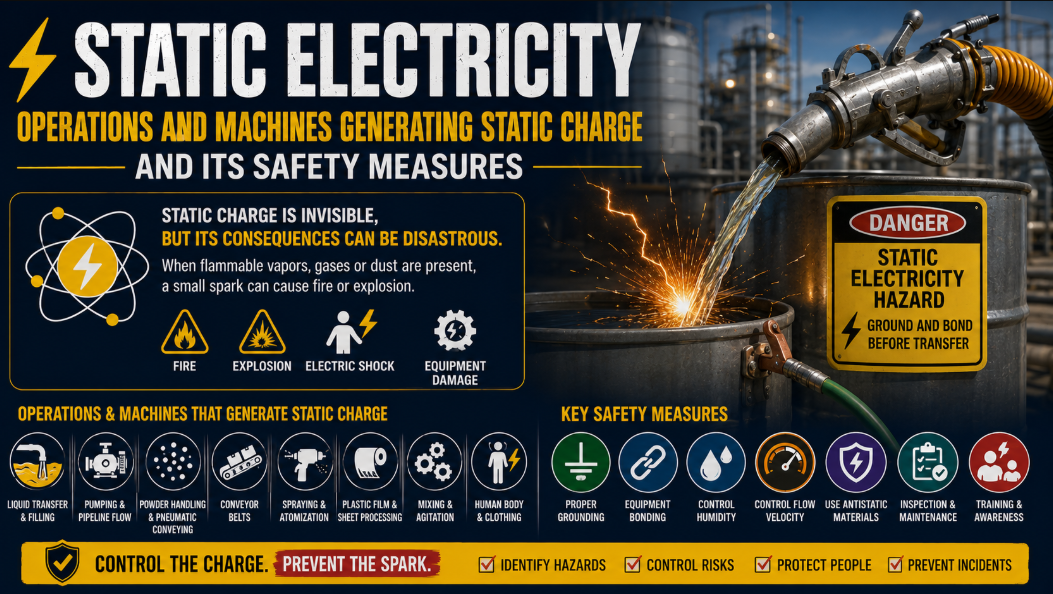
by STATIC ELECTRICITY – Operations and Machines Generating Static Charge and Its Safety Measures
Introduction: The Invisible Electrical Hazard
Static electricity is something most people experience without giving it much thought.
You walk across a carpet and touch a metal door handle—you get a small shock.
You remove a synthetic sweater and hear tiny crackling sounds.
You see your hair stand up after removing a cap.
These everyday examples may seem harmless. In an industrial environment, however, static electricity can become a serious safety hazard.
A static charge can accumulate on a person, machine, product, container, conveyor belt, pipe, hose, or other object. When the accumulated charge suddenly finds a path to ground, it can discharge as a spark.
In an ordinary environment, that spark may simply cause a small shock.
But if flammable gas, vapor, mist, or combustible dust is present, the same spark can potentially become an ignition source.
This makes static electricity particularly important in industries such as:
- Oil and gas
- Petrochemicals
- Chemical manufacturing
- Pharmaceuticals
- Paint and coatings
- Food processing
- Plastics
- Textiles
- Packaging
- Printing
- Powder handling
- Grain processing
- Solvent handling
- Fuel storage and transportation
Understanding where static charge comes from, how it accumulates, and how to safely control it is therefore an important part of EHS and process safety.
What Is Static Electricity?
Static electricity is an imbalance of electrical charge accumulated on the surface of a material.
Unlike the continuous flow of current through a conductor, static charge can remain accumulated until it finds a suitable discharge path.
Static charge can be positive or negative.
It can develop when two different materials:
- Come into contact
- Separate
- Rub against each other
- Flow past each other
- Move rapidly
- Break apart
- Are sprayed or atomized
The process can transfer electrons from one material to another.
When the charge has nowhere to dissipate, it accumulates.
Eventually, if the electrical potential becomes sufficiently high and a suitable discharge path exists, the charge may jump across an air gap.
That sudden transfer is known as electrostatic discharge (ESD).
Why Is Static Electricity Dangerous?
Static electricity becomes particularly dangerous when three conditions come together:
A combustible or flammable material + oxygen/air + an ignition-capable discharge
For example, imagine a solvent being transferred from one container to another.
During the movement of the liquid, static charge may develop.
If the container or transfer system is not properly grounded or bonded, charge can accumulate.
A spark may then occur.
If flammable vapor is present around the container, that spark could potentially ignite the vapor.
The result could be:
- Flash fire
- Explosion
- Burns
- Equipment damage
- Production loss
- Serious injury or fatality
The important lesson is:
Static electricity itself is not always dangerous. Uncontrolled static discharge in the presence of an ignitable atmosphere can be extremely dangerous.
How Is Static Charge Generated?
Static electricity is commonly produced through contact and separation of materials.
Several industrial operations naturally generate static charge.
The amount of charge generated depends on factors such as:
- Material properties
- Surface condition
- Speed of movement
- Contact area
- Separation rate
- Humidity
- Temperature
- Equipment design
- Grounding arrangements
Some materials allow charge to dissipate easily.
Others are good electrical insulators and can hold charge for long periods.
1. Liquid Transfer and Filling Operations
One of the most important industrial sources of static electricity is the movement of liquids.
Static charge can be generated when liquids flow through:
- Pipes
- Hoses
- Pumps
- Filters
- Valves
- Nozzles
- Filling systems
This is particularly important when handling liquids with relatively low electrical conductivity, including certain hydrocarbons and solvents.
The faster the liquid moves and the more turbulence or mixing occurs, the greater the potential for charge generation under some conditions.
Examples include:
- Filling drums with solvents
- Loading tank trucks
- Fuel transfer
- Pumping hydrocarbons
- Filling chemical containers
- Transferring paints and coatings
Appropriate bonding, grounding, equipment design, and operating procedures are essential.
2. Pumping Operations
Pumps can contribute to static generation during liquid transfer.
Static charge may develop as liquid passes through:
- Pump components
- Pipes
- Filters
- Valves
- Restrictions
The risk may increase when the liquid contains suspended particles, multiple phases, or has low conductivity.
Operators should therefore ensure that the transfer system has appropriate grounding and bonding arrangements and that operating procedures are followed.
3. Pipeline Flow
Liquid flowing through a pipeline can generate electrostatic charge.
This is particularly relevant when:
- Flow velocity is high
- The liquid has low conductivity
- Filters are installed
- The system contains restrictions
- Two phases are present
- Turbulence occurs
Pipeline systems should be designed and operated with appropriate controls based on the material and process.
4. Spraying and Atomization
Spraying liquids can generate substantial static charge.
Examples include:
- Spray painting
- Solvent spraying
- Chemical spraying
- Agricultural spraying
- Coating operations
- Cleaning operations
Atomization creates very small droplets with a large total surface area.
The resulting charge can create electrostatic attraction, sparks, or other hazards.
Spray systems should therefore be assessed for electrostatic risk, particularly when flammable liquids or solvents are involved.
5. Powder Handling
Static electricity is not limited to liquids.
Powders can generate significant electrostatic charge when they:
- Flow through pipes
- Fall through air
- Pass through conveyors
- Enter silos
- Move through pneumatic systems
- Are mixed
- Are sieved
- Are poured into containers
Industries handling combustible powders should take electrostatic ignition hazards seriously.
Examples include certain:
- Pharmaceutical powders
- Food powders
- Flour
- Sugar
- Plastics
- Chemical powders
- Metal powders
In these environments, static discharge can potentially ignite a combustible dust cloud.
6. Pneumatic Conveying Systems
Pneumatic conveying can generate substantial electrostatic charge because particles move rapidly through pipes and contact the pipe walls.
This is particularly relevant to:
- Plastic pellets
- Powders
- Pharmaceutical materials
- Food products
- Chemical materials
The movement of particles creates repeated contact and separation.
Appropriate grounding and bonding of conductive components, suitable equipment selection, and process-specific controls are therefore important.
7. Conveyor Belts
Conveyor belts can generate static electricity through friction and repeated contact with:
- Rollers
- Pulleys
- Product
- Support structures
This can be especially noticeable with synthetic or polymeric belt materials.
Static charge can accumulate if the belt or associated components are electrically isolated.
Where static presents a hazard, appropriate antistatic belt materials, grounding arrangements, and equipment design should be considered.
8. Textile Machines
Textile manufacturing is another area where static electricity can become significant.
Fibers continuously rub against:
- Rollers
- Guides
- Needles
- Combs
- Belts
- Other fibers
This repeated friction and separation can create electrostatic charge.
Static can cause:
- Fibers sticking together
- Product-quality problems
- Material attraction
- Operator shocks
- Ignition hazards in certain environments
Humidity control, antistatic materials, grounding, and appropriate machine design can help control the problem.
9. Plastic Film and Sheet Processing
Plastic films are generally good electrical insulators.
When plastic film passes rapidly over rollers or through processing equipment, significant static charge can develop.
This can result in:
- Film sticking to machine components
- Dust attraction
- Operator shocks
- Product handling problems
- Unexpected discharges
In some manufacturing environments, static neutralizers or ionization systems may be used to reduce charge accumulation.
10. Printing and Packaging Machines
Printing presses and packaging machinery can generate static charge through the movement of:
- Paper
- Plastic films
- Foils
- Labels
- Packaging materials
High-speed movement increases the opportunity for contact and separation.
Static charge can cause sheets to:
- Stick together
- Repel each other
- Misalign
- Attract dust
It can also create shocks for operators.
Where flammable inks, solvents, or vapors are present, electrostatic ignition must also be considered.
11. Mixing and Agitation
Mixing operations can generate static electricity when different materials move rapidly against each other.
This may occur in:
- Chemical mixers
- Blenders
- Powder mixers
- High-speed agitators
- Pharmaceutical processing equipment
The risk depends heavily on the material and process.
If flammable materials are being mixed, the possibility of static ignition should be evaluated as part of the process hazard assessment.
12. Filtration
Filters can be an important source of electrostatic charge generation.
Liquid flowing through a filter can experience:
- Turbulence
- Separation
- Friction
- Charge transfer
Similarly, powder passing through filtration systems can generate electrostatic charge.
Filter systems handling flammable materials should therefore be designed with appropriate static-control measures.
13. Rubber and Polymer Processing
Rubber and polymer materials can generate significant static electricity during:
- Extrusion
- Rolling
- Cutting
- Conveying
- Mixing
- Film production
These materials can retain charge because many polymers are electrical insulators.
Operators may experience shocks when touching machine frames or nearby conductive objects after becoming charged.
14. Human Body as a Static Charge Generator
People can also generate static electricity.
Walking across floors, especially when wearing insulating footwear, can cause the human body to accumulate charge.
Synthetic clothing and dry environmental conditions can increase static buildup.
A person may then discharge the accumulated energy when touching:
- Metal equipment
- Electrical panels
- Containers
- Machinery
- Another person
In an ordinary environment this may simply be uncomfortable.
In a hazardous atmosphere, however, a person could potentially become an ignition source.
This is why personal grounding and appropriate antistatic measures may be important in specific industrial environments.
Factors That Increase Static Charge
Several factors can make static electricity more likely.
Low Humidity
Dry air generally allows charge to remain on surfaces for longer.
This is one reason static shocks are often more noticeable in dry conditions.
High Speed
Faster movement can increase charge generation in many processes.
Examples include:
- Fast liquid transfer
- High-speed belts
- Rapid film movement
- Pneumatic conveying
Insulating Materials
Materials such as many plastics and synthetic polymers do not readily allow charge to dissipate.
Friction
Repeated rubbing and contact can generate charge.
Separation
Contact followed by separation is a major mechanism for electrostatic charge generation.
What Is Grounding?
Grounding provides a conductive path for electrical charge to dissipate to earth or an appropriate reference system.
In static-control applications, grounding helps prevent charge from accumulating to hazardous levels.
Equipment that may require grounding can include:
- Storage tanks
- Transfer vessels
- Pipes
- Pumps
- Process equipment
- Filling equipment
- Structural components
However, simply connecting a wire somewhere does not automatically guarantee effective grounding.
The grounding system must be properly designed, installed, maintained, and periodically verified according to applicable requirements.
What Is Bonding?
Grounding and bonding are related but different concepts.
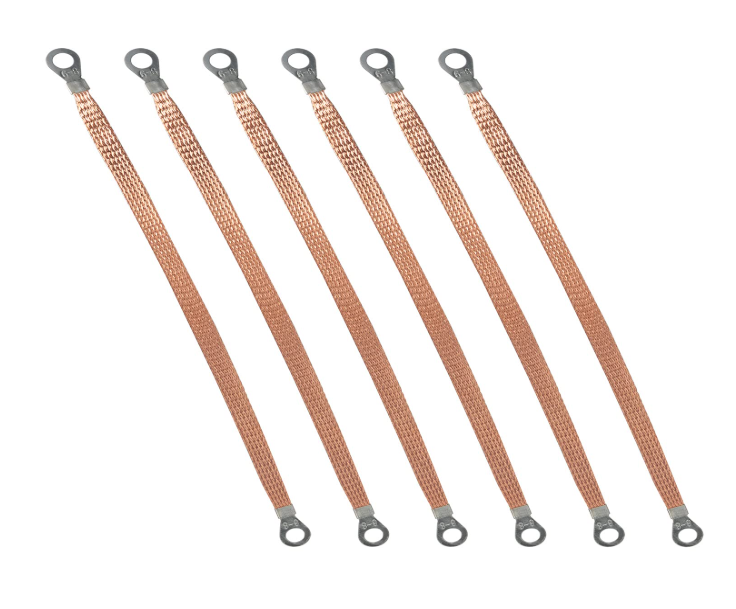
Bonding connects conductive objects together so that they remain at substantially the same electrical potential.
This reduces the possibility of a dangerous potential difference developing between two objects.
For example, during liquid transfer between two conductive containers, bonding may be used to connect the containers electrically before transfer begins.
The system can then be appropriately grounded as required.
A useful way to remember the difference is:
Bonding = connect objects together.
Grounding = provide a path to earth/reference.
Both can be important for static control.
Static Electricity Safety Measures
1. Ground Conductive Equipment
Conductive equipment that can accumulate hazardous static charge should be appropriately grounded.
Examples include:
- Tanks
- Vessels
- Pipes
- Pumps
- Filling equipment
- Metal containers
Ground connections should be maintained in good condition.
2. Bond Containers Before Transfer
When transferring flammable liquids between conductive containers, appropriate bonding and grounding procedures should be followed.
This helps minimize potential differences that could result in an electrostatic spark.
Where required by the process, bonding should be established before the transfer operation begins.
3. Control Flow Velocity
Excessively high flow rates can increase electrostatic charge generation in certain liquid-transfer operations.
Operating procedures should specify appropriate flow conditions based on the material, equipment, and process design.
The objective is not simply to transfer material as quickly as possible.
Safe transfer is more important than fast transfer.
4. Reduce Splash Filling
Splashing and turbulence can increase electrostatic charge generation and vapor formation during liquid transfer.
Where appropriate, filling arrangements should minimize unnecessary turbulence and free-fall of flammable liquids.
Engineering controls should be selected based on the properties of the liquid and the process.
5. Use Appropriate Antistatic Materials
Where static accumulation is a known hazard, materials designed to dissipate electrostatic charge may be appropriate.
Examples include:
- Antistatic flooring
- Conductive containers
- Antistatic conveyor belts
- Conductive hoses
- Antistatic footwear
- Static-dissipative work surfaces
The material must be suitable for the specific application.
Simply calling something “antistatic” does not automatically make it appropriate for every hazardous environment.
6. Control Humidity Where Practical
Increasing humidity can sometimes reduce static accumulation on certain materials.
This is particularly relevant in:
- Textile operations
- Plastic processing
- Packaging
- Electronics manufacturing
However, humidity control is not a universal solution.
In hazardous chemical or process environments, grounding, bonding, equipment design, and ignition-source control remain critical.
7. Use Static-Elimination Devices
Industrial processes may use devices such as:
- Ionizing bars
- Static eliminators
- Ionizing blowers
- Antistatic brushes
- Charge neutralizers
These devices can help neutralize static charges on materials.
They should be selected, installed, and maintained according to the application.
8. Maintain Grounding Systems
Grounding systems can deteriorate due to:
- Corrosion
- Loose connections
- Mechanical damage
- Paint or coatings
- Improper modifications
- Broken conductors
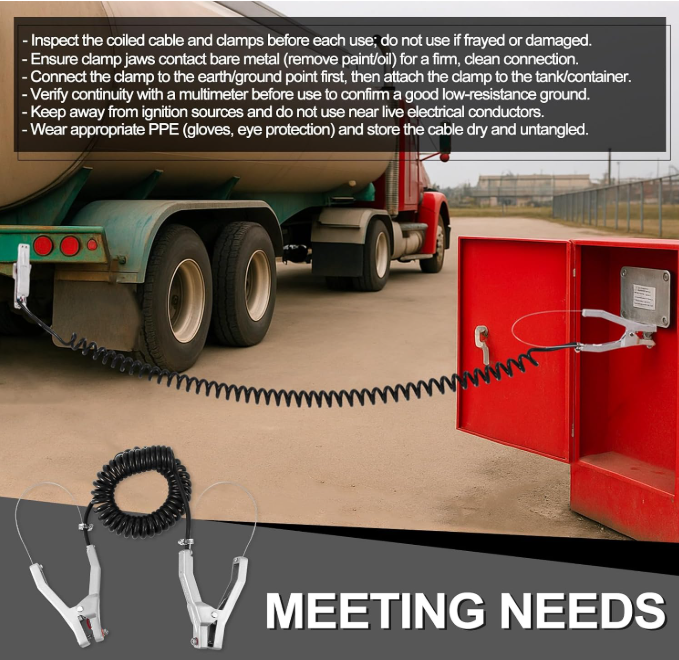
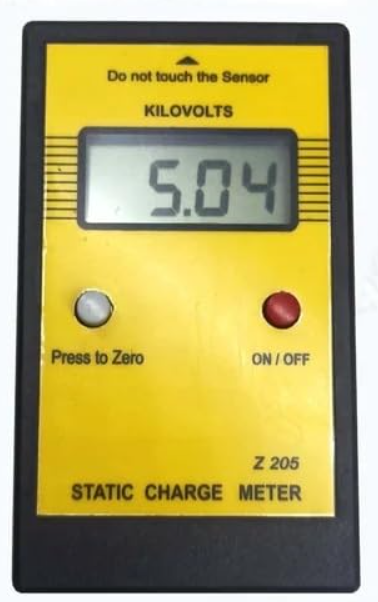

Therefore, grounding should not be treated as a one-time installation.
Periodic inspection and testing should be incorporated into the site’s maintenance program where required.
9. Avoid Insulating Connections
A conductive system can become electrically isolated by:
- Plastic sections
- Non-conductive gaskets
- Coatings
- Rubber components
- Insulating hoses
These components may interrupt the intended static-dissipation path.
Where static control is important, the complete system should be evaluated—not just the main metal equipment.
10. Use Suitable Hoses
Hoses used for flammable liquid transfer should be selected based on the material, pressure, compatibility, and electrostatic requirements of the application.
Where static accumulation is a concern, suitable conductive or static-dissipative hoses may be necessary.
A hose should never be assumed to be electrically safe simply because it looks like a normal industrial hose.
11. Control Combustible Dust
Where combustible dust is present, static-control measures should be combined with effective housekeeping.
Avoid allowing combustible dust to accumulate on:
- Machinery
- Electrical equipment
- Floors
- Beams
- Ducts
- Cable trays
Dust deposits can create additional fire and explosion hazards.
Cleaning methods should also be selected carefully to avoid creating hazardous dust clouds or ignition sources.
12. Control Ignition Sources
Static electricity should be considered alongside other ignition sources.
These may include:
- Open flames
- Hot surfaces
- Welding
- Grinding
- Electrical arcs
- Smoking
- Mechanical sparks
- Lightning
- Hot work
The goal is to prevent any credible ignition source from contacting an ignitable atmosphere.
13. Conduct Risk Assessments
Static electricity should be addressed during:
- HAZOP
- Job Safety Analysis
- Risk Assessment
- Process Hazard Analysis
- Permit-to-Work planning
- Management of Change
Ask:
Where can static charge be generated?
Where can it accumulate?
Where could it discharge?
Could a flammable atmosphere be present?
What controls prevent ignition?
This approach makes static electricity a visible part of the safety discussion.
Static Electricity Safety Checklist


Before operating equipment that may generate static charge, consider the following:
Equipment
- Is the equipment suitable for the process?
- Are conductive components appropriately grounded?
- Are required bonding connections in place?
- Are hoses suitable?
- Are grounding connections free from visible damage?
Process
- Is the transfer speed appropriate?
- Is excessive turbulence controlled?
- Is splash filling minimized where necessary?
- Are flammable materials being handled safely?
Environment
- Could a flammable atmosphere exist?
- Is combustible dust controlled?
- Is ventilation adequate?
- Are other ignition sources controlled?
Personnel
- Are workers trained?
- Is suitable PPE being used?
- Is appropriate antistatic footwear/clothing required?
- Are workers aware of static-discharge hazards?
Maintenance
- Are grounding systems inspected?
- Are bonding connections maintained?
- Are static-control devices functioning?
- Are defects reported and corrected?
Common Mistakes That Increase Static Electricity Risk
1. Assuming Small Sparks Are Harmless
A tiny spark can become a serious ignition source in the right atmosphere.
2. Ignoring Grounding
Metal equipment does not automatically mean it is properly grounded.
3. Forgetting Bonding
Two conductive objects can develop a potential difference even when both appear to be metal.
4. Transferring Flammable Liquids Too Quickly
High-speed transfer can increase electrostatic generation under certain conditions.
5. Using Ordinary Plastic Containers
Insulating containers may allow charge to accumulate.
6. Ignoring Synthetic Clothing
Synthetic materials can contribute to electrostatic charge accumulation.
7. Assuming Humidity Solves Everything
Humidity can help in some applications but should not replace proper engineering controls.
8. Ignoring Combustible Dust
Static electricity can become an ignition source for combustible dust clouds.
9. Failing to Inspect Grounding Connections
A disconnected or corroded grounding conductor may not provide the intended protection.
10. Making Unauthorized Equipment Modifications
Modifications can compromise grounding, bonding, or hazardous-area protection.
Static Electricity in Hazardous Areas
The risk becomes particularly serious when static-generating operations take place in a hazardous area.
Examples include:
- Fuel loading
- Solvent transfer
- Tank filling
- Chemical processing
- Powder handling
- Spray painting
- Gas processing
- Pharmaceutical powder handling
In these environments, static electricity must be treated as a potential ignition source.
The controls may involve a combination of:
Grounding + Bonding + Equipment Selection + Process Control + Atmospheric Control + Ignition-Source Control
No single control should automatically be assumed to eliminate the hazard.
The Role of EHS Professionals
EHS teams can help organizations manage electrostatic hazards through a structured program.
Identify
Determine which operations and equipment generate static charge.
Assess
Evaluate whether accumulated charge could produce an ignition-capable discharge.
Control
Implement grounding, bonding, equipment design, process controls, and other appropriate measures.
Inspect
Verify that static-control systems remain functional.
Train
Teach workers why static electricity matters and how to recognize unsafe conditions.
Review
Reassess the hazard whenever processes, materials, equipment, or operating conditions change.
A Simple Way to Remember Static Electricity Safety
For workers, the following five-step approach is easy to remember:
GENERATE → ACCUMULATE → DISCHARGE → IGNITE → PREVENT
Generate
Identify where the process creates static charge.
Accumulate
Determine where the charge could build up.
Discharge
Identify possible paths through which the charge could jump.
Ignite
Determine whether a flammable gas, vapor, mist, or dust could be ignited.
Prevent
Use grounding, bonding, suitable equipment, process controls, and other safeguards.
This simple thought process can make an invisible hazard much easier to understand.
Final Thoughts: Don’t Wait for the Spark
Static electricity is invisible.
You cannot always see it building up.
You may not hear it.
You may not feel it.
And you certainly cannot rely on the absence of a previous incident as proof that the process is safe.
That’s what makes electrostatic hazards particularly important in industrial environments.
A liquid flowing through a pipe, powder moving through a conveyor, plastic film passing over a roller, or a worker walking across an insulating floor can all create electrostatic charge.
Most of the time, nothing happens.
But when the right conditions come together, a small discharge can have serious consequences.
The safest approach is to identify the source of static generation and prevent the charge from accumulating to hazardous levels.
That means:
Ground conductive equipment.
Bond conductive components.
Control transfer and process conditions.
Use appropriate hoses and equipment.
Control combustible dust and flammable atmospheres.
Maintain static-control systems.
Train workers.
Never ignore a spark in a hazardous environment.
Most importantly, remember:
Static electricity may be invisible, but the consequences of an uncontrolled static discharge can be very real.
Good EHS management means recognizing the hazard before the spark occurs.
When static electricity is properly understood and controlled, many seemingly mysterious shocks, sparks, fires, and process problems can be prevented.
Control the charge before it controls the outcome.
Frequently Asked Questions
What is static electricity?
Static electricity is an imbalance of electrical charge that accumulates on the surface of a material. It can remain stored until it finds a path through which it can discharge.
How is static electricity generated in industries?
It can be generated through contact and separation, friction, liquid flow, powder movement, conveyor belts, plastic-film processing, spraying, mixing, pumping, filtration, and movement of people.
Why is static electricity dangerous in hazardous areas?
A static discharge can potentially provide an ignition source when flammable gases, vapors, mists, or combustible dust are present.
What is the difference between grounding and bonding?
Grounding provides a path for charge to dissipate to earth or an appropriate reference. Bonding electrically connects conductive objects to reduce potentially hazardous differences in electrical potential between them.
Does grounding eliminate static electricity?
Grounding can provide a means for accumulated charge to dissipate, but its effectiveness depends on proper system design, installation, continuity, and maintenance. It is one part of a broader static-control strategy.
Can plastic generate static electricity?
Yes. Many plastics are insulating materials and can readily accumulate electrostatic charge when they contact and separate from other materials or undergo friction.
Can humans generate static electricity?
Yes. Walking, clothing movement, and contact with insulating materials can cause a person to accumulate electrostatic charge.
How can static electricity be reduced?
Depending on the application, controls may include grounding, bonding, antistatic materials, humidity control, ionization, suitable equipment, controlled flow rates, and process design.
Is static electricity only a fire hazard?
No. It can also cause electric shocks, product contamination, material-handling problems, equipment malfunction, production issues, and ignition hazards.
Is a small static shock dangerous?
In many ordinary situations, a small static shock is mainly uncomfortable. However, in an environment containing an ignitable atmosphere, even a small electrostatic discharge can potentially become an ignition source.
Important Safety Note
This article is intended for general EHS and industrial safety awareness. Static-electricity hazards are highly dependent on the materials, process conditions, equipment, environmental conditions, and presence of flammable or combustible substances.
For industrial operations, appropriate controls should be established through a competent engineering assessment, applicable regulations and standards, manufacturer’s requirements, process-safety studies, and site-specific procedures.
Grounding, bonding, flow control, static-dissipative equipment, atmospheric controls, and other measures must be selected based on the actual process rather than applied as generic solutions.
🔁 Readers also enjoyed these blog posts:
- Safety Management’s Role: The Unsung Hero Behind Every Successful Organization
- Safety Management and Its Responsibilities: Protecting People, Preventing Hazards, and Promoting a Culture of Care
- Benchmarking for Safety Performance: A Key to Continuous Improvement
“Start Your Website Journey Today – Exclusive Hostinger Discounts!”