 by
by Difference Between Dust Suppression and Dust Prevention in Dust-Generating Industries
Dust is an unavoidable challenge in many industries. Whether it is a mining operation, construction site, cement plant, quarry, woodworking workshop, or material handling facility, dust generation can create serious health, safety, and environmental concerns.
Workers exposed to airborne dust may suffer from respiratory illnesses, eye irritation, skin problems, and reduced visibility that increases accident risk. In addition, uncontrolled dust can lead to equipment damage, product contamination, community complaints, and regulatory penalties.
To manage this hazard effectively, industries rely on two major approaches: dust suppression and dust prevention. Although both methods aim to reduce airborne dust, they work in fundamentally different ways.
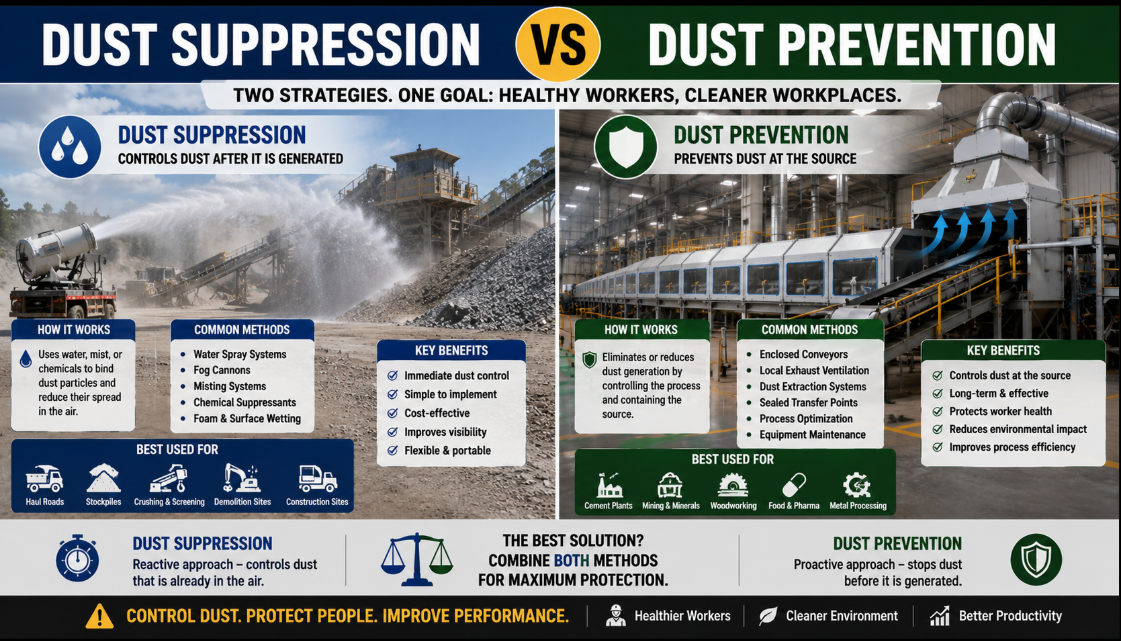
Dust suppression controls dust after it has been generated, while dust prevention focuses on stopping dust from being generated in the first place.
Understanding the difference between these two approaches is essential for safety professionals, engineers, plant managers, and environmental specialists who want to create healthier and more efficient workplaces.
In this article, we will explore the concepts of dust suppression and dust prevention, compare their advantages and limitations, discuss real-world applications, and explain how both methods contribute to effective industrial dust control.
Why Dust Control Is Important
Industrial dust may appear harmless at first glance, but prolonged exposure can have severe consequences.
Common risks associated with dust exposure include:
- Respiratory diseases such as silicosis and pneumoconiosis
- Asthma and chronic bronchitis
- Eye and skin irritation
- Reduced visibility leading to accidents
- Dust explosions in combustible dust environments
- Equipment wear and maintenance issues
- Environmental pollution
- Community complaints and legal penalties
Effective dust control is therefore not only a regulatory requirement but also a critical component of workplace health, safety, and operational efficiency.
What Is Dust Suppression?
Dust suppression refers to the methods used to control or reduce airborne dust after it has already been generated.
The main objective is to prevent dust particles from becoming airborne or to remove them from the air before they spread further.
Dust suppression does not eliminate the source of dust generation; instead, it manages the dust that is already present.
Think of dust suppression as controlling the dust cloud after it forms.
How Dust Suppression Works
Dust suppression works by:
- Wetting dust particles so they become heavier and settle quickly
- Capturing airborne particles through mist or fog systems
- Using chemical suppressants to bind dust particles together
- Reducing dust dispersion during material handling
The most common dust suppression method is water spraying, where water droplets attach to dust particles and prevent them from becoming airborne.
Common Dust Suppression Methods
Industries use several dust suppression techniques depending on the type of operation.
Examples include:
- Water spray systems
- Fogging systems
- Mist cannons
- Chemical dust suppressants
- Foam suppression
- Dust-binding agents
- Surface wetting
These methods are commonly applied in mining, quarrying, demolition, road construction, and bulk material handling operations.
Applications of Dust Suppression
Dust suppression is widely used in:
- Mining operations
- Quarrying activities
- Construction sites
- Demolition projects
- Coal handling plants
- Cement manufacturing
- Bulk material stockpiles
- Haul roads
- Crushing and screening operations
Advantages of Dust Suppression
Immediate Dust Control
Dust suppression provides rapid reduction of airborne dust.
Simple Implementation
Water spray systems and fogging equipment are relatively easy to install and operate.
Cost-Effective
Many dust suppression methods, especially water spraying, are affordable for large-scale operations.
Flexible Application
Suppression systems can be used temporarily or permanently depending on the operation.
Improved Visibility
Reducing airborne dust improves visibility and reduces accident risk.
Limitations of Dust Suppression
Despite its benefits, dust suppression has certain limitations.
- Does not eliminate the dust source
- Requires continuous application
- Water usage can be high
- May create slippery surfaces
- Less effective in windy conditions
- Chemical suppressants may have environmental considerations
What Is Dust Prevention?
Dust prevention refers to the measures taken to stop or significantly reduce dust generation at its source.
Instead of controlling dust after it forms, dust prevention aims to eliminate or minimize the conditions that create dust.
Dust prevention is generally considered a more proactive and long-term approach because it addresses the root cause of the problem.
Think of dust prevention as stopping the dust cloud from forming in the first place.
How Dust Prevention Works
Dust prevention works by:
- Enclosing dust-generating processes
- Using covered conveyors
- Installing local exhaust ventilation (LEV)
- Optimizing material handling methods
- Reducing drop heights during loading and unloading
- Using pre-moistened materials
- Automating dusty operations
- Maintaining equipment to prevent excessive dust release
The goal is to minimize the generation and release of dust particles into the workplace atmosphere.
Common Dust Prevention Methods
Examples of dust prevention techniques include:
- Enclosed conveyor systems
- Local exhaust ventilation (LEV)
- Dust extraction systems
- Process isolation
- Material handling optimization
- Equipment maintenance
- Use of less dusty materials
- Automation and remote operation
- Sealed transfer points
Applications of Dust Prevention
Dust prevention is commonly used in:
- Cement plants
- Pharmaceutical manufacturing
- Food processing industries
- Woodworking facilities
- Metal grinding operations
- Chemical manufacturing
- Grain handling facilities
- Powder processing plants
- Mining and mineral processing
Advantages of Dust Prevention
Controls Dust at the Source
Dust prevention addresses the root cause of dust generation.
Long-Term Effectiveness
Once preventive systems are installed, they can provide continuous dust reduction.
Better Worker Protection
Workers are exposed to lower levels of airborne dust.
Reduced Environmental Impact
Preventing dust generation reduces emissions and community complaints.
Improved Process Efficiency
Dust prevention often reduces material loss and equipment contamination.
Limitations of Dust Prevention
Dust prevention also has some challenges.
- Higher initial installation cost
- May require process redesign
- Maintenance of extraction systems is essential
- Not all dust-generating activities can be fully enclosed
- Implementation may require operational changes
Difference Between Dust Suppression and Dust Prevention
Although both methods reduce airborne dust, their approach and effectiveness differ significantly.
| Feature | Dust Suppression | Dust Prevention |
|---|---|---|
| Purpose | Control dust after generation | Prevent dust generation at source |
| Approach | Reactive | Proactive |
| Focus | Airborne dust particles | Dust-generating process |
| Source Control | Limited | High |
| Common Methods | Water spray, fogging, chemicals | Enclosure, LEV, covered conveyors |
| Cost | Generally lower initial cost | Higher initial investment |
| Effectiveness | Temporary or short-term | Long-term and continuous |
| Maintenance | Requires repeated application | Requires system maintenance |
| Best Used For | Outdoor and temporary operations | Permanent industrial processes |
| Environmental Impact | May use large amounts of water | Usually lower emissions |
Real-World Industrial Example
Consider a quarry where rocks are crushed and transported.
Using Dust Suppression
Water sprays are installed at the crusher and along haul roads.
The water wets dust particles and reduces the amount of airborne dust.
Using Dust Prevention
The conveyor belts are enclosed, transfer points are sealed, and local exhaust ventilation is installed at the crusher.
These measures reduce the amount of dust generated and released into the air.
In this case, dust suppression controls the dust that is already present, while dust prevention reduces the generation of dust at its source.
Which Method Is Better?
There is no universal answer because the best approach depends on the type of industry, process, and operational conditions.
Choose Dust Suppression When:
- Dust is generated in outdoor or temporary operations.
- Immediate dust control is required.
- Water or mist systems can be applied effectively.
- Budget constraints limit major process modifications.
Choose Dust Prevention When:
- Dust generation occurs in a permanent industrial process.
- Long-term dust reduction is required.
- Worker exposure levels must be minimized.
- Process redesign or equipment upgrades are feasible.
In many cases, the most effective dust control strategy combines both methods.
Combining Dust Suppression and Dust Prevention
Modern dust-generating industries often use a layered dust control approach.
For example:
- Enclose conveyor systems to prevent dust release.
- Install local exhaust ventilation at transfer points.
- Use water sprays on haul roads and stockpiles.
- Maintain equipment to reduce dust leakage.
- Monitor dust levels regularly.
- Provide respiratory protection when necessary.
By combining prevention and suppression, industries can achieve better air quality, improved worker safety, and reduced environmental impact.
Best Practices for Dust Control
To effectively manage dust in industrial operations:
- Conduct regular dust risk assessments.
- Identify major dust-generating activities.
- Prioritize dust prevention measures where feasible.
- Use dust suppression for residual or unavoidable dust.
- Maintain dust control equipment regularly.
- Monitor workplace dust concentrations.
- Train workers on dust hazards and control methods.
- Implement housekeeping practices to remove settled dust.
- Review dust control measures whenever processes change.
Frequently Asked Questions (FAQs)
Is dust suppression the same as dust prevention?
No. Dust suppression controls airborne dust after it has been generated, while dust prevention aims to stop dust from being generated at its source.
Which method is more effective?
Dust prevention is generally more effective for long-term control because it addresses the root cause of dust generation.
Can both methods be used together?
Yes. Many industries combine dust prevention and dust suppression to achieve comprehensive dust control.
Is water spraying considered dust prevention?
No. Water spraying is a dust suppression method because it controls dust after it has been generated.
Why is dust prevention preferred in permanent industrial processes?
Because it provides continuous control, reduces worker exposure, minimizes environmental emissions, and often improves process efficiency.
Final Thoughts
Dust control is a critical aspect of workplace safety and environmental management in dust-generating industries. Both dust suppression and dust prevention play valuable roles, but they differ fundamentally in their approach.
Dust suppression is a reactive method that controls airborne dust after it has been generated. It is particularly useful for outdoor operations, temporary activities, and situations where immediate dust reduction is required.
Dust prevention, on the other hand, is a proactive strategy that minimizes or eliminates dust generation at its source. By enclosing processes, optimizing material handling, and using local exhaust ventilation, industries can achieve more sustainable and effective dust control.
The most successful dust management programs often combine both approaches. Prevention measures reduce the amount of dust generated, while suppression methods control any remaining airborne dust.
By understanding the difference between dust suppression and dust prevention, industries can make informed decisions that protect workers, improve air quality, reduce environmental impact, and enhance overall operational efficiency.
🔁 Readers also enjoyed these blog posts:
- Safety Management’s Role: The Unsung Hero Behind Every Successful Organization
- Safety Management and Its Responsibilities: Protecting People, Preventing Hazards, and Promoting a Culture of Care
- Benchmarking for Safety Performance: A Key to Continuous Improvement
“Start Your Website Journey Today – Exclusive Hostinger Discounts!”

Turn Any Idea into Viral,
Jaw-Dropping AI Videos in Seconds!