 by
by Difference Between Cyclone Separator and Fabric Filter: A Complete Guide for Industrial Dust Collection
Walk into a cement plant, woodworking factory, metal processing unit, or grain handling facility, and you’ll notice one thing they all have in common: dust.
Some dust is merely a housekeeping challenge, but fine airborne particles can pose serious risks to worker health, damage equipment, reduce product quality, and contribute to environmental pollution. That’s why industrial dust collection systems are an essential part of modern manufacturing and occupational safety.
Among the most widely used dust collection technologies are the Cyclone Separator and the Fabric Filter (Baghouse Filter). Both are designed to remove particulate matter from industrial air streams, yet they work in completely different ways and are suited to different applications.
Choosing the right system can significantly improve air quality, lower maintenance costs, increase process efficiency, and help industries comply with environmental regulations.
In this comprehensive guide, we’ll explain the difference between cyclone separators and fabric filters, compare their advantages and disadvantages, discuss real-world applications, and help you determine which dust collection system is best for your facility.
Why Dust Collection Is Important
Industrial processes such as grinding, crushing, cutting, sanding, conveying, mixing, and combustion generate large amounts of airborne dust.
Without proper control, dust can lead to:
- Respiratory illnesses
- Reduced visibility
- Equipment wear
- Fire and explosion hazards
- Product contamination
- Environmental pollution
- Regulatory non-compliance
- Increased cleaning costs
Effective dust collection protects both workers and equipment while improving operational efficiency.
Understanding Industrial Dust Control
Dust control systems generally work by:
- Capturing dust at its source
- Separating dust from the air
- Collecting dust safely
- Returning clean air to the workplace or releasing it into the atmosphere
Cyclone separators and fabric filters are two of the most common technologies used to achieve this goal.
What Is a Cyclone Separator?
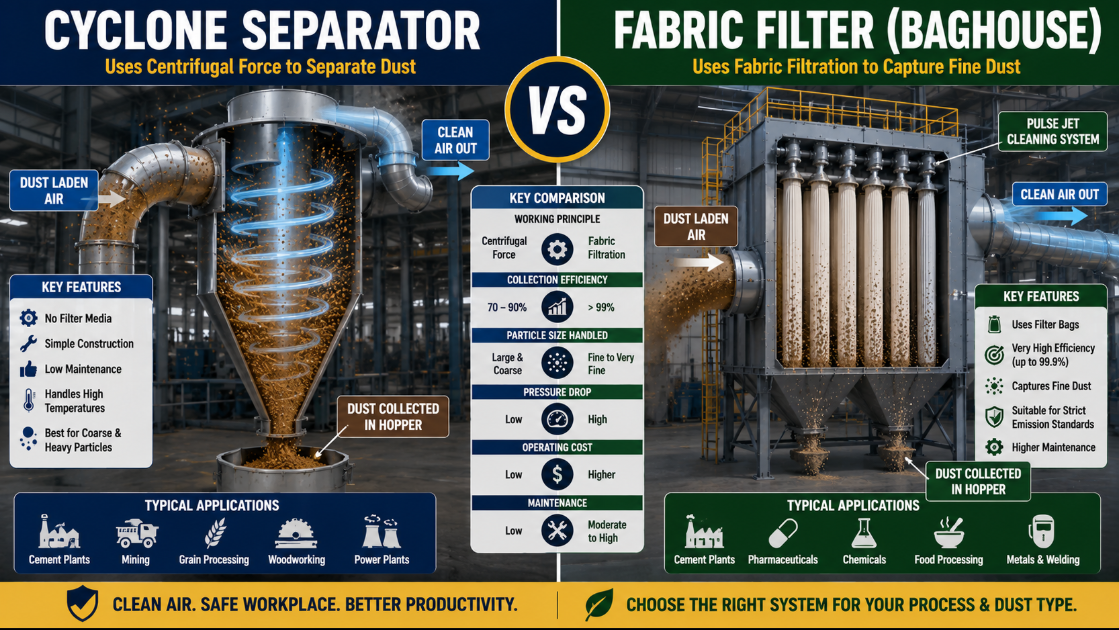
A Cyclone Separator is a mechanical dust collection device that removes dust from an air stream using centrifugal force.
Unlike filters, it contains no filter media.
Instead, dust particles are separated because they are heavier than air.
As contaminated air enters the cyclone tangentially, it begins to spin rapidly inside the cylindrical body.
The spinning motion throws heavier particles outward toward the wall of the cyclone, where they lose momentum and fall into a collection hopper.
Meanwhile, the cleaned air exits through the top outlet.
How a Cyclone Separator Works
The operation can be summarized in four steps:
- Dust-laden air enters tangentially.
- A high-speed vortex develops inside the cyclone.
- Centrifugal force pushes heavy particles toward the walls.
- Dust falls into a hopper while cleaner air exits through the outlet.
Because there are no filter bags, the system remains relatively simple and durable.
Components of a Cyclone Separator
A typical cyclone separator consists of:
- Inlet duct
- Cylindrical body
- Conical section
- Vortex finder
- Dust hopper
- Air outlet
Its simple design contributes to its reliability and low maintenance requirements.
Advantages of Cyclone Separators
Simple Construction
No moving parts or filter bags make the system robust and reliable.
Low Maintenance
Maintenance mainly involves periodic inspection and hopper cleaning.
Handles High Temperatures
Cyclones can process hot gases that might damage fabric filters.
Low Operating Cost
The absence of filter media reduces replacement expenses.
Ideal for Large Dust Particles
Cyclones efficiently remove coarse and heavy particulate matter.
Limitations of Cyclone Separators
Despite their strengths, cyclone separators have limitations.
- Lower efficiency for very fine particles.
- Not suitable where extremely clean exhaust air is required.
- Performance depends on particle size and density.
- Cannot capture ultrafine dust effectively.
What Is a Fabric Filter?
A Fabric Filter, commonly called a Baghouse Filter, is an air pollution control device that removes dust by passing contaminated air through specially designed fabric filter bags.
The fabric traps dust particles while allowing clean air to pass through.
As dust accumulates on the surface of the bags, it forms a “dust cake” that often improves filtration efficiency.
The bags are cleaned periodically using pulse jets, reverse air, or mechanical shaking.
How a Fabric Filter Works
The process includes:
- Dust-laden air enters the baghouse.
- Air passes through filter bags.
- Dust remains on the fabric surface.
- Clean air exits the collector.
- Dust is periodically removed from the bags into a hopper.
This system is capable of capturing extremely fine particles.
Components of a Fabric Filter
Typical components include:
- Housing
- Filter bags
- Tube sheet
- Dust hopper
- Pulse jet cleaning system
- Air inlet
- Clean air outlet
- Fan
Modern baghouses are available in many configurations depending on industrial requirements.
Advantages of Fabric Filters
Extremely High Collection Efficiency
Baghouses can remove over 99% of particulate matter, including very fine dust.
Suitable for Fine Dust
Excellent for cement dust, flour, pharmaceuticals, and metal fumes.
Cleaner Exhaust Air
Ideal where strict emission standards apply.
Wide Industrial Use
Compatible with many manufacturing processes.
Flexible Design
Can be customized for different airflow rates and dust characteristics.
Limitations of Fabric Filters
Fabric filters also have disadvantages.
- Higher installation cost.
- Regular filter bag replacement.
- Greater maintenance requirements.
- Pressure drop increases energy consumption.
- Some fabrics have temperature limitations.
Difference Between Cyclone Separator and Fabric Filter
Although both systems remove dust from industrial air, they operate very differently.
| Feature | Cyclone Separator | Fabric Filter |
|---|---|---|
| Working Principle | Centrifugal force | Fabric filtration |
| Filter Media | No | Yes |
| Collection Efficiency | Moderate to High | Very High (often >99%) |
| Fine Dust Removal | Limited | Excellent |
| Large Particle Removal | Excellent | Excellent |
| Temperature Resistance | High | Depends on filter material |
| Maintenance | Low | Moderate to High |
| Operating Cost | Lower | Higher |
| Pressure Drop | Low | Higher |
| Best For | Coarse dust | Fine particulate matter |
Industrial Applications
Cyclone Separator Applications
Cyclone separators are commonly used in:
- Cement plants
- Grain processing
- Woodworking
- Mining
- Foundries
- Power plants
- Metal processing
- Sawmills
They are often installed as pre-cleaners before more efficient filtration systems.
Fabric Filter Applications
Fabric filters are widely used in:
- Pharmaceutical manufacturing
- Food processing
- Cement plants
- Chemical industries
- Steel plants
- Lime production
- Fertilizer plants
- Biomass boilers
They are preferred when strict air quality standards must be met.
Can Both Systems Be Used Together?
Absolutely.
Many industrial facilities use a cyclone separator followed by a fabric filter.
Here’s why:
- The cyclone removes large and heavy particles first.
- This reduces the dust load reaching the baghouse.
- The fabric filter then captures the remaining fine particles.
This combination improves efficiency, extends filter bag life, and reduces maintenance costs.
Which Dust Collector Is Better?
The answer depends on your application.
Choose a Cyclone Separator When:
- Dust particles are large and heavy.
- High-temperature gases are present.
- Low maintenance is important.
- Budget is limited.
- A pre-cleaning stage is needed.
Choose a Fabric Filter When:
- Fine dust must be captured.
- Strict environmental regulations apply.
- High collection efficiency is essential.
- Clean exhaust air is required.
- Worker exposure to fine dust must be minimized.
Best Practices for Dust Collection Systems
To ensure reliable performance:
- Conduct regular inspections.
- Empty dust hoppers before overfilling.
- Check for air leaks.
- Replace damaged filter bags promptly.
- Monitor pressure drop.
- Maintain fans and motors.
- Ensure proper airflow balancing.
- Train operators in preventive maintenance.
Routine maintenance increases system efficiency and extends equipment life.
Frequently Asked Questions (FAQs)
Is a cyclone separator better than a fabric filter?
Not necessarily. Cyclone separators are excellent for removing coarse dust with low maintenance, while fabric filters are superior for capturing fine particulate matter.
Can a cyclone remove fine dust?
It can remove some fine particles, but its efficiency decreases as particle size becomes smaller.
Why are baghouses more efficient?
Because the filter fabric traps extremely fine particles that centrifugal force alone cannot separate effectively.
Do fabric filters require more maintenance?
Yes. Filter bags must be inspected, cleaned, and replaced periodically.
Can both systems operate together?
Yes. Many industries use a cyclone separator as a pre-cleaner before a fabric filter to improve overall performance and reduce maintenance.
Real-World Example
Consider a cement manufacturing plant.
Raw material crushing generates large, heavy dust particles, while cement grinding produces extremely fine powder.
A cyclone separator is installed first to remove the heavier particles. The remaining fine dust then passes through a fabric filter, which captures nearly all of the remaining particulate matter before the air is released.
This two-stage system reduces emissions, extends filter life, lowers maintenance costs, and ensures compliance with environmental regulations.
Final Thoughts
Both cyclone separators and fabric filters are indispensable tools for industrial dust control, but they serve different purposes.
Cyclone separators are rugged, economical, and ideal for removing coarse dust and handling high-temperature gas streams. Their simple design and low maintenance requirements make them an excellent first stage in many dust collection systems.
Fabric filters, on the other hand, deliver exceptional filtration efficiency by capturing even the finest particles. They are the preferred choice for industries that must meet strict environmental standards or protect workers from hazardous airborne dust.
Rather than viewing these technologies as competitors, many facilities achieve the best results by using them together. A cyclone separator reduces the dust load, while a fabric filter provides final polishing of the exhaust air. This combination enhances performance, improves energy efficiency, extends equipment life, and creates a cleaner, healthier workplace.
Investing in the right dust collection strategy not only supports compliance and sustainability but also safeguards employee health, protects valuable equipment, and contributes to long-term operational success.
🔁 Readers also enjoyed these blog posts:
- Safety Management’s Role: The Unsung Hero Behind Every Successful Organization
- Safety Management and Its Responsibilities: Protecting People, Preventing Hazards, and Promoting a Culture of Care
- Benchmarking for Safety Performance: A Key to Continuous Improvement
“Start Your Website Journey Today – Exclusive Hostinger Discounts!”

Turn Any Idea into Viral,
Jaw-Dropping AI Videos in Seconds!