 by
by Difference Between Exhaust Ventilation and Plenum Ventilation: A Complete Guide for Better Workplace Air Quality
Step inside a busy manufacturing plant on a hot afternoon, and you’ll immediately notice how important airflow is. In one area, warm air and fumes disappear through large exhaust fans mounted high on the walls. In another section, fresh, cool air gently flows from ceiling diffusers, creating a comfortable working environment.
Both systems improve workplace conditions, but they achieve this in very different ways.
This is the difference between Exhaust Ventilation and Plenum Ventilation.
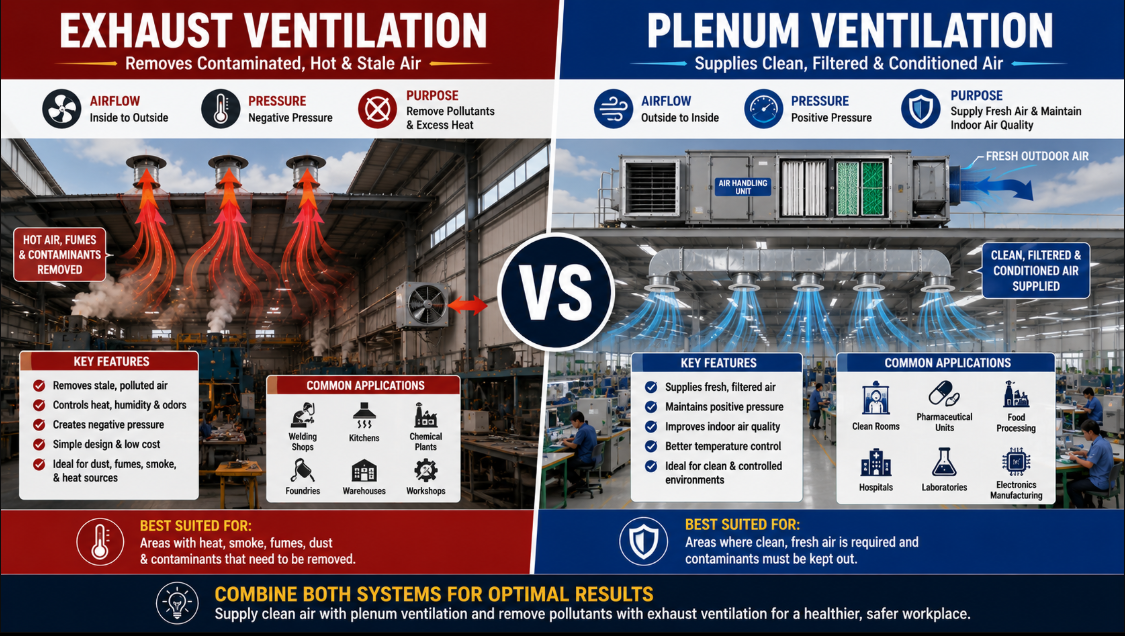
While exhaust ventilation removes contaminated or hot air from a workplace, plenum ventilation supplies fresh, filtered air into the building under slight positive pressure. Together, these systems play a critical role in maintaining indoor air quality, controlling heat, and protecting workers from airborne contaminants.
Understanding how they differ is essential for safety professionals, HVAC engineers, plant managers, and facility owners who want to design efficient and healthy workplaces.
In this article, we’ll explore the principles behind both systems, compare their advantages and disadvantages, examine real-world industrial applications, and help you decide which ventilation method best suits your needs.
Why Proper Ventilation Is Essential
Industrial operations generate a wide range of airborne hazards, including:
- Heat
- Dust
- Smoke
- Welding fumes
- Chemical vapors
- Moisture
- Carbon dioxide
- Odors
Without proper ventilation, these contaminants can accumulate and lead to:
- Heat stress
- Respiratory illnesses
- Reduced productivity
- Equipment overheating
- Poor indoor air quality
- Fire and explosion risks
- Regulatory non-compliance
Effective ventilation controls these hazards by either removing contaminated air or supplying fresh air, and often by doing both.
What Is Exhaust Ventilation?
Exhaust ventilation is a ventilation system that removes stale, contaminated, humid, or hot air from a building and discharges it outdoors.
Its primary objective is to eliminate airborne pollutants and excess heat from the work environment.
As contaminated air is exhausted, fresh replacement air enters naturally or through mechanical make-up air systems.
How Exhaust Ventilation Works
The process is straightforward:
- Exhaust fans create negative pressure inside the building.
- Contaminated air is drawn toward exhaust points.
- The air is discharged outdoors through ducts or wall-mounted fans.
- Fresh outdoor air replaces the exhausted air through inlets, doors, windows, or make-up air units.
This continuous exchange helps maintain acceptable indoor air quality.
Types of Exhaust Ventilation
General Exhaust Ventilation
Removes contaminated air from an entire building.
Local Exhaust Ventilation (LEV)
Captures contaminants directly at their source using hoods, ducts, and exhaust fans.
Roof Exhaust Systems
Common in factories where hot air naturally rises.
Wall Exhaust Systems
Frequently used in warehouses and workshops.
Applications of Exhaust Ventilation
Exhaust ventilation is widely used in:
- Welding shops
- Paint booths
- Chemical plants
- Commercial kitchens
- Foundries
- Battery charging rooms
- Laboratories
- Manufacturing facilities
- Warehouses
- Pharmaceutical plants
Advantages of Exhaust Ventilation
Removes Airborne Contaminants
Dust, fumes, vapors, and smoke are removed from occupied areas.
Controls Heat
Hot air is continuously expelled from the building.
Improves Worker Health
Reduced exposure to airborne hazards lowers occupational health risks.
Simple Design
Exhaust systems are relatively easy to install and maintain.
Cost-Effective
General exhaust systems are often less expensive than complex HVAC installations.
Limitations of Exhaust Ventilation
Despite its effectiveness, exhaust ventilation has limitations.
- Can create excessive negative pressure if replacement air is inadequate.
- May draw outdoor dust into the building.
- Heating or cooling costs may increase if conditioned air is exhausted.
- Airflow depends on proper make-up air design.
- Less effective for contaminants that spread quickly without source capture.
What Is Plenum Ventilation?
Plenum ventilation is a system that supplies fresh, filtered, and often conditioned air into a building under slight positive pressure.
Rather than pulling air out, it pushes clean air into occupied spaces, forcing stale or contaminated air to exit through designated openings or exhaust systems.
The supplied air typically enters through a plenum chamber, which distributes it evenly throughout the building.
How Plenum Ventilation Works
The system operates as follows:
- Outdoor air is drawn into an air handling unit.
- The air is filtered and, if required, cooled or heated.
- Fans deliver the conditioned air into a plenum chamber.
- The plenum distributes air evenly through ducts and diffusers.
- Excess air leaves the building through exhaust openings or relief vents.
The building remains under slight positive pressure, reducing the entry of dust and contaminants from outside.
Applications of Plenum Ventilation
Plenum ventilation is commonly used in:
- Clean rooms
- Pharmaceutical industries
- Food processing plants
- Hospitals
- Laboratories
- Electronics manufacturing
- Commercial buildings
- Offices
- Data centers
- High-quality production environments
Advantages of Plenum Ventilation
Provides Fresh Air
Occupants receive a continuous supply of clean outdoor air.
Improves Indoor Air Quality
Filtered air reduces dust, allergens, and airborne contaminants.
Positive Pressure Protection
Prevents outdoor dust, smoke, and insects from entering the building.
Better Temperature Control
Conditioned supply air improves thermal comfort.
Uniform Air Distribution
Air is delivered evenly throughout the workspace.
Limitations of Plenum Ventilation
Like any ventilation system, plenum ventilation has some drawbacks.
- Higher installation cost.
- Requires air handling equipment.
- Greater energy consumption.
- Needs regular filter maintenance.
- Poor design may result in uneven airflow.
Difference Between Exhaust Ventilation and Plenum Ventilation
Although both systems improve indoor air quality, they operate in opposite ways.
| Feature | Exhaust Ventilation | Plenum Ventilation |
|---|---|---|
| Primary Purpose | Remove contaminated air | Supply clean air |
| Airflow Direction | Inside to outside | Outside to inside |
| Building Pressure | Negative pressure | Positive pressure |
| Main Function | Air removal | Air supply |
| Heat Control | Removes hot air | Supplies cooler air |
| Air Quality | Removes pollutants | Prevents contamination entry |
| Energy Consumption | Moderate | Higher |
| Fresh Air Supply | Indirect | Direct |
| Installation Cost | Lower | Higher |
| Best Applications | Workshops, kitchens, welding | Clean rooms, hospitals, food processing |
How They Work Together
Modern industrial facilities often combine both systems.
For example:
- A plenum ventilation system supplies filtered, conditioned air.
- Local exhaust ventilation captures fumes at welding stations.
- Roof exhaust fans remove rising hot air.
- Make-up air units balance building pressure.
This combination creates healthier indoor environments while maintaining energy efficiency.
Exhaust Ventilation vs Plenum Ventilation in Heat Control
Exhaust Ventilation
Heat generated by machinery rises naturally.
Roof-mounted exhaust fans remove this hot air, lowering workplace temperatures.
Plenum Ventilation
Cool, conditioned air is introduced into occupied areas.
This fresh air dilutes indoor heat and improves thermal comfort.
Using both methods together is often the most effective solution for hot industrial environments.
Which System Is Better?
The answer depends on the application.
Choose Exhaust Ventilation When:
- Heat removal is the primary objective.
- Dust or fumes are generated.
- Local source capture is required.
- Budget is limited.
- Heavy industrial processes are involved.
Choose Plenum Ventilation When:
- High indoor air quality is required.
- Positive pressure must be maintained.
- Clean manufacturing environments are necessary.
- Occupant comfort is a priority.
- Conditioned fresh air is needed.
Best Practices for Industrial Ventilation
To maximize system performance:
- Conduct ventilation assessments regularly.
- Balance supply and exhaust airflow.
- Maintain positive or negative pressure as required.
- Replace air filters on schedule.
- Clean ducts periodically.
- Inspect fans and motors.
- Monitor indoor temperatures.
- Measure carbon dioxide levels.
- Ensure proper make-up air supply.
- Review ventilation systems whenever production changes.
Frequently Asked Questions (FAQs)
Is exhaust ventilation better than plenum ventilation?
Not necessarily. Exhaust ventilation excels at removing contaminants, while plenum ventilation is ideal for supplying clean, filtered air. Many facilities use both systems together.
What is the main difference between the two systems?
Exhaust ventilation removes indoor air, whereas plenum ventilation introduces fresh outdoor air into the building.
Why is positive pressure important?
Positive pressure prevents outdoor dust, insects, and pollutants from entering sensitive work areas.
Can plenum ventilation control heat?
Yes. By supplying conditioned air, plenum ventilation improves thermal comfort, although it does not directly remove heat sources.
Can exhaust ventilation work without make-up air?
It can, but performance will suffer. Adequate make-up air is necessary to maintain balanced airflow and prevent excessive negative pressure.
Real-World Example
Imagine a pharmaceutical manufacturing facility.
Production rooms require extremely clean air to protect product quality. A plenum ventilation system supplies filtered, temperature-controlled air, maintaining positive pressure so contaminants cannot enter.
At the same time, laboratory exhaust systems remove chemical vapors generated during testing. This combination ensures clean working conditions while protecting both employees and products.
Final Thoughts
Both exhaust ventilation and plenum ventilation are essential components of effective industrial ventilation systems, but they serve different purposes.
Exhaust ventilation protects workers by removing contaminated, humid, or hot air from the workplace. It is especially effective in environments where dust, fumes, smoke, or excessive heat are generated. Its simplicity and cost-effectiveness make it a popular choice for many industrial applications.
Plenum ventilation, on the other hand, focuses on delivering clean, filtered, and often conditioned air into occupied spaces. By maintaining positive pressure, it helps prevent contaminants from entering the building while improving indoor air quality and thermal comfort. This makes it indispensable in hospitals, pharmaceutical plants, food processing facilities, and other environments where cleanliness is critical.
Rather than choosing one system over the other, the most successful facilities integrate both into a balanced ventilation strategy. Supplying fresh air while simultaneously removing contaminated air creates healthier workplaces, reduces heat stress, enhances productivity, improves energy efficiency, and supports compliance with occupational health and environmental standards.
Investing in the right ventilation design today leads to safer employees, more efficient operations, and a cleaner, more sustainable workplace for the future.
🔁 Readers also enjoyed these blog posts:
- Safety Management’s Role: The Unsung Hero Behind Every Successful Organization
- Safety Management and Its Responsibilities: Protecting People, Preventing Hazards, and Promoting a Culture of Care
- Benchmarking for Safety Performance: A Key to Continuous Improvement
“Start Your Website Journey Today – Exclusive Hostinger Discounts!”

Turn Any Idea into Viral,
Jaw-Dropping AI Videos in Seconds!