 by
by Difference Between Smoke Tube and Gas Detection Tube
Introduction
In industrial environments, safety professionals rely on various monitoring tools to identify hazards before they become incidents. Among these tools, smoke tubes and gas detection tubes play an important role in ensuring workplace safety and maintaining healthy working conditions.
Although both devices are commonly used in industrial hygiene, environmental monitoring, and occupational safety programs, they serve entirely different purposes. Many safety professionals, especially those new to the field, often confuse smoke tubes with gas detection tubes because both are handheld devices used for air-related assessments.
Understanding the difference between these two tools is essential for selecting the right equipment for a specific task. Choosing the wrong tool can lead to inaccurate assessments, ineffective controls, and potentially unsafe working conditions.
This article explores the differences between smoke tubes and gas detection tubes, including their working principles, applications, advantages, limitations, and best-use scenarios.
What Is a Smoke Tube?
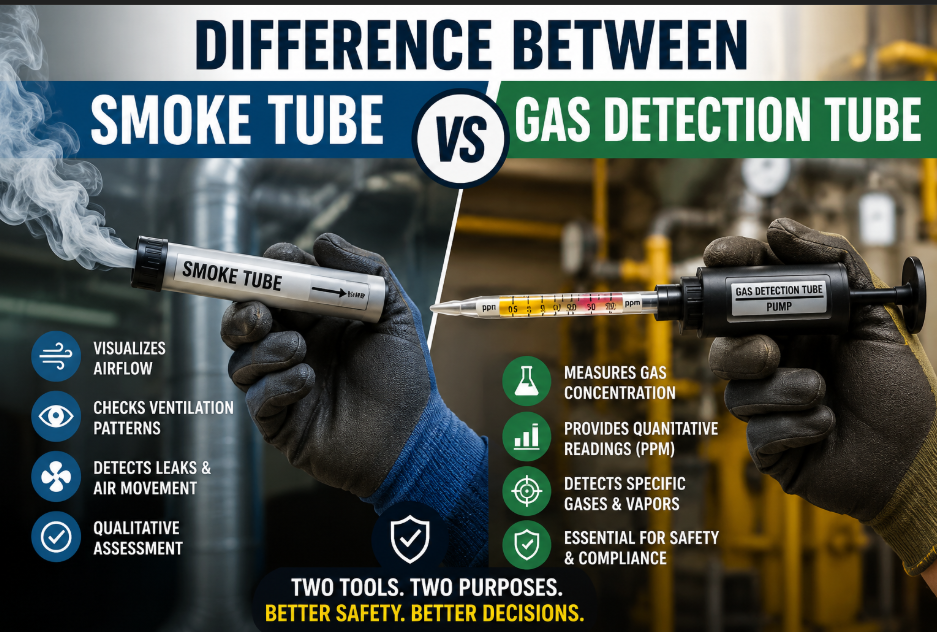
A smoke tube is a device designed to generate visible smoke for observing airflow patterns. It helps safety professionals, engineers, and ventilation specialists visualize the movement of air within a workplace or enclosed space.
The smoke produced by the tube allows users to observe:
- Airflow direction
- Ventilation efficiency
- Air leakage points
- Drafts and dead zones
- Effectiveness of exhaust systems
Smoke tubes are commonly used in ventilation studies, cleanrooms, laboratories, HVAC systems, and confined space assessments.
How a Smoke Tube Works
A smoke tube contains a chemical substance that produces a visible smoke when activated. Air is drawn through the tube using a manual pump or aspirator.
The smoke released from the tube travels with the surrounding air currents, making airflow visible to the observer.
This visual indication helps identify whether air is moving in the desired direction and whether ventilation systems are functioning effectively.
What Is a Gas Detection Tube?
A gas detection tube is a specialized device used to measure the concentration of specific gases or vapors in the atmosphere.
These tubes are widely used for monitoring workplace exposure to hazardous substances such as:
- Carbon monoxide (CO)
- Hydrogen sulfide (H₂S)
- Ammonia (NH₃)
- Sulfur dioxide (SO₂)
- Chlorine (Cl₂)
- Benzene
- Formaldehyde
Gas detection tubes provide a quantitative measurement of gas concentration rather than simply showing airflow patterns.

How a Gas Detection Tube Works
Each gas detection tube contains a chemical reagent that reacts with a particular gas.
When air is drawn through the tube using a calibrated hand pump:
- The target gas reacts with the reagent.
- A color change occurs within the tube.
- The length of the color stain corresponds to the gas concentration.
- The reading is compared against the calibration markings on the tube.
This provides a direct indication of gas concentration in parts per million (ppm) or other measurement units.
Key Differences Between Smoke Tube and Gas Detection Tube
| Feature | Smoke Tube | Gas Detection Tube |
|---|---|---|
| Primary Purpose | Visualize airflow | Measure gas concentration |
| Output | Visible smoke | Quantitative gas reading |
| Measurement Type | Qualitative | Quantitative |
| Chemical Reaction | Produces smoke | Detects specific gas |
| Application | Ventilation assessment | Gas monitoring |
| Accuracy | Visual indication only | Measurable concentration |
| Target Substance | Air movement | Specific gases or vapors |
| Use in Exposure Monitoring | No | Yes |
| Safety Compliance Testing | Limited | Extensive |
| Typical Users | HVAC technicians, engineers | Safety officers, industrial hygienists |
Applications of Smoke Tubes
Smoke tubes are highly effective when airflow behavior needs to be observed.
1. Ventilation System Evaluation
Smoke tubes help determine whether ventilation systems are effectively removing contaminated air.
2. HVAC Performance Testing
Engineers use smoke tubes to verify airflow direction and identify stagnant air zones.
3. Cleanroom Validation
In pharmaceutical and semiconductor industries, smoke tubes help confirm proper airflow patterns.
4. Confined Space Assessments
Before entry into confined spaces, smoke tubes may be used to understand airflow characteristics.
5. Leakage Detection
Smoke tubes help identify leaks around ducts, windows, doors, and ventilation systems.
Applications of Gas Detection Tubes
Gas detection tubes are essential when hazardous gas exposure needs to be measured.
1. Occupational Exposure Monitoring
Safety professionals assess worker exposure to toxic substances.
2. Confined Space Entry
Gas detection tubes help identify hazardous atmospheric conditions before entry.
3. Emergency Response
Responders can quickly identify chemical hazards during incidents.
4. Environmental Monitoring
Industries monitor emissions and environmental contaminants.
5. Process Safety Management
Gas detection tubes help identify leaks and monitor process-related hazards.
Advantages of Smoke Tubes
Easy to Use
Smoke tubes require minimal training and provide immediate visual results.
Cost-Effective
They are relatively inexpensive compared to advanced airflow monitoring equipment.
Instant Visualization
Users can immediately observe airflow behavior without complicated calculations.
Portable
Their compact design makes them suitable for field inspections.
Limitations of Smoke Tubes
No Gas Measurement Capability
Smoke tubes cannot determine the concentration of hazardous gases.
Subjective Interpretation
Results depend on visual observation and user experience.
Environmental Influences
Wind, temperature, and ventilation conditions can affect observations.
Temporary Assessment
Smoke tubes provide only a snapshot of airflow conditions at a specific time.
Advantages of Gas Detection Tubes
Accurate Gas Measurement
Gas detection tubes provide measurable concentration readings.
Quick Results
Most readings can be obtained within minutes.
Portable and Convenient
Ideal for field use and emergency situations.
Wide Range of Applications
Available for hundreds of different gases and vapors.
No Power Source Required
Most manual tube systems operate without batteries or electricity.
Limitations of Gas Detection Tubes
Gas Specific
Each tube is designed for a specific gas or chemical.
Single-Use
Most tubes can only be used once.
Limited Precision
Electronic gas detectors may offer higher accuracy.
Potential Interference
Other chemicals may occasionally affect results.
When Should You Use a Smoke Tube?
Choose a smoke tube when your objective is to:
- Visualize airflow patterns.
- Check ventilation effectiveness.
- Detect air leaks.
- Evaluate HVAC performance.
- Study room air movement.
A smoke tube is the preferred choice whenever airflow direction is more important than gas concentration.
When Should You Use a Gas Detection Tube?
Choose a gas detection tube when you need to:
- Measure hazardous gas concentrations.
- Verify atmospheric safety.
- Conduct exposure assessments.
- Comply with occupational health regulations.
- Investigate suspected gas leaks.
Gas detection tubes are essential whenever numerical gas concentration data is required.
Real-World Example
Imagine a maintenance team preparing for confined space entry into a storage tank.
Using a Smoke Tube
The team can determine whether fresh air supplied through ventilation ducts is reaching all areas inside the tank. The smoke reveals airflow direction and identifies dead spots.
Using a Gas Detection Tube
The team can measure oxygen levels and detect hazardous gases such as hydrogen sulfide or carbon monoxide before workers enter.
In this scenario, both tools serve important but completely different functions.
Can Smoke Tubes Replace Gas Detection Tubes?
The simple answer is no.
A smoke tube can show how air moves, but it cannot identify hazardous gases or determine their concentration.
Similarly, a gas detection tube can measure gas concentration but cannot provide information about airflow patterns.
For comprehensive workplace safety assessments, both tools are often used together.
Best Practices for Using Both Devices
To obtain reliable results:
For Smoke Tubes
- Follow manufacturer instructions.
- Conduct tests under normal operating conditions.
- Minimize external disturbances.
- Record airflow observations.
For Gas Detection Tubes
- Use the correct tube for the target gas.
- Verify pump calibration.
- Follow sampling procedures carefully.
- Store tubes according to manufacturer recommendations.
Conclusion
Smoke tubes and gas detection tubes are valuable safety tools, but they serve fundamentally different purposes.
A smoke tube helps visualize airflow and evaluate ventilation effectiveness, while a gas detection tube measures the concentration of specific gases or vapors in the atmosphere.
Understanding these differences enables safety professionals to select the right tool for the right task. In many industrial settings, both devices complement each other and contribute to a more comprehensive understanding of workplace conditions.
By using smoke tubes to assess airflow and gas detection tubes to monitor hazardous atmospheres, organizations can improve safety performance, reduce occupational health risks, and maintain compliance with industry regulations.
Ultimately, effective hazard identification begins with choosing the correct monitoring equipment, and knowing the difference between smoke tubes and gas detection tubes is a critical step toward creating safer workplaces.
🔁 Readers also enjoyed these blog posts:
- Safety Management’s Role: The Unsung Hero Behind Every Successful Organization
- Safety Management and Its Responsibilities: Protecting People, Preventing Hazards, and Promoting a Culture of Care
- Benchmarking for Safety Performance: A Key to Continuous Improvement
“Start Your Website Journey Today – Exclusive Hostinger Discounts!”

Turn Any Idea into Viral,
Jaw-Dropping AI Videos in Seconds!