 by
by Difference Between General Ventilation and Natural Ventilation: Everything You Need to Know
Imagine walking into a factory where the air feels heavy, warm, and filled with dust. Within minutes, breathing becomes uncomfortable and concentration starts to fade. Now imagine another workplace where fresh air constantly circulates, temperatures remain comfortable, and harmful contaminants never get a chance to build up.
The difference isn’t luck. It’s ventilation.
Ventilation is one of the most important yet overlooked aspects of workplace safety. Whether it’s an office, warehouse, chemical plant, workshop, laboratory, or construction site, proper ventilation protects employees from harmful airborne contaminants while creating a healthier and more productive environment.
Among the different ventilation methods, General Ventilation and Natural Ventilation are the two most commonly used systems. Although both improve indoor air quality, they work in very different ways and are suitable for different situations.
In this guide, we’ll explore the difference between General Ventilation and Natural Ventilation in detail, including their working principles, advantages, disadvantages, applications, and how to choose the right system for your workplace.
What is Ventilation?
Ventilation is the process of supplying fresh outdoor air while removing stale, contaminated indoor air from an enclosed space.
A properly designed ventilation system helps:
- Remove dust and airborne particles
- Control heat and humidity
- Reduce toxic gases and vapors
- Maintain oxygen levels
- Improve employee comfort
- Prevent airborne diseases
- Enhance productivity
Without proper ventilation, indoor air pollution can become far more dangerous than outdoor pollution.
What is General Ventilation?
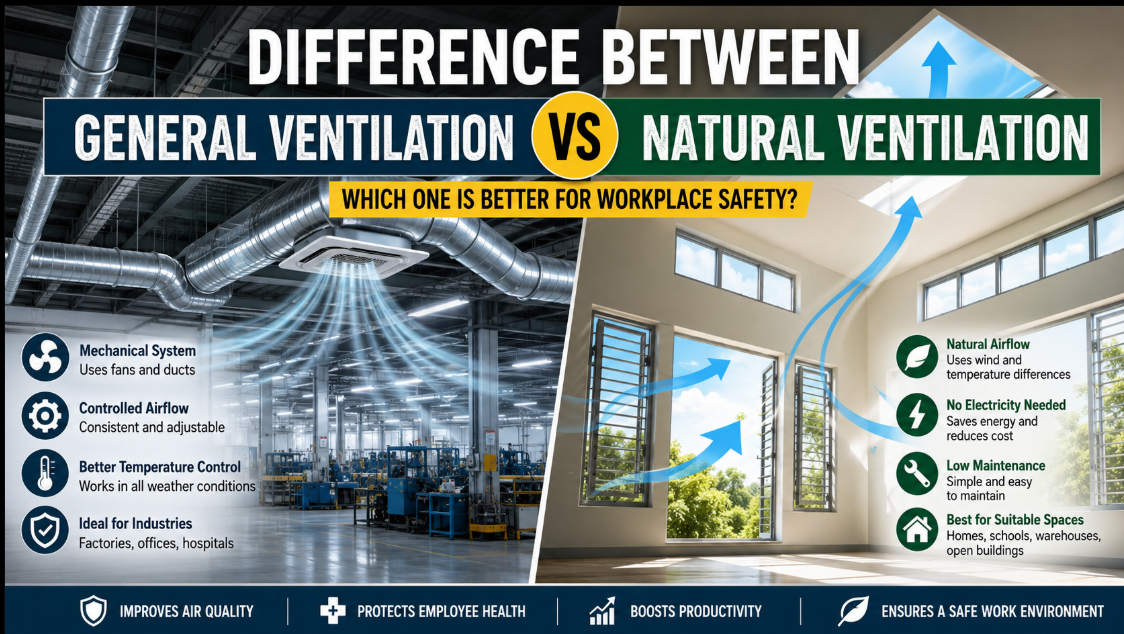
General Ventilation, also called Dilution Ventilation, is a mechanical ventilation system that uses fans, blowers, ducts, and air handling units to continuously replace contaminated indoor air with fresh outdoor air.
Instead of capturing contaminants directly at their source, general ventilation dilutes polluted air by mixing it with clean air.
Think of it like adding clean water to dirty water until the contamination becomes much less concentrated.
How General Ventilation Works
The system generally includes:
- Fresh air intake
- Supply fans
- Exhaust fans
- Air ducts
- Air filters
- HVAC equipment
Fresh outdoor air enters the building while stale indoor air is exhausted outside, maintaining healthy air quality.
Examples of General Ventilation
General ventilation is commonly found in:
- Manufacturing plants
- Warehouses
- Commercial buildings
- Shopping malls
- Schools
- Hospitals
- Offices
- Assembly workshops
Advantages of General Ventilation
1. Consistent Air Quality
Mechanical systems provide a continuous supply of fresh air regardless of outdoor weather.
2. Better Temperature Control
Most systems are connected with HVAC equipment, allowing heating and cooling along with ventilation.
3. Effective for Large Buildings
General ventilation distributes fresh air evenly across large workspaces.
4. Improves Employee Comfort
Proper airflow reduces stuffiness and creates a more comfortable working environment.
5. Works in Enclosed Buildings
Even buildings with sealed windows can maintain excellent air quality using mechanical ventilation.
Disadvantages of General Ventilation
Despite its advantages, general ventilation has limitations.
Higher Installation Cost
Fans, ducts, motors, and HVAC systems require a significant initial investment.
Energy Consumption
Mechanical ventilation operates using electricity, increasing operating costs.
Regular Maintenance
Filters, ducts, motors, and fans require periodic inspection and servicing.
Not Suitable for Highly Toxic Contaminants
General ventilation dilutes contaminants rather than capturing them at the source. Dangerous chemicals may require local exhaust ventilation instead.
What is Natural Ventilation?
Natural Ventilation uses natural forces such as wind pressure and temperature differences to move fresh air through a building without mechanical equipment.
Fresh air enters through windows, doors, roof vents, louvers, and other openings while warm contaminated air exits naturally.
No fans or motors are required.
Nature becomes the ventilation system.
How Natural Ventilation Works
Natural ventilation depends on two primary forces.
Wind Effect
Wind creates pressure differences around the building, pushing fresh air inside while forcing stale air out.
Stack Effect
Warm air naturally rises because it is lighter.
As warm indoor air escapes through roof openings, cooler outside air enters through lower openings.
This creates continuous natural airflow.
Examples of Natural Ventilation
Natural ventilation is commonly seen in:
- Residential houses
- Schools
- Agricultural buildings
- Warehouses
- Parking garages
- Greenhouses
- Open workshops
- Temporary construction structures
Advantages of Natural Ventilation
1. No Electricity Required
Natural ventilation operates without electrical equipment, reducing energy costs.
2. Low Installation Cost
Only openings such as windows, vents, and louvers are needed.
3. Environment Friendly
Natural airflow reduces energy consumption and lowers carbon emissions.
4. Minimal Maintenance
Since there are very few mechanical components, maintenance requirements are minimal.
5. Fresh Outdoor Air
Occupants enjoy naturally fresh air without relying on machines.
Disadvantages of Natural Ventilation
Natural ventilation also has several limitations.
Weather Dependent
Its effectiveness depends on wind speed, outdoor temperature, and seasonal changes.
Difficult to Control
Airflow cannot be adjusted precisely.
Limited Cooling
On hot, still days, natural ventilation may provide very little comfort.
Poor Performance in Polluted Areas
Outdoor pollutants can enter the building along with fresh air.
Unsuitable for Hazardous Industries
Facilities handling toxic chemicals usually require mechanical ventilation.
Major Differences Between General Ventilation and Natural Ventilation
| Feature | General Ventilation | Natural Ventilation |
|---|---|---|
| Working Method | Mechanical fans and HVAC | Wind and natural airflow |
| Power Requirement | Requires electricity | No electricity required |
| Cost | Higher installation cost | Lower installation cost |
| Maintenance | Regular maintenance | Very little maintenance |
| Airflow Control | Highly controllable | Limited control |
| Weather Dependency | Independent of weather | Weather dependent |
| Temperature Control | Excellent | Limited |
| Best For | Industries, offices, hospitals | Homes, schools, open buildings |
| Operating Cost | Higher | Very low |
| Reliability | Highly reliable | Variable |
Which Ventilation System is Better?
There is no universal answer.
The best ventilation system depends on the building, work process, climate, and type of airborne hazards.
Choose General Ventilation When:
- Indoor contaminants are generated regularly.
- Temperature control is important.
- Employees work in enclosed buildings.
- Consistent airflow is required.
- HVAC integration is necessary.
Choose Natural Ventilation When:
- Energy savings are a priority.
- The building has good natural airflow.
- Outdoor air quality is good.
- The climate is suitable.
- The workplace has low contamination levels.
Many modern buildings combine both systems to maximize comfort while reducing energy consumption.
Real-Life Industrial Example
Consider a furniture manufacturing workshop.
Wood cutting produces large amounts of sawdust.
If the workshop relies only on natural ventilation, dust may remain suspended in the air during calm weather.
Installing general mechanical ventilation continuously removes dusty air while supplying fresh air, significantly improving worker safety.
In contrast, a warehouse storing packaged goods with large doors and roof vents may perform well using natural ventilation alone.
Importance of Proper Ventilation in Workplace Safety
Proper ventilation helps prevent numerous occupational health issues.
It reduces exposure to:
- Dust
- Welding fumes
- Chemical vapors
- Solvent fumes
- Carbon dioxide
- Carbon monoxide
- Excess humidity
- Heat stress
- Airborne bacteria and viruses
Good ventilation also supports compliance with workplace health and safety regulations while improving employee morale and productivity.
Common Mistakes to Avoid
Many workplaces make avoidable ventilation mistakes.
These include:
- Blocking air vents with equipment.
- Keeping exhaust fans switched off to save electricity.
- Ignoring dirty air filters.
- Closing fresh air inlets permanently.
- Assuming open doors always provide enough ventilation.
- Failing to inspect ventilation performance regularly.
Small mistakes can have significant consequences for employee health.
Best Practices for Maintaining Effective Ventilation
To ensure optimal performance:
- Inspect ventilation systems regularly.
- Replace air filters on schedule.
- Clean ducts and exhaust fans.
- Monitor indoor air quality.
- Keep vents unobstructed.
- Train employees about ventilation importance.
- Repair damaged equipment immediately.
- Review ventilation requirements whenever production changes.
Regular maintenance ensures the system continues protecting workers effectively.
Frequently Asked Questions (FAQs)
Is general ventilation better than natural ventilation?
Not always. General ventilation offers better control and consistency, while natural ventilation is economical and environmentally friendly. The right choice depends on the building and workplace hazards.
Does natural ventilation require electricity?
No. Natural ventilation relies entirely on wind pressure and temperature differences.
Can both systems be used together?
Yes. Many modern buildings use hybrid ventilation systems that combine natural airflow with mechanical ventilation for improved energy efficiency and indoor comfort.
Is general ventilation enough for toxic chemicals?
No. Highly toxic contaminants often require Local Exhaust Ventilation (LEV), which captures pollutants directly at the source before they spread throughout the workplace.
Which ventilation system is cheaper?
Natural ventilation has lower installation and operating costs because it does not require mechanical equipment or electricity.
Final Thoughts
Choosing between General Ventilation and Natural Ventilation is not about deciding which system is universally superior. It is about understanding the specific needs of your workplace and selecting the solution that delivers the safest, healthiest, and most efficient environment.
General ventilation offers dependable, controlled airflow and is ideal for factories, offices, healthcare facilities, and enclosed industrial settings where consistent indoor air quality is essential. Natural ventilation, on the other hand, provides a sustainable and energy-efficient option for buildings that can take advantage of favorable weather and thoughtful architectural design.
In many modern workplaces, the smartest approach is a hybrid strategy that blends the strengths of both systems. By combining mechanical support with natural airflow whenever possible, organizations can improve indoor air quality, reduce energy consumption, and create healthier spaces for everyone.
Investing in the right ventilation system is more than a compliance requirement. It is an investment in employee health, operational efficiency, and the long-term success of your workplace.
🔁 Readers also enjoyed these blog posts:
- Safety Management’s Role: The Unsung Hero Behind Every Successful Organization
- Safety Management and Its Responsibilities: Protecting People, Preventing Hazards, and Promoting a Culture of Care
- Benchmarking for Safety Performance: A Key to Continuous Improvement
“Start Your Website Journey Today – Exclusive Hostinger Discounts!”

Turn Any Idea into Viral,
Jaw-Dropping AI Videos in Seconds!