 by
by Difference Between Insulation and Substitution to Control Heat Exposure
Heat is an unavoidable part of many workplaces. From steel plants and foundries to commercial kitchens, glass manufacturing units, power plants, and construction sites, employees are often exposed to high temperatures that can affect their health, comfort, and productivity.
While personal protective equipment (PPE) like heat-resistant gloves and face shields offers a level of protection, the most effective way to safeguard workers is to control the hazard at its source. This is where engineering controls become essential.
Among the many engineering controls used to reduce heat exposure, insulation and substitution are two of the most effective. Although both aim to protect workers from excessive heat, they work in very different ways.
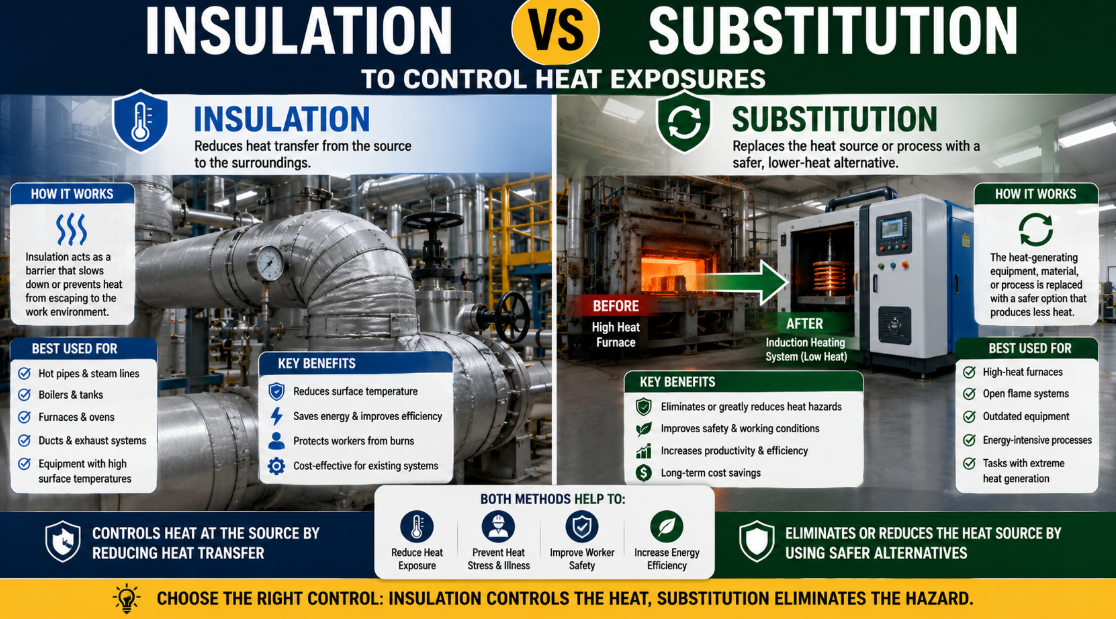
Insulation reduces the transfer of heat from a source, while substitution eliminates or replaces the source of excessive heat with a safer alternative.
Understanding the difference between these two methods is crucial for safety professionals, engineers, supervisors, and anyone responsible for creating a safe working environment.
In this article, we’ll explore insulation and substitution in detail, compare their advantages and limitations, discuss practical workplace applications, and explain how they help prevent heat stress.
Why Controlling Heat Exposure Is Important
Excessive heat can affect workers physically and mentally.
Common health risks include:
- Heat stress
- Heat exhaustion
- Heat cramps
- Heat rash
- Heat syncope
- Heat stroke
- Dehydration
- Fatigue
- Reduced concentration
- Increased accident risk
According to occupational safety guidelines, controlling workplace heat should begin with engineering controls before relying on administrative controls or personal protective equipment.
Understanding the Hierarchy of Controls
The Hierarchy of Controls ranks hazard control methods from the most effective to the least effective.
- Elimination
- Substitution
- Engineering Controls
- Administrative Controls
- Personal Protective Equipment (PPE)
Insulation is considered an engineering control, while substitution is one of the highest-ranking hazard control methods because it replaces the hazard itself.
What Is Insulation?
Insulation is the process of covering or shielding hot surfaces, pipes, tanks, furnaces, ducts, boilers, or equipment with materials that reduce the transfer of heat.
Instead of removing the heat source, insulation prevents heat from escaping into the workplace.
It acts as a protective barrier between the hot object and workers.
How Insulation Works
Heat travels in three ways:
- Conduction
- Convection
- Radiation
Insulation materials have very low thermal conductivity, meaning they slow down heat transfer.
As a result:
- Equipment retains heat internally.
- Surface temperatures decrease.
- Workers experience less radiant heat.
- Energy losses are minimized.
Common Insulation Materials
Industries use several types of insulation depending on temperature and application.
Examples include:
- Mineral wool
- Fiberglass
- Ceramic fiber
- Calcium silicate
- Rock wool
- Foam insulation
- Aerogel blankets
- Refractory bricks
Each material is selected based on operating temperature, fire resistance, durability, and maintenance requirements.
Applications of Insulation
Insulation is commonly used on:
- Steam pipes
- Boilers
- Furnaces
- Kilns
- Ovens
- Hot tanks
- Heat exchangers
- Industrial ducts
- Chemical reactors
- Exhaust systems
Advantages of Insulation
Reduces Worker Heat Exposure
Lower surface temperatures reduce the amount of radiant heat reaching employees.
Saves Energy
Insulation minimizes heat loss, improving energy efficiency and reducing fuel consumption.
Improves Workplace Comfort
Employees working near insulated equipment experience cooler conditions.
Prevents Burns
Insulated surfaces are less likely to cause accidental contact burns.
Supports Equipment Performance
Heat remains where it is needed, improving process efficiency.
Limitations of Insulation
Despite its many benefits, insulation has limitations.
- Does not eliminate the heat source
- Requires regular inspection
- Can become damaged over time
- Initial installation costs may be high
- Some insulation materials absorb moisture if not protected properly
What Is Substitution?
Substitution means replacing a hazardous process, material, or piece of equipment with a safer alternative that generates less heat or eliminates the heat hazard altogether.
Instead of controlling heat after it is produced, substitution prevents excessive heat from being created in the first place.
It is considered one of the most effective methods of hazard control because it addresses the risk at its source.
How Substitution Works
The goal of substitution is simple:
Replace the hazardous heat-generating source with a safer option.
Examples include:
- Replacing fuel-fired furnaces with energy-efficient induction heating.
- Using low-temperature curing processes instead of high-temperature ovens.
- Installing LED lighting instead of high-heat halogen lamps.
- Replacing open-flame burners with electric heating systems.
- Using automated equipment to reduce direct worker exposure.
By reducing heat generation, the workplace becomes inherently safer.
Applications of Substitution
Substitution is commonly used in:
- Manufacturing industries
- Food processing plants
- Metal fabrication
- Pharmaceutical production
- Laboratories
- Chemical industries
- Commercial kitchens
- Textile manufacturing
Advantages of Substitution
Eliminates or Reduces the Hazard
The source of excessive heat is reduced or replaced.
Long-Term Safety Improvement
Unlike temporary controls, substitution permanently lowers workplace risks.
Lower Maintenance Costs
Modern equipment often requires less maintenance and consumes less energy.
Improved Productivity
Workers experience reduced fatigue and better comfort.
Environmental Benefits
Energy-efficient technologies often reduce emissions and operating costs.
Limitations of Substitution
Substitution also has challenges.
- High initial investment
- May require redesign of production processes
- Employee retraining may be necessary
- Production downtime during installation
- Not every process has a suitable substitute
Difference Between Insulation and Substitution
Although both methods help control workplace heat exposure, they function differently.
| Feature | Insulation | Substitution |
|---|---|---|
| Purpose | Prevent heat transfer | Replace heat source |
| Type of Control | Engineering Control | Higher-level Hazard Control |
| Heat Source | Remains the same | Replaced or modified |
| Worker Protection | Indirect | Direct |
| Energy Savings | High | Often very high |
| Initial Cost | Moderate | Usually higher |
| Long-Term Effectiveness | High | Very High |
| Equipment Modification | Minimal | Significant |
| Maintenance | Required | Depends on replacement equipment |
| Best Used When | Heat source cannot be replaced | Safer technology is available |
Real-World Example
Imagine a metal fabrication workshop using a large gas-fired furnace.
Using Insulation
The furnace walls and hot pipes are insulated with ceramic fiber.
Workers experience less radiant heat, but the furnace still operates at the same temperature.
Using Substitution
The gas-fired furnace is replaced with an induction heating system.
The new process generates less surrounding heat, operates more efficiently, and reduces worker exposure significantly.
In this case, substitution provides a more permanent reduction in heat hazards, while insulation minimizes the effects of the existing heat source.
Which Method Is Better?
There is no universal answer.
The choice depends on:
- Type of process
- Available technology
- Budget
- Safety requirements
- Production needs
- Energy efficiency goals
If replacing the process is practical, substitution is generally the preferred option because it removes the hazard at its source.
When substitution is not feasible, insulation remains an excellent engineering control to reduce worker exposure.
Many industries combine both methods for maximum protection.
Combining Insulation and Substitution
The safest workplaces rarely rely on a single control method.
For example:
- Replace an old furnace with an energy-efficient induction system (substitution).
- Insulate the new heating equipment (insulation).
- Improve ventilation.
- Install heat shields.
- Rotate workers during high-heat tasks.
- Provide hydration stations.
- Supply appropriate PPE.
Using multiple layers of protection creates a safer and more resilient workplace.
Best Practices for Controlling Heat Exposure
To effectively reduce workplace heat:
- Conduct regular heat risk assessments.
- Identify high-temperature equipment.
- Insulate exposed hot surfaces.
- Evaluate opportunities for safer technologies.
- Maintain insulation materials.
- Monitor workplace temperatures.
- Improve ventilation.
- Train workers to recognize heat stress symptoms.
- Encourage regular hydration and rest breaks.
- Review control measures whenever processes change.
Frequently Asked Questions (FAQs)
Is insulation better than substitution?
Not necessarily. Substitution is generally more effective because it reduces or removes the hazard at its source, while insulation controls the transfer of heat from an existing source.
Can insulation completely eliminate heat exposure?
No. Insulation reduces heat transfer but does not remove the heat source itself.
Why is substitution higher in the Hierarchy of Controls?
Because it replaces the hazardous process or equipment, reducing the risk before workers are exposed.
Can both methods be used together?
Yes. Many workplaces combine substitution and insulation to maximize worker protection and energy efficiency.
Does insulation help save energy?
Absolutely. By reducing heat loss, insulation lowers energy consumption and improves the efficiency of industrial equipment.
Final Thoughts
Managing workplace heat exposure requires more than simply providing protective clothing. The most effective safety strategies focus on controlling hazards before they reach workers, and both insulation and substitution play a vital role in achieving this goal.
Insulation acts as a protective barrier that reduces the transfer of heat from equipment, helping lower surface temperatures, prevent burns, improve energy efficiency, and create a more comfortable work environment. It is particularly valuable when high-temperature processes are essential and cannot be replaced.
Substitution, however, takes heat control a step further by replacing hazardous equipment, materials, or processes with safer alternatives that generate less heat. As one of the highest-ranking methods in the Hierarchy of Controls, it offers long-term safety improvements, better energy performance, and reduced operational risks.
The most successful organizations often combine both approaches, along with ventilation, administrative controls, and appropriate PPE, to build a comprehensive heat stress prevention program. By understanding the difference between insulation and substitution, employers can make informed decisions that protect workers, improve productivity, reduce energy costs, and foster a safer workplace for everyone.
🔁 Readers also enjoyed these blog posts:
- Safety Management’s Role: The Unsung Hero Behind Every Successful Organization
- Safety Management and Its Responsibilities: Protecting People, Preventing Hazards, and Promoting a Culture of Care
- Benchmarking for Safety Performance: A Key to Continuous Improvement
“Start Your Website Journey Today – Exclusive Hostinger Discounts!”

Turn Any Idea into Viral,
Jaw-Dropping AI Videos in Seconds!