 by
by Introduction: Electrical Work Requires More Than Technical Skill
Electricity makes modern workplaces possible, but it is also one of the hazards that can turn a routine maintenance task into a life-changing accident within seconds.
An electrician may be repairing a distribution board. A maintenance technician may be troubleshooting a machine. An operator may be replacing a damaged cable. An engineer may be inspecting an electrical panel.
These activities can look routine—until something goes wrong.
Electrical accidents can result in electric shock, burns, arc-flash injuries, falls, equipment damage, fires, and fatalities. The good news is that many electrical incidents can be prevented when workers follow systematic safety practices rather than relying on experience, confidence, or luck.
The golden rule is simple:
Do not become part of the electrical circuit.
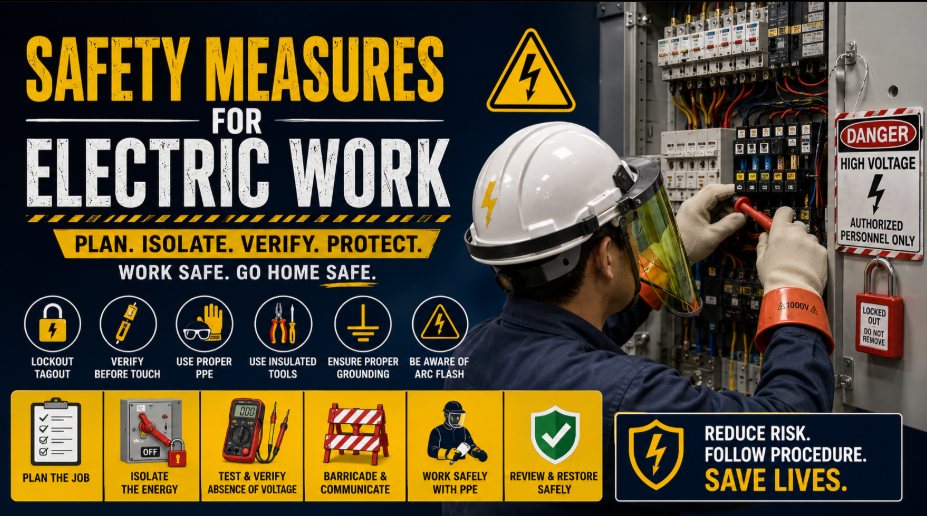
Safe electrical work begins before anyone touches a conductor. It starts with planning, identifying hazards, isolating energy, verifying the condition of the equipment, and selecting the right controls.
In this article, we’ll look at the most important safety measures for electrical work and how they can be applied in real workplace situations.
Why Is Electrical Work Dangerous?
Electrical work presents several different hazards, and they do not all involve direct contact with electricity.
The major hazards include:
- Electric shock
- Electrocution
- Arc flash
- Arc blast
- Electrical burns
- Electrical fires
- Explosions
- Unexpected energization
- Stored electrical energy
- Falls caused by electric shock
- Injuries from tools or equipment reacting to an electrical fault
The severity of an electrical injury depends on factors such as the voltage, current, duration of exposure, current path through the body, electrical system characteristics, and environmental conditions.
Even equipment that appears to be switched off can present a hazard if it has not been properly isolated and verified.
That’s why “switching it off” is not the same as “making it safe.”
1. Plan the Electrical Work Before Starting
One of the most effective electrical safety measures is also one of the simplest:
Plan the job before beginning it.
Before electrical work starts, workers should understand:
- What equipment will be worked on?
- What electrical sources supply it?
- Are there multiple energy sources?
- Is the equipment energized or de-energized?
- What hazards are present?
- What tools are required?
- What PPE is necessary?
- Who is authorized to perform the work?
- What isolation procedure will be followed?
- What will happen if something goes wrong?
A rushed job often creates shortcuts.
A few minutes spent reviewing the task can prevent hours of dealing with an accident.
For higher-risk work, an appropriate Job Safety Analysis (JSA), Job Hazard Analysis (JHA), or risk assessment should identify the hazards and controls before work begins.
2. De-Energize Whenever Possible
The safest electrical work is generally work performed on equipment that has been properly de-energized and isolated.
Before maintenance or repair, determine whether the task can be completed without exposing workers to energized electrical parts.
If the equipment can safely be de-energized, the electrical source should be disconnected using the appropriate procedure.
This reduces the possibility of:
- Electric shock
- Arc flash
- Accidental contact
- Unexpected equipment operation
- Electrical burns
However, simply turning a switch to the OFF position is not enough.
There may be additional sources of electrical energy, backfeeds, stored energy, or other connections that need to be addressed.
3. Follow Lockout/Tagout (LOTO) Procedures
Lockout/Tagout (LOTO) is one of the most important controls for electrical maintenance and servicing.
The basic purpose of LOTO is to prevent unexpected energization while people are working on equipment.
A typical isolation process involves:
- Identify all energy sources.
- Notify affected personnel.
- Shut down the equipment.
- Disconnect the energy source.
- Apply appropriate locks and tags.
- Release or control stored energy.
- Verify isolation.
- Perform the work.
- Restore energy only after confirming that the equipment is safe to re-energize.
The exact procedure should follow the organization’s electrical safety and energy-control program.
A lockout device is not simply a piece of hardware. It is part of a controlled process designed to ensure that the person performing the work can maintain control over the hazardous energy.
4. Always Verify That the Circuit Is De-Energized
This is one of the most important rules in electrical safety:
Never assume a circuit is dead. Verify it.
After isolation, an appropriately qualified person should use suitable test equipment and an established verification procedure to confirm the absence of hazardous voltage.
A common principle used for electrical testing is:
Test → verify the tester → test again
The exact method depends on the equipment and electrical system.
Why is verification so important?
Because electrical systems can contain:
- Multiple power sources
- Incorrectly identified circuits
- Backfeed
- Wiring errors
- Stored energy
- Faulty isolation devices
- Unexpected connections
A switch position or label alone cannot provide the same assurance as appropriate testing.
5. Use the Right Electrical Test Equipment
Electrical testing should be performed using equipment appropriate for the electrical environment and task.
Depending on the work, this may include:
- Voltage testers
- Multimeters
- Clamp meters
- Insulation testers
- Phase-sequence testers
- Other specialized electrical test instruments
Before using test equipment, check:
- Condition of the instrument
- Leads and probes
- Insulation
- Rating/category suitability
- Calibration status where applicable
- Battery condition
- Physical damage
Never use damaged test equipment simply because “it is only for a quick check.”
That quick check could be the moment when the equipment fails.
6. Use Proper Personal Protective Equipment
PPE should be considered an important layer of protection—but it should not be the first or only control.
Electrical PPE may include:
- Insulating gloves
- Safety footwear
- Safety glasses
- Face shields
- Arc-rated clothing
- Hearing protection
- Hard hats appropriate for the hazard
- Insulating mats or other protective equipment where applicable
The correct PPE depends on the specific electrical hazard and the task.
For example, PPE requirements for working near an energized electrical panel may differ from those for routine inspection of de-energized equipment.
The key principle is:
Select PPE based on the hazard assessment—not personal preference.
7. Inspect Electrical Tools Before Use
Electrical tools should be inspected before being used.
Look for:
- Damaged cables
- Exposed conductors
- Cracked plugs
- Damaged insulation
- Loose connections
- Missing guards
- Broken housings
- Signs of overheating
- Improper repairs
If a tool is defective, remove it from service and have it properly repaired or replaced.
Never wrap damaged insulation with ordinary tape and assume the tool is safe.
Temporary fixes can hide hazards rather than eliminate them.
8. Keep Electrical Work Areas Dry and Clean
Water and electricity are a dangerous combination.
Wet conditions can reduce electrical resistance and increase the possibility of current flowing through the human body.
Electrical work areas should therefore be kept as dry as reasonably possible.
Pay particular attention to:
- Wet floors
- Water leakage
- Rain
- Condensation
- Wet hands
- Damp electrical tools
- Outdoor electrical installations
Good housekeeping is also important.
Cables should not create unnecessary trip hazards, tools should be organized, and access to electrical panels should remain clear.
A clean work area makes it easier to see hazards before they become incidents.
9. Never Work on Energized Equipment Without Proper Controls
There are situations where energized electrical work may be necessary for testing, troubleshooting, commissioning, or other specialized activities.
But energized work should never become the default simply because:
“Switching it off will take too long.”
If energized work is necessary, it should be performed only by appropriately qualified and authorized personnel using the organization’s electrical safety procedures.
The job should consider:
- Shock hazards
- Arc-flash hazards
- Approach boundaries
- Appropriate PPE
- Insulated tools
- Test equipment
- Barriers
- Restricted access
- Emergency procedures
- Rescue considerations
The presence of an experienced electrician does not eliminate the hazard.
Experience reduces mistakes; it does not remove electrical energy.
10. Maintain Safe Approach Distances
Workers should maintain appropriate distances from exposed energized parts based on the electrical system, applicable requirements, and the nature of the task.
Unnecessary proximity increases the chance of:
- Accidental contact
- Tool drops
- Arc flash
- Unintentional movement
- Contact with conductive objects
Where appropriate, use physical barriers, covers, barricades, signs, and controlled access to prevent unauthorized personnel from entering hazardous areas.
A barrier is especially important when electrical work is taking place in an area where other employees may not understand the hazard.
11. Use Insulated and Appropriate Tools
Tools used around electrical systems should be suitable for the task and electrical environment.
Where required, use properly rated insulated tools.
Before use, inspect them for:
- Cracks
- Cuts
- Damaged insulation
- Contamination
- Missing protective components
- Excessive wear
Do not assume that a tool is electrically safe merely because its handle is plastic.
Only tools specifically designed and rated for the intended electrical application should be relied upon for electrical protection.
12. Grounding and Bonding Are Critical
Proper grounding and bonding help manage electrical fault conditions and reduce certain electrical risks.
Grounding systems should be installed, inspected, and maintained appropriately.
Workers should never remove, bypass, or modify grounding connections simply to make equipment easier to operate or repair.
A missing or damaged grounding conductor can turn a fault condition into a serious shock hazard.
When electrical equipment is repaired or modified, grounding and bonding should be checked as part of the work process.
13. Never Bypass Safety Devices
Electrical equipment may contain protective devices such as:
- Circuit breakers
- Fuses
- Interlocks
- Earth-leakage protection
- Emergency stops
- Protective relays
These devices exist for a reason.
Bypassing a protective device can expose workers and equipment to conditions the system was designed to prevent.
For example, repeatedly resetting a breaker without understanding why it trips can be extremely dangerous.
The correct response is to identify and address the underlying fault.
Never treat a repeatedly tripping protective device as an inconvenience.
Treat it as a warning.
14. Be Aware of Arc-Flash Hazards
Electrical safety isn’t limited to electric shock.
An arc flash can release an enormous amount of thermal energy in a very short time.
Potential consequences include:
- Severe burns
- Eye injuries
- Hearing damage
- Pressure effects
- Flying debris
- Clothing ignition
- Equipment destruction
Arc-flash risk should be evaluated where applicable, particularly around electrical equipment capable of releasing significant fault energy.
Appropriate engineering controls, equipment design, safe work practices, boundaries, and PPE can help reduce the risk.
Workers should never assume that an arc flash requires direct contact with an energized conductor.
An electrical arc can occur through the air under suitable fault conditions.
15. Keep Electrical Panels Accessible
Electrical panels, distribution boards, switchgear, and disconnecting means should not be blocked by:
- Boxes
- Tools
- Materials
- Furniture
- Stored chemicals
- Equipment
- Waste
Clear access is essential during both normal operation and emergencies.
If an electrical fault occurs, workers may need immediate access to disconnect the supply.
Good housekeeping around electrical equipment is therefore a genuine safety control—not simply an organizational preference.
16. Use Warning Signs and Barricades
When electrical work creates a temporary hazard, other workers need to know about it.
Use appropriate:
- Warning signs
- Danger signs
- Barricades
- Tags
- Restricted-access areas
- Temporary covers
The objective is simple:
Keep people who are not involved in the work away from the hazard.
A highly skilled electrical worker may understand an open panel immediately.
A visitor walking past may not.
17. Never Wear Conductive Jewelry During Electrical Work
Metal objects can become dangerous around electrical systems.
Workers involved in electrical tasks should avoid items that could create an unintended conductive path or become caught in equipment, as appropriate to the task.
Examples include:
- Rings
- Metal watches
- Bracelets
- Neck chains
- Metal accessories
A ring can also become a serious burn hazard if it contacts an energized component or becomes heated by electrical current.
Small habits can therefore have significant consequences.
18. Be Careful With Portable Electrical Equipment
Portable electrical equipment is frequently used in construction, manufacturing, maintenance, warehouses, workshops, and other workplaces.
Before use:
Inspect → connect safely → use correctly → disconnect safely → report defects.
Pay attention to:
- Extension cords
- Portable drills
- Grinders
- Welding equipment
- Temporary power supplies
- Portable lighting
- Plugs and sockets
Avoid overloading outlets and using damaged extension cords.
Extension cords should not become a permanent substitute for a properly designed electrical installation.
19. Electrical Work at Height Requires Two Safety Plans
Electrical work performed at height presents two hazards simultaneously:
Electrical hazard + fall hazard
A worker may receive a shock and lose balance, resulting in a fall.
Therefore, electrical work on:
- Ladders
- Platforms
- Scaffolds
- Rooftops
- Elevated structures
requires consideration of both hazards.
The safest solution is not simply to focus on electrical PPE.
The work-at-height controls must also be appropriate.
20. Never Ignore Unusual Electrical Conditions
Electrical equipment often gives warning signs before failure.
Pay attention to:
- Burning smells
- Buzzing sounds
- Sparking
- Discoloration
- Hot plugs
- Repeated breaker trips
- Flickering lights
- Damaged insulation
- Smoke
- Unusual vibration
- Overheating
These signs should be reported and investigated by appropriately qualified personnel.
Never continue using defective electrical equipment simply because it is still functioning.
“It works” does not mean “it is safe.”
21. Emergency Response: Know What to Do After an Electrical Accident
An electrical emergency requires careful response.
If someone is receiving an electric shock, do not immediately touch the person, because you could also become part of the electrical circuit.
The electrical source should be isolated safely if possible, without exposing the rescuer to the same hazard.
Emergency medical assistance should be requested according to workplace procedures.
Once the electrical hazard has been controlled, trained personnel should provide appropriate first aid/CPR and use an AED when indicated and available.
After the incident:
- Secure the area.
- Prevent further exposure.
- Preserve relevant evidence where appropriate.
- Report the incident.
- Investigate the root causes.
- Implement corrective actions.
- Share lessons learned.
An incident investigation should look beyond “worker error.”
Ask:
Why was the worker exposed?
Why was the equipment energized?
Why did the procedure fail?
Were the hazards identified?
Was the worker trained and authorized?
Were engineering controls adequate?
These questions help prevent recurrence.
22. Electrical Safety Is a Team Responsibility
Electrical safety is not solely the electrician’s responsibility.
Management must provide:
- Safe equipment
- Adequate resources
- Training
- Procedures
- Maintenance
- Appropriate PPE
- Qualified personnel
Supervisors must ensure that work is planned and performed safely.
Workers must follow procedures, use equipment correctly, and report hazards.
EHS professionals help build systems that identify hazards and ensure appropriate controls.
When everyone treats electrical safety as a shared responsibility, the likelihood of incidents decreases.
A Simple Electrical Safety Checklist
Before starting electrical work, ask:
Before the Job
- Is the worker trained and authorized?
- Has the electrical hazard been identified?
- Has the job been risk assessed?
- Can the equipment be de-energized?
- Have all energy sources been identified?
- Is the LOTO procedure available?
- Is the correct PPE available?
- Are the tools and test instruments suitable?
- Is the work area dry and controlled?
During the Job
- Has the energy source been isolated?
- Are locks and tags correctly applied?
- Has absence of voltage been verified?
- Are barriers and warning signs in place?
- Is unauthorized access prevented?
- Are tools and PPE being used correctly?
- Has the work condition changed?
Before Re-Energization
- Are all workers clear of the equipment?
- Have tools and materials been removed?
- Are covers and guards restored?
- Have temporary grounds or other protective measures been addressed according to procedure?
- Have affected employees been informed?
- Is the equipment ready for safe operation?
A checklist cannot replace competence, but it can help prevent important steps from being forgotten.
The Golden Rules of Electrical Safety
If you remember nothing else from this article, remember these principles:
1. Treat electrical energy as hazardous until proven otherwise.
2. De-energize whenever feasible.
3. Lock out and tag out the energy source.
4. Verify the absence of voltage using appropriate equipment and procedures.
5. Never bypass electrical protective devices.
6. Use appropriate tools and PPE.
7. Keep electrical equipment and work areas dry and well maintained.
8. Keep unauthorized people away from electrical hazards.
9. Never take shortcuts because a task appears routine.
10. Stop work when conditions become unsafe.
Final Thoughts: Safe Electrical Work Starts Before the First Connection
Electrical safety is not about being afraid of electricity.
It is about respecting its energy and controlling the hazard.
Most electrical accidents do not happen because electricity suddenly becomes unpredictable. They happen when hazardous energy is not properly identified, isolated, controlled, or respected.
A worker may think:
“I’ve done this hundreds of times.”
A supervisor may think:
“It will only take five minutes.”
A technician may think:
“The breaker is already off.”
These assumptions can be dangerous.
The safer mindset is:
Identify the hazard. Isolate the energy. Lock it out. Verify it. Control the exposure. Then begin the work.
Electrical safety should become a habit rather than something workers remember only after an accident.
Whether you are an electrician, maintenance technician, supervisor, engineer, contractor, or EHS professional, the objective remains the same:
Complete the job efficiently—but make sure everyone goes home safely.
Because no repair, inspection, installation, or production target is more important than a person’s life.
Work safely. Isolate energy. Verify before touching. Respect electricity.
🔁 Readers also enjoyed these blog posts:
- Safety Management’s Role: The Unsung Hero Behind Every Successful Organization
- Safety Management and Its Responsibilities: Protecting People, Preventing Hazards, and Promoting a Culture of Care
- Benchmarking for Safety Performance: A Key to Continuous Improvement
“Start Your Website Journey Today – Exclusive Hostinger Discounts!”