 by
by Introduction
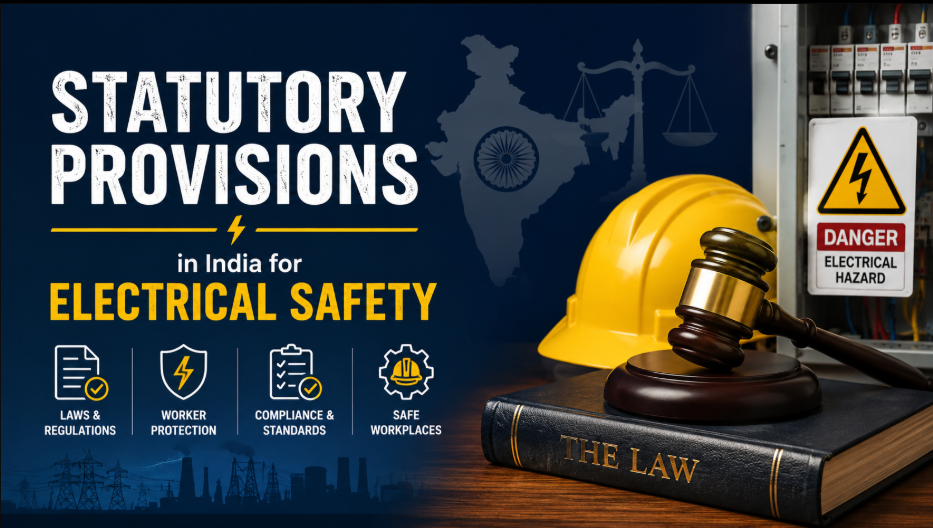
Electricity is indispensable to modern life, but it is also one of the most serious sources of workplace risk.
A factory may depend on electrical motors, transformers, control panels and distribution systems. An office may rely on computers, UPS systems and electrical appliances. A construction project may involve temporary electrical installations, portable equipment and work near overhead lines.
Behind all of these activities is one fundamental EHS question:
Are electrical hazards being controlled in accordance with the law?
In India, electrical safety is not governed by one single rulebook. Instead, it is supported by a framework of legislation, regulations, standards, state-level requirements and technical requirements.
At the centre of this framework is the Electricity Act, 2003, under which the Central Electricity Authority (CEA) has the power to specify measures relating to electrical safety and electric supply. The current principal CEA framework is the Central Electricity Authority (Measures relating to Safety and Electric Supply) Regulations, 2023. The CEA’s official website also lists the 2026 Amendment Regulations, which introduce additional requirements for battery energy storage systems and are scheduled to take effect from 1 April 2027.
For EHS professionals, electrical engineers, safety officers, facility managers and employers, understanding this framework is essential.
Let’s break it down in practical terms.
What Are Statutory Provisions for Electrical Safety?
The term statutory provisions refers to requirements established through legislation, regulations, rules, notifications or other legally enforceable instruments.
In the electrical safety context, these provisions can address matters such as:
- Design and installation of electrical systems
- Inspection and testing
- Earthing
- Electrical protection
- Safe operation and maintenance
- Electrical accident reporting
- Competency and authorization
- Electrical installations
- Overhead lines
- High-voltage installations
- Protection against electrical hazards
The exact compliance requirements depend on the type of installation, voltage level, activity, location and applicable government requirements.
This is important because an office, a manufacturing plant, a power station and a mine may not all have identical compliance obligations.
1. Electricity Act, 2003
The Electricity Act, 2003 is one of the most important pieces of legislation in India’s electricity sector.
The Act provides the broader legal framework for generation, transmission, distribution, trading and use of electricity.
For electrical safety, Section 53 is particularly important.
Section 53 empowers the Central Electricity Authority, in consultation with the State Government, to specify suitable measures for protecting people from dangers arising from the generation, transmission, distribution, trading and use of electricity, as well as from the installation, maintenance and use of electric lines and electrical plants.
The provision also covers reducing risks of:
- Personal injury
- Property damage
- Unsafe electrical systems
- Electrical accidents
- Unsafe electric lines and plants
This section effectively provides the statutory foundation for the CEA’s electrical safety regulations.
2. Section 161: Reporting of Electrical Accidents
Another important provision is Section 161 of the Electricity Act, 2003, which deals with notice of accidents and injuries.
The Act includes a statutory framework for reporting electrical accidents and injuries to the appropriate authorities.
This is important from an EHS perspective because an electrical accident should not simply disappear into an organization’s internal incident register.
Where the law requires statutory reporting, the appropriate authority must be notified in the prescribed manner.
This also helps authorities investigate electrical accidents and identify measures that may prevent recurrence.
The CEA’s Chief Electrical Inspectorate Division specifically identifies the inquiry of fatal and non-fatal electrical accidents and the recommendation of remedial measures as one of its responsibilities.
3. Chief Electrical Inspector and Electrical Inspector
The Electricity Act also provides for the appointment of the Chief Electrical Inspector and Electrical Inspectors.
Section 162 deals with their appointment.
Electrical Inspectors play an important role in statutory electrical safety oversight.
Depending on the applicable requirements and jurisdiction, their functions can include:
- Inspection of electrical installations
- Verification of compliance
- Approval-related activities
- Periodic inspections
- Investigation of electrical accidents
- Examination of safety measures
The CEA’s Chief Electrical Inspectorate Division states that it carries out statutory inspection of relevant electrical installations and accident inquiries, while state electrical inspectorates have corresponding responsibilities within their jurisdictions.
4. CEA Measures Relating to Safety and Electric Supply Regulations, 2023
For anyone working in electrical EHS, this is the regulation that deserves special attention.
The Central Electricity Authority (Measures relating to Safety and Electric Supply) Regulations, 2023 were notified on 8 June 2023. The CEA currently lists them as the principal safety regulations, alongside the 2026 amendment.
These regulations cover a broad range of electrical safety requirements.
They address areas including:
- Electrical installations
- Safety precautions
- Earthing
- Protective devices
- Electrical inspection
- Testing
- Operation and maintenance
- High-voltage installations
- Overhead lines
- Electrical accidents
- Safety requirements for various electrical systems
For an EHS professional, these regulations should be treated as a primary reference when evaluating electrical safety compliance.
5. Periodic Inspection and Testing of Electrical Installations
One of the most important compliance requirements is inspection and testing.
Under Regulation 32 of the 2023 CEA Regulations, periodic inspection and testing of electrical installations above the notified voltage is carried out by the Electrical Inspector.
Installations at or below the notified voltage are subject to self-certification by the owner, supplier or consumer, as applicable.
The regulations provide that the periodicity is directed by the Appropriate Government and cannot exceed five years.
This is a significant point for EHS teams.
Electrical safety is not something that should be checked only when an installation is first commissioned.
It requires continuing verification.
A useful compliance mindset is:
Install → Inspect → Test → Certify → Maintain → Reinspect
6. Approval and Self-Certification Before Energisation
The CEA regulations also address approval and self-certification requirements.
Regulation 45 provides for inspection, testing and self-certification of installations within the applicable notified-voltage framework before commencement of supply or recommencement after a shutdown of six months or more.
The regulations provide mechanisms for submitting self-certification reports to the Electrical Inspector and also provide for inspection by the Electrical Inspector in applicable cases.
The CEA itself describes statutory inspection under Regulations 45 and 32 for applicable installations and approval-related activities.
For organizations, this means commissioning should never be treated as merely a construction milestone.
Electrical safety verification is part of commissioning.
7. Earthing Requirements
If there is one electrical safety topic that repeatedly appears in EHS discussions, it is earthing.
Proper earthing helps provide a path for fault current and supports the operation of protective devices.
The CEA 2023 Regulations contain detailed provisions relating to connection with earth and earthing systems.
For applicable systems, requirements address matters such as:
- Earthing of neutral conductors
- Earthing of equipment
- Protective equipotential bonding
- Earthing of metallic components
- Earth-fault loop impedance
- Testing of earthing systems
- Continuity of earthing
- Earthing of generators and transformers
The regulations also specify requirements concerning testing and maintaining records in applicable circumstances.
For EHS teams, the practical lesson is simple:
“It is earthed” should be a verified engineering condition, not an assumption.
8. Residual Current Protection
Residual current protection is another important electrical safety measure.
The 2023 CEA Regulations contain provisions for the use of residual current devices (RCDs) to disconnect supply under specified residual-current conditions.
For domestic installations, the regulation specifies a residual operating current not exceeding 30 mA, subject to the provisions and exceptions stated in the regulation.
RCDs are particularly important because electrical protection should not depend solely on conventional overcurrent protection.
Different protective devices address different failure modes.
This is why electrical protection needs to be considered as a coordinated system.
9. Protection Against Overcurrent and Earth Faults
Electrical systems need protection against abnormal conditions.
The CEA regulations include provisions requiring appropriate protection for situations such as:
- Overcurrent
- Earth faults
- Earth leakage
- Transformer faults
- Generator faults
- Certain substation faults
The objective is to automatically disconnect supply when an abnormal condition reaches the relevant limits.
For larger electrical systems, the regulations also specify additional protection requirements for certain transformers, generators and high-voltage substations.
From an EHS perspective, protective devices should be correctly selected, installed, tested and maintained.
A protection device that exists on paper but does not operate when required is not an effective safety control.
10. Insulation Testing
Electrical insulation separates energized conductors from people and other conductive parts.
If insulation deteriorates, electrical leakage or faults can occur.
The CEA regulations address insulation testing for applicable electrical supply lines.
For example, where a supply line at a voltage not exceeding 650 V has been disconnected for addition, alteration or repair, it is not to be reconnected until the required insulation test has been carried out by the supplier or owner, as applicable.
This highlights an important principle:
Electrical systems should be tested after relevant work, not simply switched back on because the physical work appears complete.
11. Testing, Operation and Maintenance
Electrical safety does not end after installation.
The CEA regulations contain requirements relating to testing, operation and maintenance.
For higher-voltage apparatus, cables and supply lines, applicable site testing requirements apply before commissioning and after certain periods of disconnection for alteration or repair.
An effective electrical safety program should therefore include:
- Preventive maintenance
- Inspection
- Testing
- Protection-system verification
- Earthing checks
- Thermographic inspections where appropriate
- Defect tracking
- Corrective action
- Documentation
The exact tests and intervals should be determined by applicable regulations, standards, equipment specifications and the organization’s maintenance program.
12. Safety of Overhead Electrical Lines
Overhead lines present significant risks to workers and the public.
The CEA regulations contain provisions relating to:
- Earthing of supports
- Guarding
- Stay wires
- Pole and tower safety
- Protection against unauthorized climbing
- Lightning protection
- Cable arrangements
- Line patrolling
- Fencing of electrical installations
The regulations include specific provisions for overhead lines up to and above certain voltage levels.
This becomes especially important in:
- Construction
- Road projects
- Crane operations
- Excavation
- Infrastructure projects
- Agricultural work
- Maintenance activities
Before work begins near overhead lines, the electrical hazard should be identified and appropriate controls established.
13. Temporary Electrical Installations
Temporary electrical installations deserve particular attention.
Construction sites and temporary workplaces may contain:
- Temporary distribution boards
- Portable tools
- Extension cables
- Temporary lighting
- Generators
- Welding equipment
- Temporary power supplies
Because these systems are frequently moved, modified or exposed to harsh conditions, their condition can deteriorate quickly.
The Electricity Act also specifically addresses control of certain electricity use, including provisions connected with temporary installations, while the applicable CEA safety framework provides the technical safety requirements.
Temporary should never mean less safe.
14. Occupational Safety, Health and Working Conditions Code, 2020
Electrical safety in workplaces also intersects with India’s occupational safety legislation.
The Occupational Safety, Health and Working Conditions Code, 2020 (OSH Code) is now an important part of India’s workplace safety framework. India Code records its enforcement date as 21 November 2025.
Section 6 places duties on employers, including ensuring that workplaces are free from hazards likely to cause injury or occupational disease and providing, as far as reasonably practicable, a working environment that is safe and without risk to employees’ health.
The Code also provides for occupational safety and health standards, safety committees and safety officers in applicable establishments.
For EHS professionals, this means electrical safety should be integrated into the organization’s broader occupational safety management system.
15. State-Level Electrical Safety Requirements
India’s electrical safety framework is not purely central.
State governments and state electrical inspectorates have important roles.
Requirements can vary according to:
- State or Union Territory
- Type of installation
- Voltage
- Industry
- Building
- Electrical Inspectorate procedures
- Local rules and notifications
Therefore, an organization should not assume that reading only the central CEA regulations is enough to establish complete compliance.
The correct approach is to create a legal register covering the central and state requirements applicable to the particular facility.
16. What About BIS Standards?
The Bureau of Indian Standards (BIS) develops Indian Standards covering many aspects of electrical installations, equipment and safety.
The CEA regulations frequently refer to relevant standards.
This means an EHS or electrical compliance review may involve more than reading one regulation.
Depending on the installation, applicable requirements may involve:
- CEA regulations
- BIS standards
- Electricity Act provisions
- State rules
- Building requirements
- Fire-safety requirements
- Manufacturer requirements
- Industry-specific requirements
The important point is to determine which standards are legally applicable or referenced for the specific installation.
17. Electrical Safety and Competency
Electrical work should not be treated like an ordinary maintenance activity.
Organizations need competent personnel for electrical installation, testing, maintenance and specialized work.
Depending on the applicable legal requirements, roles may include:
- Electrical contractors
- Supervisors
- Electrical workers
- Authorized persons
- Electrical engineers
- Electrical Inspectors
Competency requirements can depend on the work, voltage level, state rules and applicable regulatory framework.
A strong EHS system therefore asks:
Who is authorized to perform this electrical task?
rather than simply:
Who is available to do it?
18. The 2026 CEA Amendment: What Is Changing?
There is an important recent development that EHS professionals should watch.
The CEA’s Measures relating to Safety and Electric Supply Amendment Regulations, 2026 were notified in March 2026. The CEA lists the amendment on its official regulations page.
The amendment introduces additional safety requirements for Battery Energy Storage Systems (BESS).
It adds definitions for systems such as:
- Battery Energy Storage Systems
- Battery Management Systems
- Power Conversion Systems
It also introduces a dedicated chapter addressing additional BESS safety requirements, including areas such as battery containers, equipment location, ventilation, hazard detection and suppression.
Important date
These 2026 amendment provisions are scheduled to come into force on:
1 April 2027.
Therefore, organizations with relevant battery energy storage projects should not wait until 2027 to begin reviewing their compliance strategy.
Electrical Safety Compliance Checklist for EHS Professionals
A practical electrical safety audit can begin with the following questions:
Legal compliance
- Is the applicable electrical legislation identified?
- Are current CEA requirements included in the legal register?
- Are state-specific requirements identified?
- Are required Electrical Inspector approvals available?
Installation
- Are electrical installations properly designed?
- Are panels appropriately protected?
- Is suitable earthing provided?
- Is electrical protection correctly installed?
Inspection and testing
- Are statutory inspections completed?
- Are periodic inspections current?
- Are test certificates available?
- Are defects tracked to closure?
Maintenance
- Are electrical systems maintained according to the required schedule?
- Are damaged cables removed from service?
- Are protective devices tested?
- Are earthing systems inspected?
Workforce
- Are electrical workers competent and authorized?
- Are electrical safety procedures documented?
- Is energy isolation implemented where applicable?
- Are workers trained for the hazards they may encounter?
Emergency preparedness
- Are electrical emergency procedures established?
- Are electrical accidents reported as legally required?
- Are emergency contacts available?
- Are appropriate fire-protection arrangements provided?
Common Electrical Safety Compliance Mistakes
Even organizations with good safety programs can make avoidable mistakes.
Mistake 1: Treating the legal register as a paperwork exercise
A legal register is useful only when its requirements are translated into actual controls.
Mistake 2: Ignoring state requirements
Central regulations do not necessarily represent the entire compliance picture.
Mistake 3: Checking installations only during commissioning
Electrical systems deteriorate. Periodic inspection and testing are therefore essential.
Mistake 4: Assuming earthing exists because a wire is visible
Earthing needs appropriate design, continuity and testing.
Mistake 5: Treating temporary installations casually
Temporary electrical systems can present serious hazards.
Mistake 6: Failing to document testing
If a test is required, appropriate records are an important part of demonstrating compliance.
Mistake 7: Waiting for an accident before correcting defects
Electrical safety should be proactive.
Why Electrical Safety Laws Matter
Statutory electrical safety requirements serve a larger purpose than compliance certificates and inspection reports.
They establish minimum safety expectations for systems that can otherwise cause severe injury, fire, equipment damage and loss of life.
For employers and EHS professionals, legal compliance should therefore be viewed as the baseline, not the finish line.
A mature electrical safety program goes further by combining:
Legal requirements + engineering controls + competent people + preventive maintenance + safe work procedures + continuous improvement
That is where compliance becomes safety culture.
Key Takeaways
The most important statutory provisions and compliance themes to remember are:
- The Electricity Act, 2003 provides the principal legislative foundation for electrical safety.
- Section 53 empowers the CEA to specify safety measures for electricity generation, transmission, distribution, use and electrical installations.
- Section 161 addresses statutory notice of electrical accidents and injuries.
- Section 162 provides for the Chief Electrical Inspector and Electrical Inspectors.
- The CEA Safety Regulations 2023 are the principal current central safety regulations.
- The regulations address inspection, testing, earthing, protection, maintenance and other electrical safety requirements.
- Periodic inspection requirements apply according to the applicable voltage, installation and government directions, with the stated maximum periodicity not exceeding five years under Regulation 32.
- Workplace electrical safety also falls within the broader occupational safety framework under the OSH Code, 2020, which India Code records as enforced from 21 November 2025.
- State-specific requirements must also be considered.
- The 2026 CEA amendment introduces additional BESS safety provisions, scheduled to take effect on 1 April 2027.
Frequently Asked Questions
What is the main law governing electrical safety in India?
The Electricity Act, 2003 is a central legislative foundation for electrical safety. Section 53 provides the basis for the CEA to specify suitable safety measures. The detailed central safety framework is contained in the CEA Measures relating to Safety and Electric Supply Regulations, 2023.
What are the CEA Safety Regulations?
The Central Electricity Authority (Measures relating to Safety and Electric Supply) Regulations, 2023 establish detailed safety requirements for electrical installations and electricity supply systems.
Is electrical inspection mandatory in India?
Applicable electrical installations are subject to inspection, testing or self-certification requirements depending on factors such as voltage, installation type and the applicable government directions. Regulation 32 addresses periodic inspection and testing.
What is the role of the Electrical Inspector?
The Electrical Inspector has statutory responsibilities relating to inspection and safety compliance for applicable electrical installations. The CEA’s inspectorate also conducts accident inquiries and recommends remedial measures.
What does Section 53 of the Electricity Act cover?
Section 53 provides for safety measures intended to protect people and property from dangers associated with electricity generation, transmission, distribution, trading, use, electric lines and electrical plants.
How often should electrical installations be inspected?
The applicable periodicity is determined by the Appropriate Government under the CEA framework, and Regulation 32 states that the periodicity of inspection or self-certification shall not exceed five years, subject to the specific provisions of the regulations.
What is the latest CEA electrical safety amendment?
The Central Electricity Authority notified the Measures relating to Safety and Electric Supply Amendment Regulations, 2026. It introduces additional safety provisions for Battery Energy Storage Systems and is scheduled to come into force on 1 April 2027.
Conclusion
Electrical safety in India is supported by a layered statutory framework rather than a single piece of legislation.
At the foundation is the Electricity Act, 2003. Section 53 provides the statutory basis for electrical safety measures, while provisions such as Sections 161 and 162 establish important requirements and institutional responsibilities relating to electrical accidents and Electrical Inspectors.
The detailed technical safety framework is provided by the CEA (Measures relating to Safety and Electric Supply) Regulations, 2023, covering subjects such as inspection, testing, earthing, protective devices, electrical installations, operation and maintenance.
For workplaces, electrical safety must also be integrated into the broader occupational safety framework under the OSH Code, 2020, together with applicable state requirements and relevant technical standards.
And the regulatory landscape continues to evolve. The 2026 CEA amendment introduces dedicated safety requirements for Battery Energy Storage Systems, with those provisions scheduled to take effect from April 2027.
For an EHS professional, the best approach is therefore not to ask only:
“Are we following the electrical safety law?”
The better question is:
“Have we identified every applicable legal requirement, converted it into practical controls, verified those controls and maintained evidence of compliance?”
That is the difference between simply having an electrical safety document and having a functioning electrical safety management system.
Important: This article is intended as an EHS educational overview, not legal advice. Electrical safety requirements can depend on the installation, voltage, industry, state/UT and applicable notifications or standards. Organizations should verify the current requirements with the appropriate Electrical Inspectorate and competent legal/technical professionals before relying on this article for compliance decisions.
🔁 Readers also enjoyed these blog posts:
- Safety Management’s Role: The Unsung Hero Behind Every Successful Organization
- Safety Management and Its Responsibilities: Protecting People, Preventing Hazards, and Promoting a Culture of Care
- Benchmarking for Safety Performance: A Key to Continuous Improvement
“Start Your Website Journey Today – Exclusive Hostinger Discounts!”