 by
by Introduction
Electricity is one of those things we rarely think about until something goes wrong.
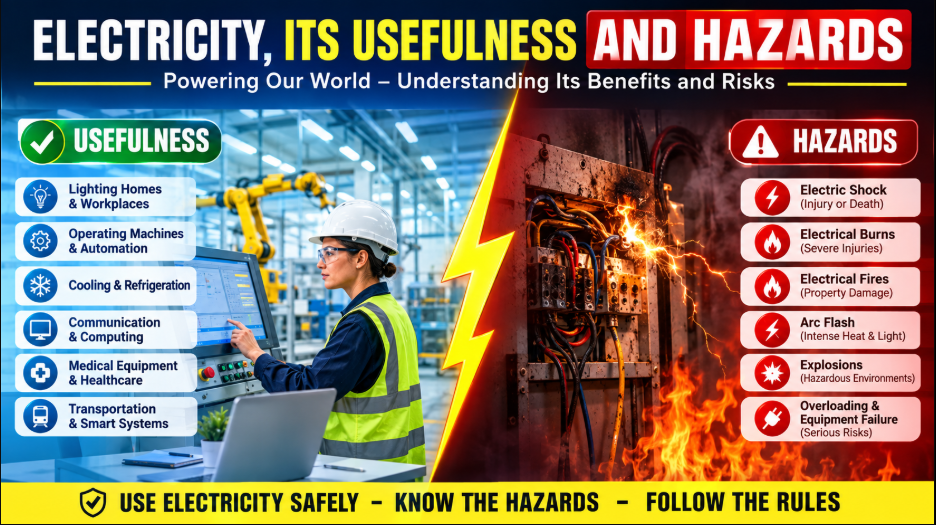
We switch on a light, charge a phone, start a machine, use a computer or operate industrial equipment, and electricity quietly does its job in the background. Modern homes, offices, hospitals, factories, transportation systems and communication networks all depend heavily on electrical energy.
It has transformed the way we live and work.
But electricity has another side.
The same energy that powers a machine can cause electric shock, burns, fires, explosions and fatal injuries when it is uncontrolled or improperly handled.
This leads to an important EHS question:
Is electricity useful or dangerous?
The answer is: both.
Electricity itself is not something that should simply be feared. Instead, it should be understood, controlled and used safely.
In this article, we will explore the usefulness of electricity, common electrical hazards, how accidents happen, and the essential safety practices that help protect workers and the public.
What Is Electricity?
Electricity is a form of energy associated with the presence and movement of electric charge.
In everyday life, electricity may be supplied through electrical grids, batteries, generators, solar systems and other sources.
It can be used to produce:
- Light
- Heat
- Motion
- Sound
- Cooling
- Communication
- Computing
- Automation
A simple electrical system typically involves a source of electrical energy, conductors and electrical equipment that uses the energy.
For example, when a lamp is connected to an electrical supply and switched on, electrical energy is converted into light and heat.
This conversion of electrical energy into useful forms is what makes electricity so valuable.
Why Is Electricity So Useful?
It is difficult to imagine modern life without electricity.
From a small household fan to a massive manufacturing plant, electricity supports countless activities.
Let’s look at some of its major uses.
1. Lighting
One of the most obvious uses of electricity is lighting.
Electric lights allow people to work, study, travel and perform activities safely after dark.
In workplaces, adequate lighting is also important for safety because poor visibility can contribute to mistakes, trips, falls and other incidents.
2. Operating Machines
Industries depend heavily on electricity.
Electrical motors can operate:
- Pumps
- Compressors
- Conveyors
- Machine tools
- Fans
- Cranes
- Production equipment
- Material-handling systems
In modern manufacturing facilities, electricity is one of the fundamental sources of energy that keeps production moving.
Without it, many automated processes would simply stop.
3. Heating
Electricity can be converted into heat.
Examples include:
- Electric heaters
- Ovens
- Industrial furnaces
- Water heaters
- Soldering equipment
Industrial processes may require precisely controlled temperatures, and electrical heating systems can provide that control.
4. Cooling and Refrigeration
Electricity is equally important for removing heat.
Refrigerators, air conditioners, chillers and industrial cooling systems all rely on electrical energy.
This is particularly important in:
- Hospitals
- Food storage
- Laboratories
- Manufacturing
- Data centers
- Commercial buildings
5. Communication
Modern communication would look completely different without electricity.
Electricity powers the infrastructure behind:
- Computers
- Telephones
- Mobile networks
- Internet equipment
- Television
- Radio
- Data centers
A huge portion of the digital world ultimately depends on electrical power.
6. Medical Applications
Healthcare facilities use electricity to operate critical equipment.
Examples include:
- Medical monitors
- Diagnostic equipment
- Laboratory instruments
- Ventilators
- Refrigeration systems
- Surgical equipment
- Hospital lighting
Reliable electrical systems can therefore be extremely important in healthcare environments.
7. Transportation
Electricity is also increasingly important in transportation.
It powers systems such as:
- Electric trains
- Metro systems
- Electric vehicles
- Railway signaling
- Traffic signals
- Charging infrastructure
Even transportation systems that do not directly use electric motors often depend on electricity for communication, control and safety systems.
What Are Electrical Hazards?
An electrical hazard is a dangerous condition associated with electricity that can result in injury, illness, property damage or fire.
Electrical hazards can occur in homes, offices, construction sites and industrial workplaces.
Some hazards are immediately obvious, while others may be hidden.
For example, a damaged electrical cable may look like a minor maintenance issue. However, if the damaged insulation exposes an energized conductor, touching it could create a serious shock hazard.
Major Electrical Hazards
1. Electric Shock
Electric shock occurs when a person’s body becomes part of an electrical path.
The severity of an electric shock depends on several factors, including:
- Amount of current
- Duration of contact
- Path through the body
- Electrical resistance
- Voltage
- Environmental conditions
Electric shock can cause anything from a painful sensation to severe injury or death.
Wet conditions can make electrical hazards particularly dangerous because moisture can reduce electrical resistance and increase the possibility of current passing through the body.
2. Electrical Burns
Electrical energy can produce intense heat.
Contact with energized equipment or an electrical fault can result in burns.
Burn injuries may occur directly through electrical contact or indirectly through heat generated by an electrical event.
This is why workers must never assume that a small electrical component represents a small hazard.
3. Electrical Fires
Electrical faults can cause fires.
Possible causes include:
- Overloaded circuits
- Damaged wiring
- Loose connections
- Faulty equipment
- Short circuits
- Improperly maintained electrical systems
- Overheating
Electrical fires can spread quickly, especially when combustible materials are nearby.
Preventing electrical faults is therefore an important part of fire prevention.
4. Arc Flash and Arc Blast
An electrical arc can occur when electricity travels through an unintended path across a gap.
An arc flash can release extremely high levels of heat and energy.
Workers exposed to an arc-flash event may face serious risks, including burns, flying particles, intense light and pressure effects.
Arc-flash hazards are particularly important in certain electrical installations and high-energy systems.
Electrical work should therefore be performed only by appropriately qualified and authorized personnel following applicable safety procedures.
5. Electrical Explosion Hazards
Electrical equipment can become an ignition source in environments containing flammable gases, vapors or combustible dust.
For example, certain industrial processes may involve:
- Flammable solvents
- Fuel vapors
- Combustible dust
- Flammable gases
Using unsuitable electrical equipment in such environments can create an ignition risk.
This is why hazardous areas may require specially selected electrical equipment and controls.
6. Overloading
An electrical circuit has limits.
Connecting too many devices or equipment loads to a circuit can cause excessive current and overheating.
Overloading may result in:
Excessive current → Heating → Insulation damage → Electrical fault → Possible fire
Proper circuit design, protection devices and load management are therefore essential.
7. Damaged Cords and Cables
Damaged electrical cables are a common workplace hazard.
Damage can result from:
- Crushing
- Cutting
- Abrasion
- Heat
- Chemicals
- Improper storage
- Repeated bending
A damaged cable should not simply be wrapped with tape and returned to service unless that repair is specifically appropriate and carried out according to applicable requirements.
Electrical equipment should be inspected and defective items removed from service until properly repaired or replaced.
8. Contact With Overhead Power Lines
Overhead power lines create serious hazards, particularly for construction and maintenance activities.
Workers may accidentally bring:
- Cranes
- Ladders
- Scaffolds
- Long materials
- Vehicles
- Other equipment
too close to energized lines.
Importantly, direct physical contact is not always necessary for an electrical event to occur.
Work near electrical lines therefore requires proper planning, identification of the lines, maintaining required clearances and following applicable electrical safety procedures.
9. Faulty Grounding and Earthing
Grounding or earthing provides an important path for fault current and helps electrical protection systems operate as intended.
A faulty or missing grounding arrangement can increase the risk associated with equipment faults.
Metal equipment that becomes energized because of an internal fault can become especially dangerous if appropriate protective measures are absent.
Electrical installations should therefore be designed, inspected and maintained by competent professionals.
10. Wet Conditions
Water and electricity are a particularly dangerous combination.
Wet hands, wet floors and damp environments can increase electrical risk.
This is why electrical equipment must be appropriate for the environment in which it is used.
Workers should never operate electrical equipment with wet hands unless the equipment and procedure are specifically designed for such conditions.
How Do Electrical Accidents Happen?
Electrical accidents rarely happen because electricity suddenly decides to cause trouble.
Usually, there is a chain of contributing factors.
Some common causes include:
- Poor maintenance
- Damaged equipment
- Lack of training
- Improper electrical installation
- Failure to isolate energy
- Unauthorized electrical work
- Incorrect use of equipment
- Overloaded circuits
- Wet conditions
- Poor housekeeping
- Bypassed safety devices
- Inadequate inspection
- Failure to follow procedures
From an EHS perspective, identifying these underlying causes is important because simply telling workers to “be careful” is not an adequate safety system.
Electrical Safety in the Workplace
Electrical safety begins with recognizing that electricity is a form of hazardous energy.
A strong electrical safety program should include several elements.
1. Risk Assessment
Before electrical work or work near electrical hazards begins, the hazards should be identified and assessed.
The assessment should consider:
- Electrical sources
- Equipment condition
- Work environment
- Potential exposure
- Required controls
- Competency of workers
- Emergency arrangements
2. Proper Training
Workers should receive training appropriate to their responsibilities.
Employees who use electrical equipment may need basic electrical safety awareness.
Workers who perform electrical tasks require appropriate technical training, authorization and competency.
Electrical work should never be assigned to someone simply because they are available.
3. Inspection and Maintenance
Electrical equipment should be inspected and maintained according to the manufacturer’s requirements, applicable standards and workplace procedures.
Look for signs such as:
- Frayed cables
- Broken plugs
- Damaged insulation
- Loose connections
- Burn marks
- Unusual smells
- Overheating
- Repeated circuit trips
A small warning sign can be an early indication of a larger electrical problem.
4. Lockout/Tagout and Energy Isolation
When electrical equipment requires maintenance or repair, simply switching off a control button may not be enough.
Appropriate energy isolation and lockout/tagout procedures may be necessary to prevent unexpected energization.
The basic principle is straightforward:
Identify → Isolate → Lock → Tag → Verify → Perform the work
The exact procedure should follow the organization’s safety program and applicable legal requirements.
5. Use Appropriate PPE
Personal protective equipment may be required for certain electrical tasks.
Depending on the hazard assessment and work activity, electrical workers may require specialized PPE such as:
- Insulating gloves
- Protective clothing
- Eye and face protection
- Safety footwear
- Arc-rated clothing
- Other task-specific protection
PPE should be considered an important layer of protection, but it should not replace engineering controls and safe work practices.
6. Good Housekeeping
Housekeeping also plays a role in electrical safety.
Electrical panels and equipment should remain accessible.
Cables should be routed and protected appropriately.
Materials should not be stacked against electrical equipment in a way that blocks access or creates additional hazards.
A tidy electrical area is not merely aesthetically pleasing. It can make hazards easier to identify and emergencies easier to manage.
7. Never Ignore Warning Signs
If electrical equipment:
- Sparks
- Smokes
- Produces unusual sounds
- Gives a tingling sensation
- Trips protective devices repeatedly
- Becomes unusually hot
- Shows visible damage
it should not be ignored.
The equipment should be taken out of service where appropriate and assessed by a qualified person.
“It’s been doing that for months” is not an electrical safety argument.
Electricity: Useful Servant, Serious Hazard
Electricity has changed civilization.
It powers homes, factories, hospitals, transportation systems, communication networks and countless technologies.
Without electricity, modern society would look radically different.
But its usefulness should never lead to complacency.
Electrical energy can cause severe harm when it is uncontrolled, poorly maintained or improperly handled.
The key EHS principle is therefore not:
“Avoid electricity.”
It is:
“Control electrical hazards.”
That means identifying hazards, using suitable equipment, maintaining installations, training workers, isolating energy when required and following safe work procedures.
Key Takeaways
Here are the most important points to remember:
- Electricity is an essential source of energy in modern life.
- It can produce useful effects such as light, heat, cooling and mechanical motion.
- Electrical hazards can cause shocks, burns, fires and other serious injuries.
- Overloaded circuits and damaged wiring can create fire hazards.
- Wet conditions can increase electrical risk.
- Overhead power lines require careful planning and safe clearances.
- Electrical equipment should be inspected and maintained.
- Electrical work should be performed only by appropriately trained and authorized personnel.
- Energy isolation and lockout/tagout are important controls during applicable maintenance activities.
- PPE may provide an additional layer of protection when required.
- Good housekeeping and hazard reporting contribute to electrical safety.
- Effective EHS management focuses on controlling the hazard rather than relying only on worker caution.
Frequently Asked Questions
What are the main hazards of electricity?
The major electrical hazards include electric shock, burns, electrical fires, arc-flash events, explosions in hazardous environments, and injuries associated with contact with energized equipment or power lines.
Why is electricity dangerous?
Electricity can pass through the human body and can also produce intense heat, arcs and fires. The severity of an electrical incident depends on the circumstances and exposure.
What causes electrical fires?
Electrical fires can result from conditions such as overloaded circuits, damaged wiring, loose connections, faulty equipment and overheating.
How can electrical hazards be prevented?
Electrical hazards can be controlled through proper design, engineering controls, inspection, maintenance, training, safe work procedures, energy isolation and appropriate PPE.
Can water increase electrical risk?
Yes. Wet conditions can increase the risk associated with electrical equipment because moisture can affect the body’s electrical resistance and the behavior of electrical systems.
Who should perform electrical work?
Electrical work should be performed by appropriately qualified, trained and authorized persons, in accordance with applicable laws, standards and workplace procedures.
Why is grounding or earthing important?
Grounding or earthing can provide a path for fault current and help protective devices operate as intended. Proper electrical system design and installation are essential.
Conclusion
Electricity is one of the most useful forms of energy in the modern world. It illuminates our buildings, drives industrial machinery, powers medical equipment, enables communication and supports almost every part of modern infrastructure.
Yet electricity demands respect.
A damaged cable, overloaded circuit, exposed conductor or poorly controlled electrical task can turn an ordinary work activity into a serious safety event.
For EHS professionals and workers alike, the goal is not to eliminate the use of electricity. The goal is to identify electrical hazards, assess the risks and apply effective controls.
When electrical systems are properly designed, installed, protected, inspected and maintained, electricity can deliver enormous benefits while keeping risks under control.
Electricity is powerful. Safe systems make that power useful rather than dangerous.
Final EHS Message
Respect electricity, identify its hazards, control the energy and never compromise on electrical safety.
🔁 Readers also enjoyed these blog posts:
- Safety Management’s Role: The Unsung Hero Behind Every Successful Organization
- Safety Management and Its Responsibilities: Protecting People, Preventing Hazards, and Promoting a Culture of Care
- Benchmarking for Safety Performance: A Key to Continuous Improvement
“Start Your Website Journey Today – Exclusive Hostinger Discounts!”

Turn Any Idea into Viral,
Jaw-Dropping AI Videos in Seconds!