 by
by Does Human Body (Core) Temperature Equal the Environmental Temperature? The Truth Behind This Common Myth
Spend enough time outdoors on a scorching summer afternoon or a freezing winter morning, and you’ve probably heard someone say:
“Your body temperature becomes the same as the surrounding temperature.”
It sounds logical. After all, if you’re standing in a hot factory or a cold mountain, wouldn’t your body simply adjust to the environment?
The answer is no.
This statement is false when referring to a healthy human being.
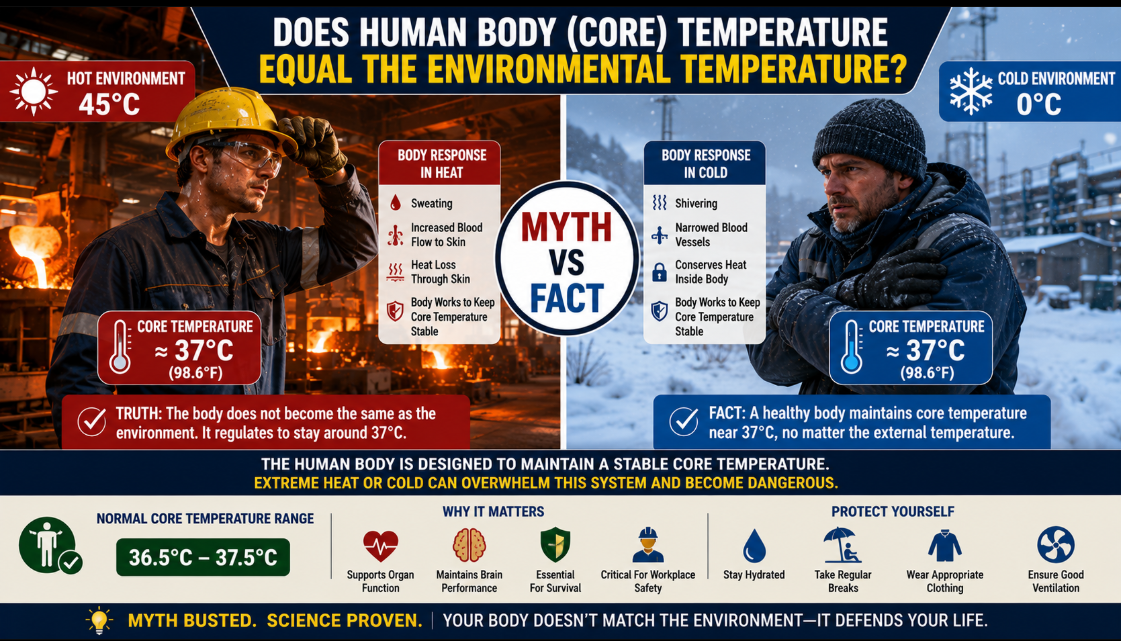
The human body is one of nature’s most sophisticated temperature-control systems. Regardless of whether you’re working in a steel plant at 45°C, hiking in snowy conditions below freezing, or relaxing in a room at 22°C, your body constantly works to keep its core temperature remarkably stable.
This process is called thermoregulation, and without it, human life would not be possible.
Understanding how the body maintains its internal temperature is especially important for industrial workers, safety professionals, athletes, outdoor workers, and anyone exposed to extreme weather conditions.
In this comprehensive guide, we’ll explain the science behind body temperature, why the myth persists, what really happens during heat exposure and cold exposure, and how this knowledge helps prevent heat stress and other temperature-related illnesses.
The Short Answer
Is the statement true?
No.
A healthy person’s core body temperature does not normally become equal to the environmental temperature.
Instead, the body actively regulates its internal temperature to remain within a narrow and safe range.
Only in severe or life-threatening situations, where the body’s thermoregulation fails, can the core temperature move dangerously away from normal.
What Is Core Body Temperature?
Core body temperature is the temperature of the body’s internal organs, including the:
- Brain
- Heart
- Liver
- Kidneys
- Lungs
These organs must function within a narrow temperature range for the body to survive.
For most healthy adults:
- Average core temperature: about 37°C (98.6°F)
- Normal range: approximately 36.5°C to 37.5°C
Small variations occur throughout the day, but they are minimal compared with changes in outdoor temperatures.
Core Temperature vs Skin Temperature
This is where many people become confused.
Your skin temperature changes frequently.
For example:
- Cold weather makes your skin feel cold.
- Hot weather makes your skin feel warm.
- Standing near a furnace raises skin temperature.
- Air conditioning cools your skin.
However, your core temperature remains nearly constant because your body works continuously to protect vital organs.
Think of your skin as the body’s “front line,” while your core is the protected command center.
How Does the Body Control Its Temperature?
The body uses an automatic control system similar to a thermostat.
At the center of this system is the hypothalamus, a small part of the brain that monitors blood temperature and coordinates responses.
When your body becomes too hot or too cold, the hypothalamus activates different mechanisms to restore balance.
What Happens When the Environment Is Hot?
Imagine stepping into a steel factory where the air temperature is 42°C.
Your body does not immediately become 42°C.
Instead, it responds by trying to lose heat.
Sweating
Sweat glands release moisture onto the skin.
As sweat evaporates, it removes heat from the body.
Increased Blood Flow
Blood vessels near the skin widen (vasodilation), allowing more heat to escape.
Faster Breathing
Breathing rate may increase slightly, contributing to heat loss.
Reduced Heat Production
The body naturally lowers unnecessary heat generation where possible.
These responses help maintain a stable core temperature despite the hot environment.
What Happens When the Environment Is Cold?
Now imagine standing outside on a winter morning when the temperature is 5°C.
Your body still tries to maintain approximately 37°C internally.
It does this by conserving heat.
Shivering
Muscles contract rapidly to generate additional heat.
Vasoconstriction
Blood vessels narrow, reducing heat loss through the skin.
Goosebumps
Although less effective in humans than in furry animals, goosebumps are part of the body’s cold response.
Increased Metabolism
The body burns more energy to produce heat.
Again, these mechanisms help keep the core temperature stable.
Why Doesn’t the Body Match Environmental Temperature?
If our core temperature simply matched the surrounding air:
- Enzymes would stop functioning properly.
- The heart would fail to pump efficiently.
- Brain activity would deteriorate.
- Muscles would lose function.
- Vital organs would shut down.
Life depends on maintaining a relatively constant internal environment, a concept known as homeostasis.
What Is Homeostasis?
Homeostasis is the body’s ability to maintain stable internal conditions despite external changes.
It regulates:
- Temperature
- Blood pressure
- Blood sugar
- Fluid balance
- Oxygen levels
- pH balance
Thermoregulation is one of the most important aspects of homeostasis.
When Can Core Temperature Change?
Although the body regulates temperature effectively, certain situations can overwhelm these defenses.
Heat Stroke
When heat gain exceeds heat loss, core temperature may rise above 40°C (104°F).
This is a medical emergency.
Symptoms include:
- Confusion
- Loss of consciousness
- Hot skin
- Rapid heartbeat
- Seizures
Immediate cooling and emergency medical care are essential.
Hypothermia
In extreme cold, the body may lose heat faster than it can produce it.
Core temperature falls below 35°C (95°F).
Symptoms include:
- Uncontrollable shivering
- Slurred speech
- Drowsiness
- Confusion
- Slow heartbeat
Without treatment, hypothermia can become life-threatening.
Environmental Temperature vs Body Temperature
The difference becomes clear when we compare them.
| Feature | Core Body Temperature | Environmental Temperature |
|---|---|---|
| Controlled by | Human body | Nature |
| Normal Value | Around 37°C | Varies widely |
| Stability | Relatively constant | Continuously changing |
| Importance | Essential for survival | External condition |
| Changes Rapidly? | Usually no | Yes |
| Regulation | Thermoregulation | Weather and climate |
Common Myths About Body Temperature
Myth 1: Body Temperature Always Equals Outdoor Temperature
False.
Healthy humans actively regulate core temperature.
Myth 2: Sweating Means Your Body Is Overheating
Not necessarily.
Sweating is a normal cooling mechanism.
Myth 3: Feeling Cold Means Your Core Temperature Is Low
Not always.
Your skin may be cold while your core remains normal.
Myth 4: Air Conditioning Makes Your Body Temperature Too Low
Generally false.
Air conditioning primarily cools the surrounding environment and skin, while the body maintains a stable core temperature.
Why This Matters in Workplace Safety
Understanding thermoregulation is essential in industries where workers are exposed to high temperatures, including:
- Steel plants
- Foundries
- Glass manufacturing
- Cement production
- Construction
- Mining
- Commercial kitchens
- Agriculture
- Oil and gas
Even though the body regulates temperature, prolonged exposure to extreme heat can eventually overwhelm these natural defenses.
Preventing Heat Stress at Work
Employers and workers should take preventive measures, including:
- Drinking water frequently.
- Taking scheduled rest breaks.
- Wearing appropriate clothing.
- Using cooling fans or ventilation.
- Providing shaded or cooled rest areas.
- Monitoring workers for signs of heat illness.
- Acclimatizing new employees gradually.
These practices help the body maintain a safe core temperature.
How Is Core Temperature Measured?
Medical professionals can measure core temperature using:
- Oral thermometers (approximation)
- Tympanic (ear) thermometers
- Rectal thermometers (most accurate in many emergency settings)
- Esophageal probes (clinical use)
- Ingestible temperature sensors (specialized applications)
Skin temperature alone is not a reliable indicator of core body temperature.
Frequently Asked Questions (FAQs)
Does body temperature increase in hot weather?
Core body temperature usually remains close to normal because the body activates cooling mechanisms such as sweating and increased blood flow. However, if these mechanisms are overwhelmed, the core temperature can rise, leading to heat-related illnesses.
Can body temperature become the same as environmental temperature?
Not under normal healthy conditions. The body continuously regulates its core temperature to keep it within a narrow, safe range.
Why do I feel hot if my core temperature stays the same?
Your skin temperature and the heat receptors in your skin respond to the surrounding environment, making you feel hot even though your internal organs remain close to their normal temperature.
What happens if core temperature rises too much?
If the core temperature exceeds about 40°C (104°F), heat stroke can occur. This is a medical emergency requiring immediate treatment.
Why is thermoregulation important?
Thermoregulation keeps enzymes, organs, muscles, and the brain functioning correctly. Without it, normal body processes would fail.
Real-World Example
Imagine two workers in a steel rolling mill where the air temperature reaches 45°C.
One worker drinks water regularly, takes breaks in a cooled rest area, and works near effective ventilation. Their body continues to regulate its core temperature successfully.
The second worker skips hydration and remains in the hot environment for long periods without rest. Over time, sweating becomes less effective, the body’s cooling mechanisms begin to fail, and the core temperature rises. This can lead to heat exhaustion or even heat stroke.
This example shows that while the environment places stress on the body, the core temperature does not automatically become the same as the surrounding temperature. It is the body’s ability to regulate heat, along with proper workplace controls, that determines whether a person remains safe.
Final Thoughts
The belief that the human body’s core temperature becomes equal to the environmental temperature is a common misconception. In reality, healthy humans are warm-blooded (homeothermic) organisms that maintain a relatively constant core temperature of around 37°C, regardless of whether the surrounding environment is hot or cold.
This remarkable stability is made possible by the body’s thermoregulation system, which continuously balances heat production and heat loss through mechanisms such as sweating, shivering, changes in blood flow, and adjustments in metabolism. These processes protect vital organs and allow us to function across a wide range of climates.
However, thermoregulation has its limits. During prolonged exposure to extreme heat or cold, especially without adequate hydration, rest, ventilation, or protective measures, the body’s defenses can become overwhelmed. This is when dangerous conditions such as heat exhaustion, heat stroke, or hypothermia may develop.
For workplaces, understanding this principle is more than an interesting scientific fact. It is the foundation of effective heat stress management, industrial ventilation design, and occupational safety programs. By supporting the body’s natural ability to regulate temperature through engineering controls, administrative measures, and worker education, employers can reduce the risk of heat-related illnesses and create safer, healthier, and more productive work environments.
Bottom line: The environment influences your body, but under normal conditions, it does not determine your core temperature. Your body is constantly working to keep that temperature remarkably stable, and that ability is one of the keys to human survival.
🔁 Readers also enjoyed these blog posts:
- Safety Management’s Role: The Unsung Hero Behind Every Successful Organization
- Safety Management and Its Responsibilities: Protecting People, Preventing Hazards, and Promoting a Culture of Care
- Benchmarking for Safety Performance: A Key to Continuous Improvement
“Start Your Website Journey Today – Exclusive Hostinger Discounts!”

Turn Any Idea into Viral,
Jaw-Dropping AI Videos in Seconds!