 by
by Classification of Ventilation Systems: A Complete Guide to Cleaner, Smarter Airflow
When you walk into a building and feel fresh, breathable air, you rarely stop to think about what’s making that possible. Behind the scenes, ventilation systems are doing the heavy lifting—quietly maintaining comfort, health, and efficiency. But not all ventilation systems are created equal. In fact, they come in several types, each designed to suit different environments and needs.
Understanding the classification of ventilation systems is essential whether you’re designing a building, upgrading your home, or simply curious about how air moves around you. Let’s break it all down in a way that’s easy to grasp—and surprisingly fascinating.
Why Ventilation Systems Matter More Than Ever
Before diving into classifications, it’s worth understanding why ventilation is such a big deal.
Good ventilation:
- Maintains indoor air quality
- Removes pollutants, moisture, and odors
- Regulates temperature and humidity
- Improves comfort and productivity
In today’s world—where people spend a significant amount of time indoors—proper ventilation isn’t just a luxury. It’s a necessity.
Main Classification of Ventilation Systems
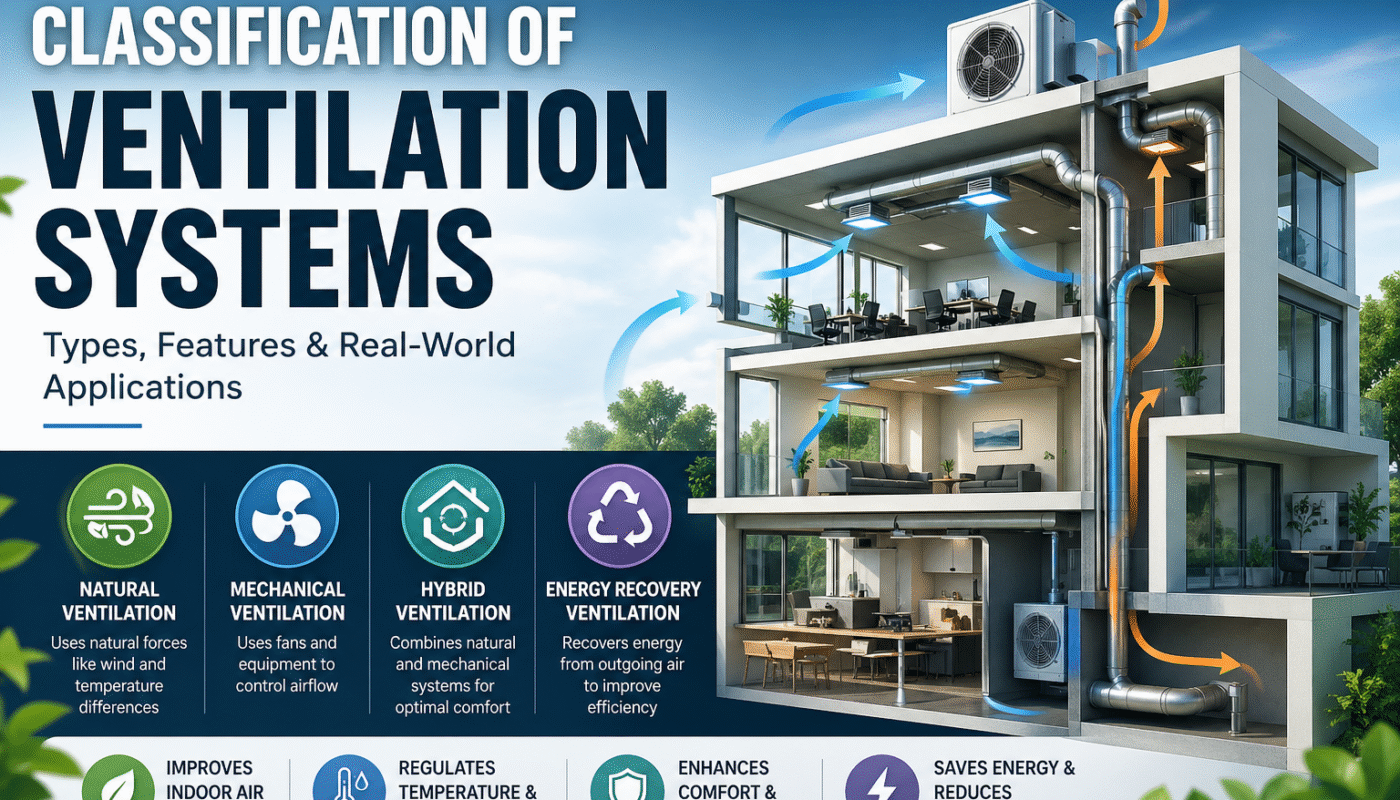
Ventilation systems are broadly classified into three primary categories:
- Natural Ventilation
- Mechanical Ventilation
- Hybrid (Mixed-Mode) Ventilation
Each type operates differently and is suited to specific conditions. Let’s explore them one by one.
1. Natural Ventilation
Natural ventilation is the simplest and most traditional form of ventilation. It relies on natural forces like wind and temperature differences to move air through a building.
How It Works
Air enters and exits through openings such as:
- Windows
- Doors
- Vents
- Louvers
There are two main mechanisms behind natural ventilation:
a. Wind-Driven Ventilation
Air moves due to pressure differences created by wind.
b. Stack Effect Ventilation
Warm air rises and escapes from higher openings, pulling cooler air inside from lower openings.
Advantages
- Energy-efficient (no electricity required)
- Low installation and maintenance cost
- Environmentally friendly
Limitations
- Limited control over airflow
- Dependent on weather conditions
- Not suitable for highly polluted or noisy environments
Where It Works Best
- Residential homes
- Low-rise buildings
- Rural or low-density urban areas
2. Mechanical Ventilation
Mechanical ventilation uses fans, ducts, and equipment to control airflow. Unlike natural ventilation, it offers precision and consistency.
This category is further divided into several subtypes.
2.1 Exhaust Ventilation System
This system works by removing indoor air, creating negative pressure that pulls fresh air inside through openings.
Key Features
- Simple design
- Uses exhaust fans
- Common in kitchens and bathrooms
Advantages
- Cost-effective
- Easy to install
Drawbacks
- May draw in unfiltered air
- Not ideal in extreme climates
2.2 Supply Ventilation System
Supply systems push fresh air into a building using fans, creating positive pressure.
Key Features
- Controlled air intake
- Often includes filters
Advantages
- Better control over incoming air
- Reduces entry of pollutants
Drawbacks
- Moisture issues in humid climates
- Requires proper design
2.3 Balanced Ventilation System
Balanced systems use separate fans for both intake and exhaust, maintaining equal airflow.
Key Features
- Equal supply and exhaust
- Stable indoor pressure
Advantages
- Consistent airflow
- Better air quality control
Drawbacks
- Higher installation cost
- Requires maintenance
2.4 Energy Recovery Ventilation (ERV) & Heat Recovery Ventilation (HRV)
These advanced systems recover energy from outgoing air to condition incoming air.
How They Work
- Heat exchangers transfer energy between air streams
- Reduce energy loss
Advantages
- Energy-efficient
- Improves comfort
- Reduces HVAC load
Drawbacks
- Higher initial cost
- Requires professional installation
3. Hybrid (Mixed-Mode) Ventilation
Hybrid ventilation combines natural and mechanical systems to get the best of both worlds.
How It Works
- Uses natural ventilation when conditions are favorable
- Switches to mechanical systems when needed
Advantages
- Energy savings
- Flexibility
- Improved comfort
Limitations
- Complex design
- Requires smart controls
Ideal Applications
- Modern commercial buildings
- Smart homes
- Sustainable architecture projects
Additional Classification Based on Application
Ventilation systems can also be categorized based on where and how they are used.
1. Residential Ventilation Systems
Designed for homes and apartments.
Features
- Focus on comfort and air quality
- Often include exhaust fans and window ventilation
2. Commercial Ventilation Systems
Used in offices, malls, and public buildings.
Features
- Larger scale systems
- Integrated with HVAC
3. Industrial Ventilation Systems
Designed for factories and manufacturing units.
Types
- Dilution ventilation
- Local exhaust ventilation
Purpose
- Remove harmful gases, dust, and fumes
4. Spot Ventilation Systems
Targets specific areas like:
- Kitchens
- Bathrooms
- Laboratories
Classification Based on Airflow Pattern
Ventilation can also be classified based on how air moves within a space.
1. Cross Ventilation
Air flows from one side of a building to another.
Benefits
- Efficient airflow
- Natural cooling
2. Single-Sided Ventilation
Air enters and exits from the same side.
Limitations
- Less effective than cross ventilation
3. Displacement Ventilation
Fresh air is introduced at a low level and rises as it warms.
Benefits
- Improved air quality
- Energy efficiency
4. Mixing Ventilation
Air is mixed uniformly throughout the space.
Common In
- Air-conditioned buildings
Factors Influencing the Choice of Ventilation System
Choosing the right system isn’t a one-size-fits-all decision. Several factors come into play:
1. Climate
- Hot and humid areas may need mechanical systems
- Mild climates can rely more on natural ventilation
2. Building Design
- Orientation
- Size
- Layout
3. Occupancy
- Number of people
- Usage patterns
4. Air Quality Requirements
- Industrial vs residential needs
5. Energy Efficiency Goals
- Sustainability targets
- Cost considerations
Emerging Trends in Ventilation Systems
Ventilation technology is evolving rapidly. Here are some trends shaping the future:
Smart Ventilation Systems
- Automated controls
- Sensors for air quality
- Integration with smart home systems
Demand-Controlled Ventilation (DCV)
- Adjusts airflow based on occupancy
- Saves energy
Green Building Integration
- Focus on sustainability
- Use of renewable energy
Common Mistakes to Avoid
Even the best ventilation system can fail if poorly implemented. Watch out for these mistakes:
- Ignoring proper sizing
- Poor duct design
- Lack of maintenance
- Over-reliance on natural ventilation in polluted areas
Final Thoughts
The classification of ventilation systems goes far beyond just “natural” or “mechanical.” Each category has its own strengths, limitations, and ideal use cases. The key lies in understanding your specific needs and choosing a system that balances comfort, efficiency, and sustainability.
Whether you’re planning a home, managing a commercial building, or designing an industrial facility, the right ventilation system can make all the difference—not just in air quality, but in overall well-being.
And once you start paying attention, you’ll realize: good air isn’t accidental—it’s engineered.
Ready to upgrade your indoor air quality? Start by identifying which ventilation system suits your space best—and take that first step toward cleaner, healthier living.
🔁 Readers also enjoyed these blog posts:
- Safety Management’s Role: The Unsung Hero Behind Every Successful Organization
- Safety Management and Its Responsibilities: Protecting People, Preventing Hazards, and Promoting a Culture of Care
- Benchmarking for Safety Performance: A Key to Continuous Improvement
“Start Your Website Journey Today – Exclusive Hostinger Discounts!”

Turn Any Idea into Viral,
Jaw-Dropping AI Videos in Seconds!