 by
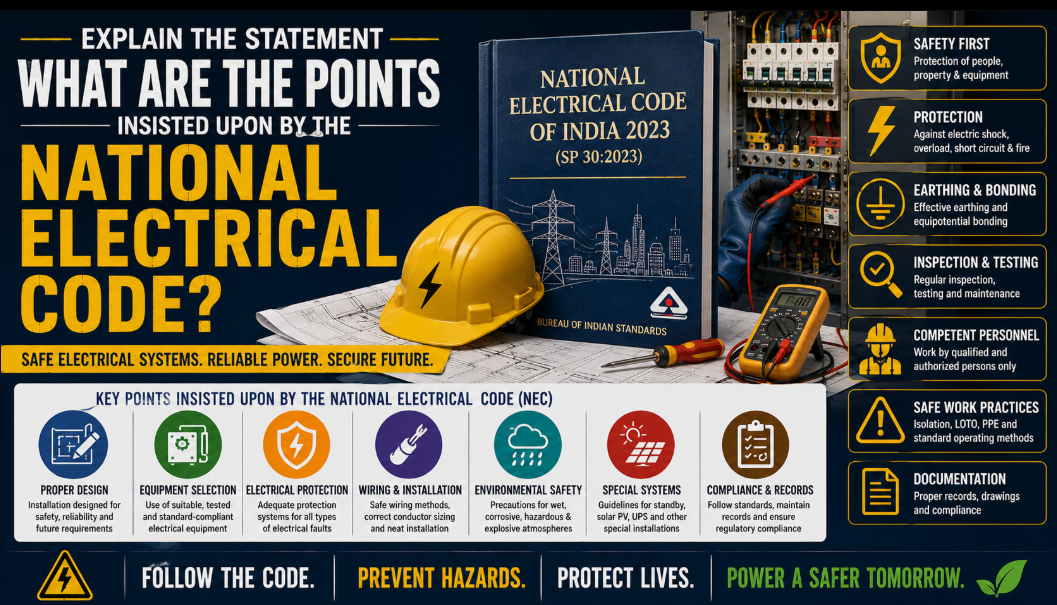
What Are the Points Insisted Upon by the National Electrical Code?
Understanding the National Electrical Code of India 2023 and Its Key Safety Requirements
Electricity is one of the most useful forms of energy in modern society. It powers our homes, factories, offices, hospitals, transportation systems and almost every modern technology we use.
But electricity also has another side.
A poorly designed electrical installation can result in electric shock, burns, electrical fires, equipment damage, arc-flash incidents and even loss of life.
This is why electrical installations cannot be designed simply by connecting wires and equipment together. They need to follow recognized engineering principles, safety practices and applicable regulations.
One of the important references for electrical installations in India is the National Electrical Code of India, commonly known as NEC India or SP 30.
The current edition is National Electrical Code of India 2023 (SP 30:2023). The Bureau of Indian Standards (BIS) describes it as a comprehensive document covering good practices for selecting electrical equipment, electrical installations in buildings, wiring safety, general electrical-work practices and additional precautions for special environments such as explosive atmospheres and solar photovoltaic systems.
So, when we ask:
“What are the points insisted upon by the National Electrical Code?”
we are essentially asking:
What fundamental principles should be followed to make an electrical installation safe, reliable, suitable and maintainable?
Let’s understand them in simple language.
What Is the National Electrical Code of India?
The National Electrical Code of India is a BIS publication that brings together recommended good practices for electrical installations.
It is intended to help various stakeholders involved in:
- Planning
- Design
- Selection of equipment
- Installation
- Testing
- Commissioning
- Operation
- Maintenance
- Electrical safety
The Code is particularly useful for electrical engineers, consultants, contractors, developers, architects, government departments, electrical inspectors, industry professionals and other stakeholders involved in electrical installations.
BIS describes NEC 2023 as a comprehensive electrical-installation code covering equipment selection, wiring safety, general safety practices and additional precautions for special environmental conditions.
Is the National Electrical Code the Same as the Electricity Act?
No.
This is an important distinction.
The Electricity Act, 2003 is legislation.
The Central Electricity Authority (CEA) safety regulations establish detailed regulatory requirements under the authority of the Act.
The National Electrical Code of India is a BIS code that provides technical guidance and good practices for electrical installations.
BIS itself explains that NEC 2023 has a correlating role with the Electricity Act and CEA regulations.
Therefore, electrical compliance should not be evaluated by looking at the NEC alone. The applicable CEA regulations, statutory requirements, Indian Standards, local requirements and other applicable regulations must also be considered.
The Main Objective of the National Electrical Code
The central idea behind the NEC can be summarized in one sentence:
Design, install, operate and maintain electrical systems in a manner that protects people, property and equipment while providing reliable electrical service.
The Code therefore emphasizes several interconnected principles:
- Safety
- Proper design
- Correct equipment selection
- Protection against electric shock
- Protection against fire
- Overcurrent and fault protection
- Protection against voltage disturbances
- Proper earthing
- Lightning protection
- Inspection and testing
- Safe electrical work
- Suitable installations for special environments
- Reliable and energy-efficient operation
Let’s look at these points in detail.
1. Safety Must Be the First Priority
One of the strongest principles of electrical installation design is that safety should be given the highest priority.
A good electrical installation should not merely work.
It should work safely.
This means designers and engineers should consider potential hazards before the installation is constructed.
For example:
- What happens if insulation fails?
- What happens if a conductor becomes overloaded?
- What happens during a short circuit?
- What happens if water enters equipment?
- What happens if someone touches an exposed conductive part?
- What happens during a lightning event?
- What happens if the supply voltage becomes abnormal?
Good electrical design anticipates these situations rather than waiting for an accident to expose them.
2. Proper Electrical Installation Design
The Code emphasizes that electrical design is the foundation of a safe and trouble-free installation.
The design should consider:
- Nature of the building
- Intended use
- Electrical load
- Supply characteristics
- Distribution arrangement
- Equipment ratings
- Environmental conditions
- Future expansion
- Protection requirements
- Maintenance requirements
The load should be properly assessed before selecting the electrical supply and distribution equipment.
A system that is too small may become overloaded.
A system that is unnecessarily oversized may increase cost and reduce efficiency.
Good design aims for the appropriate balance between safety, reliability, functionality and economy.
3. Proper Assessment of Electrical Load
Electrical load assessment is a fundamental part of electrical design.
Before installing electrical equipment, designers should determine what loads the installation will have.
These may include:
- Lighting
- Fans
- Air conditioners
- Motors
- Pumps
- Heating equipment
- Computers
- Machinery
- Elevators
- HVAC systems
- Emergency systems
- Special process equipment
The expected demand helps determine the appropriate:
- Cable sizes
- Switchgear
- Transformers
- Distribution boards
- Protective devices
- Generator capacity
Incorrect load assessment can eventually result in overloading and overheating.
4. Correct Selection of Electrical Equipment
Electrical equipment should never be selected simply because it is inexpensive or readily available.
It must be suitable for the intended application.
Important factors include:
- Voltage rating
- Current rating
- Frequency
- Short-circuit withstand capability
- Environmental conditions
- Temperature
- Moisture
- Dust
- Mechanical stresses
- Hazardous atmosphere
- Operating duty
BIS specifically identifies the selection of electrical equipment as one of the major areas covered by NEC 2023.
5. Protection Against Electric Shock
Electric shock is one of the most serious electrical hazards.
NEC 2023 addresses protection against electric shock through its safety provisions.
The basic objective is to prevent people from coming into dangerous contact with energized parts and to reduce the consequences of faults.
Protection can involve:
- Insulation
- Barriers
- Enclosures
- Protective earthing
- Automatic disconnection
- Residual-current protection
- Equipotential bonding
- Appropriate clearances
- Additional protection where required
The Code’s protection framework distinguishes between basic protection, fault protection and additional protection. BIS training material identifies protection against electric shock as one of the major NEC 2023 safety subjects.
6. Protection Against Thermal Effects and Electrical Fire
Electrical installations can become sources of fire when faults, overheating or arcing occur.
The National Electrical Code therefore gives significant attention to protection against:
- Excessive heat
- Overcurrent
- Insulation failure
- Electrical arcs
- Hot surfaces
- Fault conditions
- Fire propagation
BIS-related material identifies Part 1, Section 11 of NEC 2023 as dealing with protection against thermal effects and fire due to arcing.
This is particularly important because electrical fires may start inside equipment and remain unnoticed until considerable damage has occurred.
7. Prevention of Overloading
Every electrical conductor and piece of equipment has a designed capacity.
When current exceeds that capacity for an unacceptable period, excessive heat can develop.
Therefore, electrical installations require appropriate protection against overcurrent.
The NEC’s protection framework includes protection against:
- Overload
- Short circuit
- Fault current
Appropriate protective devices must be selected and coordinated with the electrical system.
The objective is to interrupt dangerous conditions before conductors or equipment are damaged.
8. Protection Against Short Circuits and Fault Currents
A short circuit can produce extremely high currents.
The resulting energy can cause:
- Severe heating
- Arc formation
- Equipment damage
- Fire
- Explosive effects
- Dangerous pressure and thermal effects
Therefore, electrical systems must be designed with suitable fault protection.
This includes considering:
- Prospective fault current
- Breaking capacity
- Protective-device characteristics
- Selectivity
- Coordination
- Cable withstand capability
A protective device should be capable of safely interrupting the fault current it may encounter.
9. Proper Earthing
Few topics are as important in electrical safety as earthing.
Earthing helps control fault conditions and provides an appropriate path for fault current.
A properly designed earthing system can help:
- Reduce dangerous touch voltages
- Enable protective devices to operate correctly
- Protect equipment
- Improve electrical safety
- Provide reference potential where required
NEC 2023 includes earthing as an important subject within its electrical-installation guidance, alongside related Indian Standards such as IS 3043:2018, Code of Practice for Earthing. BIS materials identify IS 3043 as a key associated standard.
10. Bonding and Equipotential Protection
Earthing alone is not the complete answer.
Different conductive parts may develop different electrical potentials during a fault.
Bonding helps bring appropriate exposed conductive parts to substantially the same potential and supports the overall protection system.
This is especially important in installations containing:
- Metal structures
- Pipes
- Cable trays
- Equipment enclosures
- Structural steel
- Electrical panels
The exact bonding arrangement depends on the electrical system and applicable standards.
11. Protection Against Voltage Disturbances
Electrical equipment can be affected by abnormal voltage conditions.
These may include:
- Overvoltage
- Undervoltage
- Voltage fluctuations
- Switching surges
- Transient disturbances
Sensitive electronic equipment can be particularly vulnerable.
The NEC therefore addresses protection against voltage disturbances and electromagnetic influences as part of its electrical safety framework. BIS training material identifies this as one of the NEC’s key protection subjects.
12. Lightning Protection
Lightning can cause enormous electrical and thermal energy to enter or affect a building or electrical installation.
Possible consequences include:
- Fire
- Equipment damage
- Electrical surges
- Structural damage
- Electric shock
- Failure of critical systems
Proper lightning protection can help control the effects of lightning and safely conduct lightning current toward earth.
NEC-related electrical-installation provisions consider lightning protection along with associated Indian and international standards. BIS materials reference the relevant lightning-protection standards within the electrical-installation framework.
13. Surge Protection
Lightning is not the only source of transient overvoltage.
Switching operations and other electrical events can also create surges.
Surge protection devices may be used where appropriate to protect electrical and electronic equipment.
This is particularly important for:
- Computers
- Control systems
- Communication equipment
- PLCs
- Instrumentation
- Security systems
- Building-management systems
A modern electrical installation therefore needs to consider both electrical power and sensitive electronic equipment.
14. Electrical Wiring Must Be Properly Designed
Electrical wiring is the backbone of an installation.
Improper wiring can result in:
- Overheating
- Voltage drop
- Short circuits
- Electric shock
- Fire
- Equipment malfunction
The NEC refers to relevant wiring standards, including IS 732:2019, Code of Practice for Electrical Wiring Installations. BIS documentation identifies IS 732 as an important associated code for electrical wiring.
Wiring design should consider:
- Conductor size
- Insulation
- Installation method
- Current-carrying capacity
- Voltage drop
- Environmental conditions
- Mechanical protection
- Circuit protection
15. Adequate Protection and Isolation
Electrical equipment should be arranged so that it can be safely:
- Operated
- Isolated
- Maintained
- Inspected
- Tested
Isolation is particularly important during maintenance.
A worker should not have to improvise a method of disconnecting dangerous electrical energy.
Isolation points should be clearly identifiable and accessible to authorized personnel.
16. Safe Access and Working Space
Electrical panels and equipment require appropriate working space.
Access should not be obstructed by:
- Boxes
- Raw materials
- Furniture
- Tools
- Waste
- Stored equipment
This is a simple point, but it can become critical during an emergency.
Imagine a worker trying to isolate a faulty electrical panel while boxes are stacked directly in front of it.
Good electrical safety includes good housekeeping.
17. Inspection and Testing
An electrical installation is not permanently safe simply because it was installed correctly.
Conditions change.
Components age.
Connections loosen.
Insulation deteriorates.
Equipment gets modified.
Therefore, inspection and testing are essential.
The Code addresses erection and pre-commissioning testing as part of its electrical-installation guidance. BIS training material also identifies testing and commissioning-related stages as important areas of the NEC.
Testing may involve appropriate methods for:
- Continuity
- Insulation resistance
- Earthing
- Protective devices
- Polarity
- Functional operation
- Other applicable electrical characteristics
The exact tests depend on the installation.
18. Preventive Maintenance
Electrical safety does not end after commissioning.
A proper maintenance program should identify deterioration before it becomes an incident.
Maintenance activities may include:
- Visual inspections
- Cleaning
- Tightening connections
- Thermal inspections where appropriate
- Testing
- Replacement of deteriorated components
- Verification of protection
- Earthing checks
Maintenance should be performed by competent personnel using appropriate procedures.
19. Safety in Electrical Work
One of the most important areas from an EHS perspective is safe electrical work.
NEC 2023 includes a dedicated section dealing with safety in electrical work.
BIS training material identifies Section 16 – Safety in Electrical Work among the Code’s important areas.
Safe electrical work involves more than wearing gloves.
It requires a systematic approach.
Before starting work, personnel should consider:
- What equipment is involved?
- What energy sources exist?
- Is the equipment energized?
- Can it be de-energized?
- What isolation is required?
- Is there stored energy?
- Who is authorized to perform the work?
- What PPE is required?
- What emergency arrangements are available?
20. Permit-to-Work and Safe Work Procedures
For higher-risk electrical activities, organizations may use a Permit-to-Work (PTW) system.
A permit system helps ensure that:
- The work scope is understood.
- Hazards are identified.
- Isolation requirements are established.
- Responsibilities are assigned.
- Necessary precautions are confirmed.
- Authorization is documented.
However, a permit is not itself a safety control.
It is part of a broader safe-work system.
21. Isolation and Lockout/Tagout
Before electrical maintenance, appropriate isolation should be established according to the work procedure.
A typical energy-control sequence may include:
Identify → Shut Down → Isolate → Lock/Tag → Verify → Work
Verification is particularly important.
A switch being in the OFF position is not, by itself, proof that hazardous electrical energy is absent.
The responsible person must follow the approved procedure for establishing and verifying the safe state.
22. Competent and Authorized Personnel
Electrical work should not be treated as an ordinary maintenance task.
People performing electrical work require appropriate knowledge, skills, authorization and, where applicable, licenses or permits.
Competence includes understanding:
- Electrical hazards
- Electrical systems
- Protection
- Isolation
- Testing
- Emergency procedures
- Applicable standards
- Safe work practices
The safest electrical installation can become dangerous if operated or modified by unqualified personnel.
23. Special Environmental Conditions
Not every electrical installation operates in a normal environment.
Some locations may contain:
- Flammable gases
- Flammable vapors
- Combustible dust
- Corrosive chemicals
- High humidity
- Extreme temperatures
- Water
- Explosive atmospheres
NEC 2023 specifically addresses additional precautions for special environmental conditions, including explosive and active atmospheres.
Equipment suitable for an ordinary office may therefore be completely unsuitable for a hazardous process area.
24. Hazardous Areas Require Special Attention
Where flammable gases, vapors or combustible dust may be present, electrical equipment can potentially become an ignition source.
Therefore, the installation must consider:
- Area classification
- Equipment selection
- Enclosure requirements
- Temperature classification
- Installation methods
- Cable entries
- Inspection
- Maintenance
The electrical system must be designed around the hazards of the location.
25. Solar Photovoltaic Systems
Modern electrical installations increasingly include renewable-energy systems.
NEC 2023 also includes additional precautions relating to solar photovoltaic power systems. BIS specifically identifies solar PV systems among the special areas covered by the Code.
PV systems introduce their own considerations, including:
- DC electrical hazards
- Isolation
- String protection
- Inverters
- Earthing
- Surge protection
- Cable routing
- Fire safety
- Maintenance
The presence of renewable energy does not eliminate electrical hazards; it changes their nature.
26. Standby and Emergency Power Systems
Many facilities require electricity even when the normal supply fails.
Examples include:
- Hospitals
- Data centers
- Industrial plants
- Commercial buildings
- Emergency facilities
Standby systems may include:
- Diesel generators
- UPS systems
- Battery systems
- Automatic transfer systems
These systems require proper design, installation, protection, testing and maintenance.
NEC guidance includes provisions concerning electrical installations of standby generating sets and related systems.
27. Lighting and Illumination
Electrical safety also involves adequate lighting.
Poor illumination can increase the likelihood of:
- Trips
- Falls
- Incorrect operation
- Maintenance errors
- Poor visibility around electrical equipment
Lighting design should therefore provide appropriate illumination for the activity and location.
The NEC works alongside the National Lighting Code and other applicable standards for lighting-related requirements.
28. Power Quality
Modern facilities contain large quantities of electronic equipment.
Poor power quality can affect:
- Motors
- Drives
- Computers
- PLCs
- Instrumentation
- Communication systems
Electrical design therefore needs to consider issues such as:
- Voltage variation
- Harmonics
- Unbalance
- Transients
- Power factor
- Electromagnetic interference
Power-quality considerations help improve both reliability and equipment life.
29. Energy Efficiency
Safety and energy efficiency are not necessarily separate objectives.
A well-designed electrical installation can reduce:
- Energy losses
- Excessive heating
- Equipment stress
- Unnecessary consumption
Energy-efficient equipment and appropriate system design can improve both operating efficiency and overall performance.
The important point is that energy efficiency should never compromise safety.
30. Good Housekeeping Around Electrical Installations
Housekeeping may sound like a general EHS topic, but it has an important electrical-safety role.
Electrical areas should be kept free from:
- Combustible waste
- Water accumulation
- Oil
- Dust
- Unnecessary materials
- Obstructions
CPWD’s electrical-work specifications, for example, reference NEC 2023 for protection against electrical fire and identify sound design, quality materials, good housekeeping, skilled maintenance and periodic inspection as important fire-prevention measures.
A clean electrical room is not simply more attractive.
It is safer.
31. Fire Prevention Must Begin With Electrical Design
Electrical fire prevention should not depend entirely on extinguishers.
The first objective should be to prevent the fire.
This means controlling:
- Overloading
- Short circuits
- Poor connections
- Insulation failures
- Excessive heating
- Arcing
- Improper equipment selection
Fire protection systems then provide additional layers of protection.
32. Documentation and Drawings
Electrical installations should have appropriate documentation.
This may include:
- Single-line diagrams
- Panel schedules
- Cable schedules
- Equipment information
- Protection settings
- Earthing arrangements
- Test reports
- Maintenance records
Good documentation makes maintenance and emergency response safer.
Imagine an emergency where nobody knows which circuit supplies a particular machine.
Accurate drawings can make a major difference.
33. Identification and Warning Signs
Electrical hazards should be clearly identified.
Appropriate identification may include:
- Voltage labels
- Equipment names
- Circuit identification
- Danger signs
- Restricted-access signs
- Emergency information
Clear identification reduces the possibility of operating or isolating the wrong equipment.
34. Emergency Preparedness
Electrical incidents can happen despite preventive measures.
Organizations should therefore prepare for:
- Electric shock
- Electrical fire
- Arc-flash events
- Power failure
- Equipment failure
- Electrical explosion
- Contact with overhead lines
Emergency arrangements should include appropriate response procedures, communication, first-aid arrangements and emergency isolation processes.
Workers should know what to do before an emergency occurs.
35. The NEC Encourages a Life-Cycle Approach
One of the most useful ways to understand the National Electrical Code is to view electrical safety across the entire life cycle:
PLAN
Understand the building, process, load and hazards.
DESIGN
Develop a safe electrical system.
SELECT
Choose appropriate equipment.
INSTALL
Install the system according to applicable standards.
TEST
Verify the installation before use.
COMMISSION
Place it into service safely.
OPERATE
Operate within design limits.
MAINTAIN
Prevent deterioration.
INSPECT
Identify unsafe conditions.
MODIFY
Control changes properly.
DECOMMISSION
Safely isolate and remove equipment when its service life ends.
This is much better than viewing electrical safety as simply a wiring issue.
A Simple Way to Remember the NEC’s Main Points
For EHS training, the major principles can be remembered using the following sequence:
DESIGN → PROTECT → EARTH → TEST → WORK SAFELY → MAINTAIN
DESIGN
Design the electrical system correctly.
PROTECT
Protect people and equipment against shock, overload, short circuit, fire and abnormal electrical conditions.
EARTH
Provide appropriate earthing and bonding.
TEST
Inspect and test the installation before and during its operational life.
WORK SAFELY
Use competent personnel, isolation, safe procedures and appropriate PPE.
MAINTAIN
Keep the installation safe throughout its life.
Practical NEC-Based Electrical Safety Checklist
Design
- Electrical load has been properly assessed.
- Equipment ratings are appropriate.
- Wiring has been correctly designed.
- Protection has been coordinated.
- Future requirements have been considered.
Protection
- Electric-shock protection is provided.
- Overcurrent protection is appropriate.
- Short-circuit protection is provided.
- Fire hazards are addressed.
- Surge/voltage protection is considered where required.
Earthing
- Earthing system is properly designed.
- Bonding is provided where required.
- Earthing is periodically inspected/tested.
Installation
- Wiring is properly installed.
- Equipment is suitable for the environment.
- Panels are accessible.
- Cables are protected from damage.
- Electrical rooms are maintained properly.
Maintenance
- Preventive maintenance is scheduled.
- Electrical equipment is inspected.
- Defects are corrected promptly.
- Test records are maintained.
Electrical Work
- Only competent/authorized personnel perform electrical work.
- Isolation procedures are followed.
- LOTO is applied where required.
- Energized work is controlled according to applicable procedures.
- Appropriate PPE is used.
Frequently Asked Questions
What is the National Electrical Code of India?
The National Electrical Code of India is a BIS publication providing comprehensive guidance and good practices for electrical installations, including equipment selection, wiring, electrical safety, testing, special environments and related installation practices. The current edition is NEC 2023 (SP 30:2023).
What is SP 30?
SP 30 is the BIS Special Publication number associated with the National Electrical Code of India.
Is NEC 2023 a replacement for the Electricity Act?
No. The NEC is not a replacement for the Electricity Act. The Act and applicable CEA regulations establish the statutory/regulatory framework, while NEC provides technical guidance and good practices.
What is the most important objective of the NEC?
The fundamental objective is to promote safe, reliable and properly designed electrical installations while protecting people, property and equipment from electrical hazards.
Does the NEC cover electric shock?
Yes. NEC 2023 contains provisions dealing specifically with protection against electric shock. BIS identifies protection against electric shock as one of the principal safety subjects covered by the Code.
Does the NEC cover electrical fire prevention?
Yes. NEC 2023 addresses protection against thermal effects and fire caused by electrical equipment and arcing.
Does the NEC cover hazardous areas?
Yes. The Code includes additional precautions for special environmental conditions, including explosive and active atmospheres.
Does the NEC cover solar power systems?
Yes. BIS identifies solar photovoltaic power systems among the special areas covered by NEC 2023.
Conclusion
The statement “What are the points insisted upon by the National Electrical Code?” can be answered in a very practical way.
The National Electrical Code insists on a systematic approach to electrical safety.
It emphasizes:
- Safe electrical design
- Correct load assessment
- Proper equipment selection
- Safe wiring
- Protection against electric shock
- Protection against overload and short circuits
- Protection against electrical fires
- Proper earthing and bonding
- Protection against voltage disturbances
- Lightning and surge protection
- Inspection and testing
- Safe electrical work
- Competent and authorized personnel
- Isolation and safe maintenance
- Special precautions for hazardous environments
- Safe operation of standby and renewable-energy systems
- Good housekeeping
- Proper documentation
- Preventive maintenance
- Emergency preparedness
The most important lesson is that electrical safety cannot be achieved through a single device or a single procedure.
It requires layers of protection.
A properly designed installation provides the first layer.
Correct equipment provides another.
Earthing and protective devices provide additional protection.
Inspection and testing identify problems.
Maintenance prevents deterioration.
Safe work procedures protect workers during maintenance.
Training and competence ensure people know how to work safely.
And effective EHS management keeps the entire system working together.
The National Electrical Code therefore should not be viewed merely as a collection of technical requirements.
It represents a safety mindset:
Design safely. Install correctly. Protect adequately. Test thoroughly. Work responsibly. Maintain continuously.
When these principles become part of everyday electrical work, the goal is not merely compliance with a code—it is the creation of electrical installations where people can work, operate and maintain equipment with a much lower risk of injury or loss.
Important Legal and Technical Note
This article is intended for general EHS awareness and educational purposes. NEC 2023 is a technical code and should be read together with the applicable Indian Standards, manufacturer’s instructions, statutory requirements and current regulatory requirements.
BIS describes NEC 2023 as a comprehensive code for electrical-installation practices, while electrical safety requirements under the applicable Central Electricity Authority regulations and other statutory requirements must also be complied with. BIS materials specifically note the relationship between the NEC and the CEA regulatory framework.
For an actual electrical installation, compliance should be determined by appropriately qualified electrical professionals with reference to the latest applicable edition of each relevant standard, current CEA regulations, state requirements and instructions of the competent authority.
🔁 Readers also enjoyed these blog posts:
- Safety Management’s Role: The Unsung Hero Behind Every Successful Organization
- Safety Management and Its Responsibilities: Protecting People, Preventing Hazards, and Promoting a Culture of Care
- Benchmarking for Safety Performance: A Key to Continuous Improvement
“Start Your Website Journey Today – Exclusive Hostinger Discounts!”