 by
by Difference Between Segregation and Enclosure in Ventilation and Heat Control
Walk through a steel manufacturing plant or a busy production facility, and you’ll quickly notice that not every worker is exposed to the same level of heat. Some employees operate machinery from climate-controlled control rooms, while others work near furnaces that are surrounded by protective walls or enclosed structures.
This isn’t a coincidence. It’s the result of carefully planned engineering controls designed to reduce worker exposure to heat and airborne contaminants.
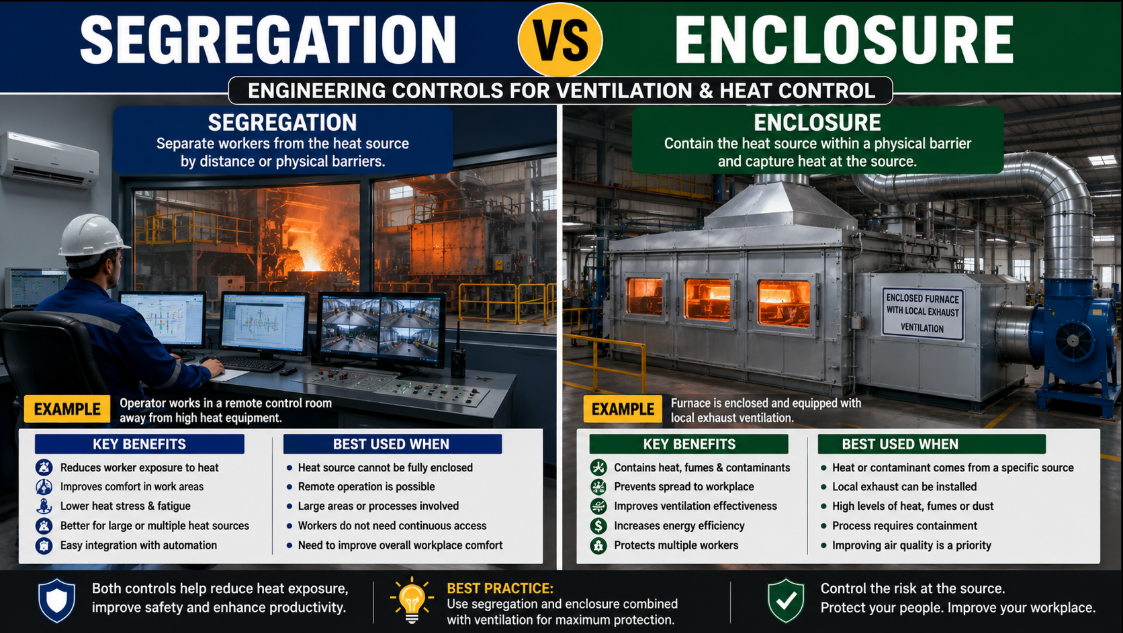
Two of the most effective engineering controls are Segregation and Enclosure. Although these terms are sometimes used interchangeably, they are fundamentally different. Segregation protects people by increasing the distance between workers and hazards, while enclosure contains the hazard itself within a physical barrier.
Understanding the distinction is essential for safety officers, engineers, facility managers, and employers who want to improve ventilation, reduce heat exposure, and create safer workplaces.
In this comprehensive guide, we’ll explain the difference between segregation and enclosure, how each control method works, where they are used, and why both are important in modern industrial ventilation and heat control strategies.
Why Heat Control and Ventilation Matter
Many industrial processes generate significant amounts of heat.
Examples include:
- Steel manufacturing
- Glass production
- Cement plants
- Power stations
- Foundries
- Commercial kitchens
- Chemical processing
- Welding operations
- Boiler rooms
Without proper heat control, workers may experience:
- Heat stress
- Heat exhaustion
- Heat cramps
- Dehydration
- Fatigue
- Reduced concentration
- Increased accident risk
- Heat stroke
Ventilation and engineering controls reduce these risks before they affect employees.
Engineering Controls in the Hierarchy of Controls
The Hierarchy of Controls ranks hazard control methods from most effective to least effective.
- Elimination
- Substitution
- Engineering Controls
- Administrative Controls
- Personal Protective Equipment (PPE)
Both Segregation and Enclosure are engineering controls because they reduce worker exposure without relying on individual behavior.
What Is Segregation?
Segregation is the practice of separating workers from heat-generating equipment or hazardous processes by creating physical distance or dedicated work areas.
Instead of changing the equipment itself, segregation reduces exposure by relocating people away from the hazard.
The hazard remains active, but workers spend less time near it.
Think of segregation as creating a “safe zone” between employees and the heat source.
How Segregation Works
Segregation controls exposure by:
- Increasing the distance between workers and heat sources
- Relocating control stations
- Installing remote operating rooms
- Separating production areas
- Restricting access to hazardous zones
The greater the distance from the heat source, the lower the heat exposure experienced by workers.
Examples of Segregation
Segregation is commonly used in:
- Steel plants
- Power plants
- Boiler rooms
- Glass factories
- Cement plants
- Chemical processing units
- Foundries
- High-temperature manufacturing facilities
Examples include:
- Remote control rooms
- Separate operator cabins
- Restricted hot work zones
- Safety barriers
- Isolated machinery rooms
Advantages of Segregation
Reduces Worker Heat Exposure
Workers remain farther away from high-temperature equipment.
Improves Worker Comfort
Control rooms often include air conditioning and ventilation.
Reduces Noise Exposure
Segregation frequently lowers noise levels as well.
Improves Productivity
Comfortable employees remain focused and productive.
Supports Automation
Many segregated workstations use remote monitoring systems.
Limitations of Segregation
Segregation also has limitations.
- Hazard still exists
- Requires sufficient building space
- Initial construction costs
- May reduce direct process visibility
- Communication between work areas may require additional systems
What Is Enclosure?
Enclosure means surrounding or containing a heat source or contaminant inside a physical barrier that prevents heat, fumes, dust, or hazardous substances from spreading into the workplace.
Instead of moving workers away from the hazard, enclosure contains the hazard itself.
The enclosure may be complete or partial depending on the process.
How Enclosure Works
An enclosure acts like a protective shell around equipment.
It reduces:
- Radiant heat
- Airborne contaminants
- Dust
- Smoke
- Fumes
- Hot air movement
Enclosures are often combined with exhaust ventilation systems that remove heat and contaminants directly from inside the enclosed space.
Examples of Enclosure
Enclosures are widely used on:
- Furnaces
- Welding booths
- Grinding machines
- Paint spray booths
- Chemical mixing tanks
- Dust-producing equipment
- Boilers
- Industrial ovens
- Compressors
Advantages of Enclosure
Contains Heat at the Source
Radiant heat is prevented from spreading throughout the workplace.
Improves Ventilation Efficiency
Exhaust systems become more effective when contaminants are enclosed.
Reduces Air Pollution
Dust, fumes, and vapors remain inside the enclosure until removed.
Improves Energy Efficiency
Heat is confined to the process instead of escaping into the building.
Protects Multiple Workers
One enclosure can reduce exposure for everyone nearby.
Limitations of Enclosure
Despite its advantages, enclosure has some drawbacks.
- Higher installation cost
- Requires careful ventilation design
- Maintenance access may be more difficult
- Poorly designed enclosures can trap excessive heat
- Some processes cannot be fully enclosed
Difference Between Segregation and Enclosure
Although both methods reduce workplace heat exposure, they do so in different ways.
| Feature | Segregation | Enclosure |
|---|---|---|
| Primary Purpose | Separate workers from hazards | Contain the hazard |
| Control Method | Distance | Physical barrier |
| Hazard Location | Remains exposed | Contained within enclosure |
| Worker Position | Moved away | Can remain nearby |
| Heat Control | Indirect | Direct |
| Ventilation | General building ventilation | Often combined with local exhaust ventilation |
| Energy Efficiency | Moderate | High |
| Initial Cost | Moderate | Higher |
| Maintenance | Low | Moderate |
| Best Used For | Large industrial plants | Individual equipment or processes |
Real-Life Industrial Example
Imagine a large metal foundry with several melting furnaces.
Using Segregation
Operators monitor the furnaces from an air-conditioned control room located 40 meters away.
Workers only approach the furnace during maintenance or charging operations.
Heat exposure is greatly reduced because employees spend most of their time away from the heat source.
Using Enclosure
Each furnace is surrounded by insulated walls and equipped with a local exhaust ventilation hood.
Heat and fumes are captured before they spread throughout the facility.
In this case, segregation protects workers through distance, while enclosure controls the hazard directly at its source.
Segregation vs Enclosure in Ventilation
Ventilation performance improves differently with each method.
Segregation
Ventilation primarily serves occupied areas, ensuring workers receive clean, cool air while hazardous zones remain isolated.
Enclosure
Ventilation removes heat, fumes, and contaminants from within the enclosed process before they escape into the workplace.
This makes enclosure especially effective for controlling airborne hazards.
Which Method Is Better?
The answer depends on the workplace.
Choose Segregation When:
- Large equipment cannot be enclosed.
- Remote operation is possible.
- Workers do not need continuous access.
- Automation systems are available.
Choose Enclosure When:
- Heat or contaminants originate from a specific machine.
- Local exhaust ventilation can be installed.
- Preventing contaminant spread is critical.
- Energy efficiency is important.
Many facilities use both methods simultaneously.
Combining Segregation and Enclosure
Modern industrial facilities rarely rely on a single engineering control.
For example:
- Enclose a furnace with insulated panels.
- Install local exhaust ventilation.
- Place operators in a remote control room.
- Improve general ventilation.
- Add radiant heat shields.
- Provide cooling stations.
- Supply heat-resistant PPE when necessary.
Using multiple engineering controls provides stronger protection than relying on only one method.
Best Practices for Heat Exposure Control
To improve workplace safety:
- Conduct heat hazard assessments regularly.
- Identify major heat sources.
- Enclose equipment whenever practical.
- Separate workers from hazardous areas.
- Maintain ventilation systems.
- Monitor workplace temperatures.
- Improve airflow.
- Train employees on heat stress symptoms.
- Schedule preventive maintenance.
- Review controls whenever production changes.
Frequently Asked Questions (FAQs)
Is segregation the same as enclosure?
No. Segregation protects workers by increasing the distance between people and hazards, while enclosure contains the hazard inside a physical barrier.
Which control is more effective?
Both are effective, but enclosure usually provides better control of heat and airborne contaminants because it addresses the hazard at its source.
Can segregation reduce heat stress?
Yes. By relocating workers away from heat-generating equipment, segregation significantly reduces heat exposure.
Why is enclosure often combined with ventilation?
Enclosures trap heat and contaminants, allowing local exhaust ventilation systems to remove them efficiently before they enter the workplace.
Can both methods be used together?
Absolutely. Many industries combine segregation and enclosure for maximum worker protection and improved ventilation performance.
Final Thoughts
Protecting workers from excessive heat requires more than personal protective equipment. Effective engineering controls such as segregation and enclosure play a vital role in reducing heat exposure and improving workplace safety.
Segregation creates a safer environment by increasing the distance between workers and hazardous heat sources. It is particularly valuable in large industrial facilities where remote operation and dedicated control rooms can dramatically reduce employee exposure.
Enclosure, on the other hand, contains heat and airborne contaminants at their source. By surrounding equipment with physical barriers and integrating local exhaust ventilation, enclosure prevents heat, dust, fumes, and vapors from spreading into the workplace. This not only protects employees but also improves energy efficiency and process control.
Rather than choosing one method over the other, the most successful heat control strategies combine segregation, enclosure, effective ventilation, administrative controls, and appropriate PPE. This layered approach creates safer, healthier, and more productive workplaces while supporting compliance with occupational health and safety standards.
Investing in the right engineering controls today helps protect workers, reduce operational risks, and build a more sustainable industrial environment for the future.
🔁 Readers also enjoyed these blog posts:
- Safety Management’s Role: The Unsung Hero Behind Every Successful Organization
- Safety Management and Its Responsibilities: Protecting People, Preventing Hazards, and Promoting a Culture of Care
- Benchmarking for Safety Performance: A Key to Continuous Improvement
“Start Your Website Journey Today – Exclusive Hostinger Discounts!”

Turn Any Idea into Viral,
Jaw-Dropping AI Videos in Seconds!