 by
by Difference Between Make-Up Air and Air Changes in Ventilation and Heat Control
Walk into a busy manufacturing plant during the peak of summer, and you’ll instantly notice two things: machines generating intense heat and exhaust systems working tirelessly to remove contaminated air. But have you ever wondered what happens to all the air that is exhausted from the building?
If air is constantly being removed, something must replace it.
This is where Make-Up Air (MUA) comes into play.
At the same time, safety professionals often talk about Air Changes Per Hour (ACH) when discussing ventilation effectiveness. While both concepts are closely related, they are not the same. Confusing them can lead to poor ventilation design, uncomfortable working conditions, increased energy costs, and even health hazards.
In this comprehensive guide, you’ll learn the difference between Make-Up Air and Air Changes, how each works, their role in ventilation and heat control, where they are used, and why understanding both is essential for creating safe, healthy, and energy-efficient workplaces.
Understanding Workplace Ventilation
Ventilation is the controlled movement of air into and out of a building to maintain healthy indoor conditions.
A well-designed ventilation system helps to:
- Remove heat generated by machines and equipment
- Eliminate dust, fumes, smoke, and chemical vapors
- Maintain comfortable temperatures
- Control humidity
- Prevent oxygen depletion
- Improve indoor air quality
- Protect employee health and productivity
Two important concepts in industrial ventilation are Make-Up Air and Air Changes Per Hour (ACH).
Although they work together, they serve very different purposes.
What Is Make-Up Air?
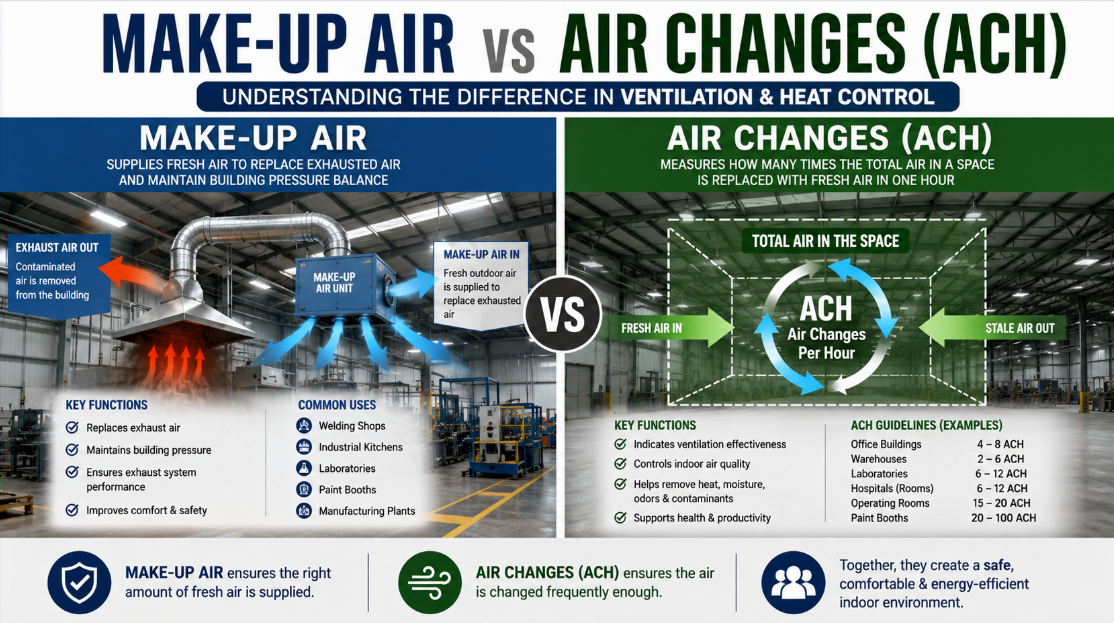
Make-Up Air (MUA) is the fresh outdoor air introduced into a building to replace air that has been removed by exhaust systems.
Every exhaust fan, dust collector, kitchen hood, paint booth, welding exhaust, or laboratory exhaust removes air from the building. Without replacing that lost air, the building develops negative pressure, which can cause several operational and safety problems.
Think of a balloon with air slowly escaping. Unless more air is added, the balloon collapses. Buildings behave in much the same way.
Make-Up Air keeps the indoor air pressure balanced by supplying clean replacement air.
Why Is Make-Up Air Important?
Whenever contaminated air leaves a building, it must be replaced.
Without make-up air:
- Doors become difficult to open.
- Dust enters through cracks.
- Exhaust systems lose efficiency.
- Heating and cooling costs increase.
- Workers experience uncomfortable drafts.
- Combustion appliances may backdraft dangerous gases.
Providing adequate make-up air ensures that exhaust systems perform as intended while maintaining a comfortable indoor environment.
Sources of Make-Up Air
Fresh replacement air can enter through:
- Dedicated make-up air units (MAUs)
- HVAC supply systems
- Roof-mounted air handling units
- Louvers
- Fresh air dampers
- Large wall openings
- Natural ventilation openings (where suitable)
Modern industrial buildings often use heated or cooled make-up air to prevent discomfort during extreme weather.
Applications of Make-Up Air
Make-Up Air is commonly required in:
- Manufacturing plants
- Welding workshops
- Commercial kitchens
- Paint spray booths
- Chemical processing facilities
- Laboratories
- Pharmaceutical plants
- Warehouses
- Automotive repair shops
Any facility with powerful exhaust systems requires adequate make-up air.
Advantages of Make-Up Air
Maintains Building Pressure
Balanced pressure prevents unwanted infiltration of dust and outdoor pollutants.
Supports Exhaust System Performance
Exhaust fans operate more efficiently when replacement air is available.
Improves Worker Comfort
Conditioned make-up air helps maintain stable indoor temperatures.
Enhances Indoor Air Quality
Fresh outdoor air dilutes indoor contaminants.
Prevents Equipment Problems
Proper pressure balance protects combustion appliances and sensitive HVAC equipment.
What Are Air Changes?
Air Changes, often expressed as Air Changes Per Hour (ACH), refer to the number of times the total volume of air inside a room is replaced within one hour.
Unlike Make-Up Air, which focuses on replacing exhausted air, ACH measures how effectively the air within a space is being renewed.
For example:
If the air inside a room is completely replaced 10 times every hour, the room has an ACH of 10.
Why Are Air Changes Important?
Different workplaces require different ventilation rates.
Higher ACH values mean:
- Faster removal of contaminants
- Better heat control
- Reduced airborne infection risk
- Improved air freshness
- Better employee comfort
However, excessively high ACH can increase energy consumption and operating costs.
The goal is to achieve the right balance.
Air Changes Per Hour (ACH) Formula
The standard formula is:
ACH = (Total Supply Airflow × 60) ÷ Room Volume
Where:
- Airflow is measured in cubic feet per minute (CFM) or cubic meters per minute (m³/min).
- Room volume is the length × width × height of the space.
For example:
A workshop has:
- Airflow = 5,000 CFM
- Room Volume = 30,000 cubic feet
ACH = (5,000 × 60) ÷ 30,000
ACH = 10 Air Changes Per Hour
This means the room’s air is replaced ten times every hour.
Typical Recommended ACH Values
Although requirements vary by industry and local regulations, common examples include:
| Area | Typical ACH |
|---|---|
| Office | 4–8 |
| Classroom | 5–8 |
| Warehouse | 2–6 |
| Laboratory | 6–12 |
| Hospital Patient Room | 6–12 |
| Operating Room | 15–20 |
| Paint Booth | 20–100 |
| Clean Room | 20–600 |
Higher-risk environments require higher ACH values to maintain safety.
Advantages of Air Changes
Better Air Quality
Frequent air replacement reduces contaminant concentrations.
Improved Heat Removal
High ACH helps remove excess heat generated by machinery and occupants.
Reduced Odors
Air changes quickly remove unpleasant smells.
Supports Infection Control
Healthcare facilities rely on high ACH to reduce airborne disease transmission.
Enhances Productivity
Fresh air improves concentration and reduces fatigue.
Difference Between Make-Up Air and Air Changes
Although both concepts relate to ventilation, they address different aspects of air movement.
| Feature | Make-Up Air | Air Changes (ACH) |
|---|---|---|
| Purpose | Replaces exhausted air | Measures air replacement frequency |
| Focus | Pressure balance | Ventilation effectiveness |
| Unit | CFM or m³/h | Air Changes Per Hour (ACH) |
| Main Goal | Prevent negative pressure | Improve indoor air quality |
| Measurement | Supply airflow | Air replacement rate |
| Used For | Exhaust compensation | Ventilation design |
| Heat Control | Indirect | Direct |
| Energy Impact | Maintains system balance | Influences ventilation energy demand |
Relationship Between Make-Up Air and ACH
These two concepts work together.
Imagine a factory with large exhaust fans removing hot air from welding operations.
The exhaust fans require Make-Up Air to replace the air leaving the building.
The amount of fresh air supplied also contributes to the building’s Air Changes Per Hour (ACH).
In other words:
- Make-Up Air ensures pressure balance.
- ACH measures how often the air is refreshed.
One supports the ventilation system, while the other evaluates its effectiveness.
Role in Heat Control
Heat generated by:
- Furnaces
- Welding
- Compressors
- Manufacturing equipment
- People
- Lighting
can quickly make a workplace uncomfortable.
How Make-Up Air Helps
Fresh replacement air prevents hot air from accumulating and keeps exhaust systems operating efficiently.
How Air Changes Help
Higher ACH removes heated air more rapidly, reducing indoor temperatures and improving thermal comfort.
When both are properly designed, workplaces remain cooler, healthier, and more productive.
Common Mistakes in Ventilation Design
Many facilities experience ventilation problems because they misunderstand these concepts.
Common mistakes include:
- Installing powerful exhaust fans without make-up air.
- Assuming higher ACH automatically solves pressure problems.
- Ignoring building pressure measurements.
- Blocking fresh air intakes.
- Closing outdoor air dampers to save energy.
- Neglecting regular HVAC maintenance.
These mistakes can reduce ventilation performance and increase operating costs.
Best Practices for Effective Ventilation
To optimize both Make-Up Air and ACH:
- Size make-up air systems to match exhaust airflow.
- Calculate ACH based on room volume and occupancy.
- Use energy-efficient HVAC equipment.
- Inspect filters regularly.
- Keep supply and exhaust openings unobstructed.
- Monitor indoor air quality.
- Balance airflow during commissioning.
- Adjust ventilation rates when processes change.
Regular maintenance and monitoring ensure long-term performance.
Frequently Asked Questions (FAQs)
Is Make-Up Air the same as Air Changes?
No. Make-Up Air replaces air removed by exhaust systems, while Air Changes measure how many times the air in a space is replaced each hour.
Why is Make-Up Air necessary?
Without it, buildings develop negative pressure, reducing exhaust efficiency and causing comfort and safety issues.
What does ACH stand for?
ACH stands for Air Changes Per Hour, indicating how frequently the air within a room is replaced.
Does a higher ACH always mean better ventilation?
Not necessarily. While higher ACH improves contaminant removal, excessively high rates can increase energy costs and may not be needed for every space.
Can a building have good ACH but poor Make-Up Air?
Yes. A building may circulate air frequently yet still experience pressure imbalances if exhausted air is not adequately replaced.
Final Thoughts
When designing or evaluating a ventilation system, understanding the distinction between Make-Up Air and Air Changes Per Hour (ACH) is essential. Although they are often mentioned together, they serve different purposes that are equally important for workplace safety and heat control.
Make-Up Air keeps the building in pressure balance by replacing exhausted air, ensuring that ventilation equipment performs efficiently and occupants remain comfortable. Air Changes, on the other hand, indicate how effectively fresh air replaces stale indoor air, helping remove heat, contaminants, and airborne pollutants.
The most effective ventilation systems are those that balance both concepts. Adequate make-up air combined with the correct ACH creates healthier indoor environments, improves energy efficiency, enhances employee comfort, and supports compliance with occupational health and safety standards.
Whether you manage a factory, warehouse, laboratory, office, or commercial facility, investing in proper ventilation is an investment in the well-being of your workforce and the long-term performance of your operations.
🔁 Readers also enjoyed these blog posts:
- Safety Management’s Role: The Unsung Hero Behind Every Successful Organization
- Safety Management and Its Responsibilities: Protecting People, Preventing Hazards, and Promoting a Culture of Care
- Benchmarking for Safety Performance: A Key to Continuous Improvement
“Start Your Website Journey Today – Exclusive Hostinger Discounts!”

Turn Any Idea into Viral,
Jaw-Dropping AI Videos in Seconds!