 by
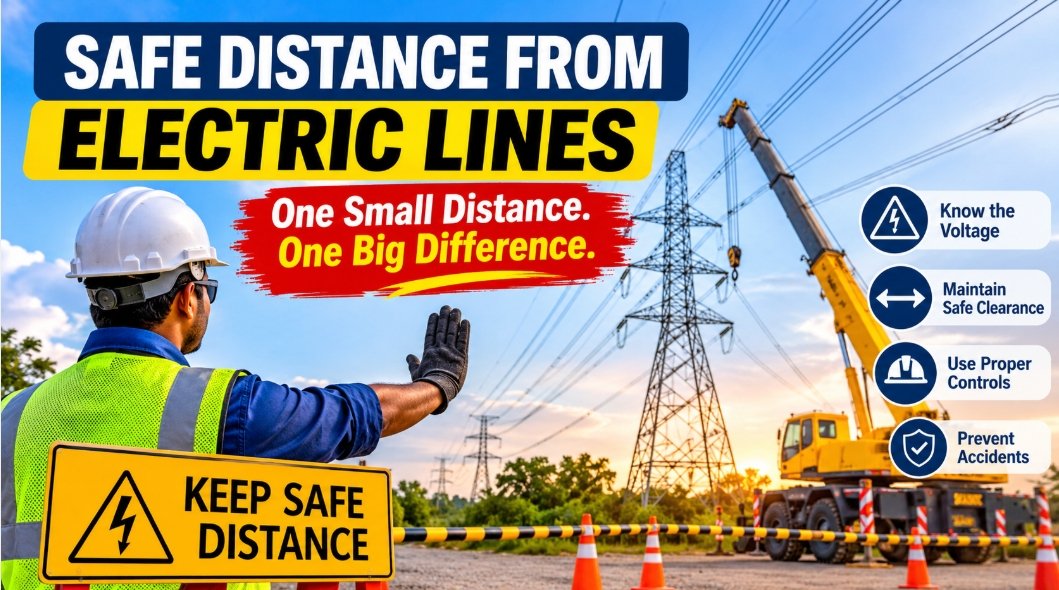
Safe Distance from Electric Lines: How Much Clearance Is Really Needed to Prevent Electrical Accidents?
Introduction: Electricity Does Not Give a Second Chance
Electricity is one of the most essential resources in our daily lives. From residential buildings and commercial establishments to manufacturing plants, construction sites and infrastructure projects, almost every activity depends on a reliable electrical supply.
However, the same electricity that makes modern life possible can become extremely dangerous when people, vehicles, machinery or structures come too close to overhead electrical lines.
One common misconception is that an electric line is safe as long as nobody physically touches it. Unfortunately, this is not always true.
High-voltage electricity can jump through the air under certain conditions. This phenomenon, known as electrical arcing or flashover, can cause severe burns, electric shocks, fires and even fatal injuries.
A construction worker operating a crane, a maintenance technician handling a long metal ladder, a farmer using agricultural equipment or a truck driver raising a hydraulic tipping body can unintentionally enter a dangerous electrical zone.
The critical question is: How much distance should we maintain from electric lines to prevent accidents?
The answer depends on several factors, including voltage level, electrical installation, nature of the work, equipment movement and applicable safety regulations.
Understanding these distances is essential for EHS professionals, electrical engineers, contractors, construction supervisors, maintenance teams and everyone working around electrical infrastructure.
Let’s explore the important safety requirements and practical precautions.
1. Why Is Maintaining a Safe Distance from Electric Lines So Important?
An electrical accident does not always require direct contact with a live conductor. Depending on the voltage, environmental conditions and distance, electricity may travel through the air and create an arc.
Some of the major hazards associated with working near overhead electrical lines include:
1. Electrical shock and electrocution
A person touching an energized conductor, or coming within an unsafe approach distance, may receive a potentially fatal electric shock.
2. Electrical arc flash
An electrical arc can release enormous thermal energy within a fraction of a second. It can cause serious skin burns, ignite clothing and damage nearby equipment.
3. Fire and explosion
Electrical contact involving vehicles, cranes, scaffolding or metallic structures can cause sparks and ignition, particularly in industrial areas where combustible materials or flammable vapours are present.
4. Step and touch potential
When an energized conductor falls onto the ground, electricity may spread through the surrounding soil.
A person walking near the point of contact can experience a voltage difference between their feet. This is known as step potential.
Similarly, touching an energized vehicle or metal structure while standing on the ground can expose a person to touch potential.
5. Equipment damage and operational disruption
Contact between cranes, forklifts, dump trucks or other machinery and overhead power lines can result in equipment damage, production interruptions, injuries and significant financial losses.
The most important lesson is simple: maintaining an appropriate distance is not just an electrical safety requirement; it is a life-saving precaution.
2. Understanding Different Types of Electric Lines
Before deciding how much distance to maintain, it is important to understand the different electrical voltage levels commonly found around us.
| Electrical line | Typical application |
|---|---|
| Low voltage (LV) | Residential and commercial supply |
| 415 V | Three-phase industrial distribution |
| 11 kV | Local distribution feeders |
| 22 kV | Distribution networks in some areas |
| 33 kV | Industrial and distribution networks |
| 66 kV | Sub-transmission |
| 132 kV | High-voltage transmission |
| 220 kV | Transmission networks |
| 400 kV | Extra-high-voltage transmission |
| 765 kV | Ultra-high-voltage transmission |
The higher the voltage, the greater the potential electrical hazard and the more carefully the approach distance must be assessed.
However, remember that even a low-voltage electrical line can cause fatal injuries.
Never assume that an overhead wire is safe because it looks small, is covered or is installed close to a building.
Only the electricity distribution company or an authorised electrical professional can confirm the status and characteristics of a line.
3. Safe Distance from Electric Lines as per Indian CEA Regulations
In India, electrical safety requirements are governed by the Central Electricity Authority (CEA).
The Central Electricity Authority (Measures relating to Safety and Electric Supply) Regulations, 2023 establish important requirements for electrical installations, overhead lines and clearances from buildings.
For EHS professionals, engineers, contractors and building owners, Regulations 60, 62 and 63 are particularly important when evaluating overhead electrical line clearances.
A. Minimum clearance from buildings
Under Regulation 62, the minimum clearance requirements for overhead lines not exceeding 650 volts are:
| Situation | Minimum clearance |
|---|---|
| Vertical clearance above a flat roof or accessible building point | 2.5 metres |
| Horizontal clearance from an adjacent building | 1.2 metres |
These clearances are based on maximum conductor sag and the relevant measurement conditions.
B. Clearance for high-voltage lines
Under Regulation 63, the following minimum clearances apply to overhead AC lines exceeding 650 volts.
| Voltage of overhead line | Minimum vertical clearance above building | Minimum horizontal clearance |
|---|---|---|
| Above 650 V up to 11 kV | 3.7 m | 1.2 m |
| Above 11 kV up to 33 kV | 3.7 m | 2.0 m |
| Above 33 kV | 3.7 m plus 0.3 m for every additional 33 kV or part thereof | 2.0 m plus 0.3 m for every additional 33 kV or part thereof |
These are statutory building clearances, not general permission for workers to approach live electrical conductors.
The horizontal clearance is assessed considering maximum conductor deflection due to wind pressure.
For HVDC lines, separate clearance requirements apply.
Important: These values must be interpreted in the context of the applicable regulation, voltage classification, line configuration and measurement conditions. Before approving construction or maintenance work near an overhead line, consult the electricity distribution or transmission utility and a competent electrical engineer.
The CEA’s official website provides the applicable regulations and notifications:
CEA electrical safety regulations – official website.
4. Safe Distance from Electric Lines During Construction and Maintenance Work
One of the most dangerous situations occurs when construction or maintenance activities take place near overhead electrical lines.
Workers may unintentionally bring tools, equipment or materials close to an energized conductor.
Common examples include:
- Operating mobile cranes near overhead power lines.
- Erecting scaffolding near electrical distribution lines.
- Painting or repairing building exteriors.
- Installing rooftop structures and solar panels.
- Using boom lifts and aerial work platforms.
- Handling long metal pipes, ladders and structural members.
- Transporting oversized machinery or fabricated structures.
For these activities, the organisation must establish a job-specific safe approach distance based on the electrical voltage and the equipment’s maximum possible movement.
Recommended precautions
1. Identify the voltage level
Contact the electricity utility to establish the voltage and ownership of the overhead line.
Do not estimate the voltage based on the number of conductors or the appearance of poles.
2. Maintain an exclusion zone
Establish a clearly marked restricted area around the electrical hazard.
Use physical barricades, warning boards, flags and other suitable controls.
3. De-energise whenever possible
Where work can be planned around an outage, arrange isolation through the authorised electrical utility.
The line must be confirmed de-energised and properly earthed before work begins under the authorised procedure.
4. Use a trained spotter
Assign a dedicated spotter when operating mobile equipment near overhead electrical lines.
The spotter must have a clear view of the equipment and its proximity to the electrical hazard.
5. Control equipment movement
Use mechanical movement restrictions, height limiters and suitable warning systems where appropriate.
Do not rely entirely on the operator’s judgement.
6. Conduct a pre-job safety briefing
Explain the electrical hazards, exclusion zone, emergency response and communication arrangements before starting work.
5. Safe Distance for Cranes, Excavators and Heavy Vehicles
Heavy equipment creates a particularly serious electrical safety risk because its operating dimensions can change continuously.
A crane boom may extend several metres above ground. A load suspended from the crane may swing towards an overhead conductor. A truck’s hydraulic tipping body may unexpectedly enter the electrical hazard zone.
Consider the following situations:
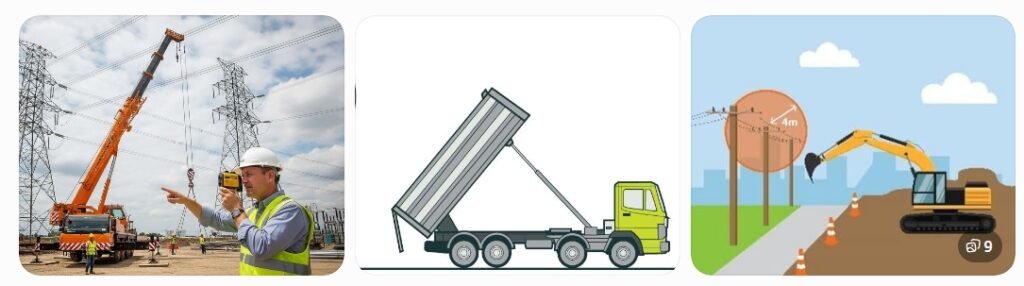
Crane operations
Before crane operations begin, the lifting supervisor should:
- Identify all overhead electrical lines within the crane operating radius.
- Determine the maximum boom height and extension.
- Consider load swing, boom deflection and wind conditions.
- Establish the permitted operating area.
- Arrange isolation or relocation of the line wherever practicable.
- Provide a dedicated trained signal person or spotter.
- Include electrical line hazards in the lifting plan and job safety analysis.
Never assume that the crane is safe because its base is outside the electrical line’s immediate vicinity. The entire crane, boom, suspended load, rigging and movement envelope must be considered.
Dump trucks and tippers
A common but underestimated accident scenario involves a truck raising its tipping body underneath or near overhead electrical lines.
The raised body can contact an overhead conductor even when the truck itself initially appears to have sufficient clearance.
Practical controls include:
- Identifying overhead lines along vehicle routes.
- Establishing designated unloading areas.
- Installing height restriction signs and physical barriers where appropriate.
- Prohibiting tipping operations within an uncontrolled electrical hazard zone.
- Ensuring the driver lowers the tipping body completely before moving.
Excavators and material-handling equipment
Excavator booms, telehandlers, forklifts and material-handling equipment can also enter electrical exclusion zones.
Their movement envelope should be assessed before work begins.
6. Why Electricity Can Jump Across an Air Gap
Many people believe that electricity flows only when a conductor physically touches another object.
This is incorrect.
When the electrical voltage is sufficiently high, the electric field can ionise the surrounding air, creating a conductive path between the energized conductor and another object.
This is called electrical arcing.
The distance at which an arc may occur depends on several factors:
- Voltage level.
- Air pressure and atmospheric conditions.
- Humidity and contamination.
- Electrode geometry.
- Electrical system characteristics.
- Transient overvoltages and switching conditions.
For this reason, there is no single universal air-gap distance that can be considered safe for every electrical line.
A person carrying a long metal pipe or working with a crane boom may unintentionally enter a hazardous zone without physically touching the conductor.
The safest approach is to maintain the prescribed exclusion distance and avoid all unauthorised approach towards energized overhead lines.
7. Safe Distance from Electric Lines for Residential Buildings
Electrical lines passing close to residential buildings are a common concern, particularly in developing urban areas.
Homeowners sometimes construct additional floors, balconies, terraces, water tanks or rooftop structures without checking the position of existing overhead electrical lines.
This can create serious electrical hazards.
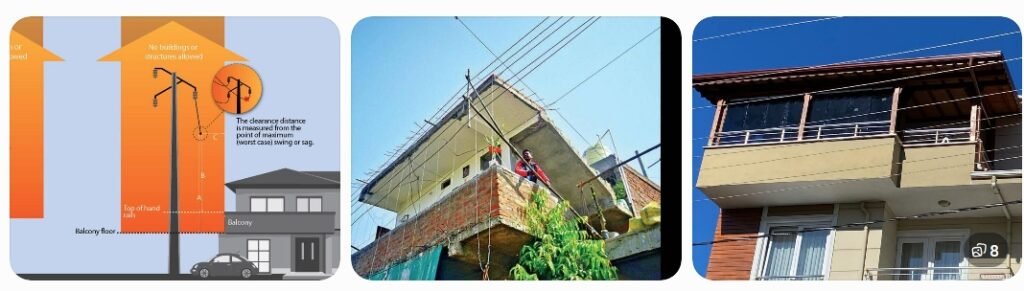
Before constructing or modifying a building, homeowners and contractors should:
- Check whether any overhead electrical line passes above or adjacent to the proposed structure.
- Identify the voltage level through the electricity distribution company.
- Verify compliance with CEA building-clearance requirements.
- Obtain necessary permissions before relocating or modifying electrical lines.
- Avoid constructing balconies, terraces or other accessible structures within the required clearance zone.
- Ensure that rooftop water tanks, solar panels and metal structures do not create additional electrical hazards.
A particularly dangerous situation arises when a person stands on a terrace and attempts to use a long metal pole, antenna or cleaning tool near an overhead conductor.
Even without direct contact, the person may be exposed to electrical arcing.
Never attempt to shift, lift, insulate or relocate an overhead electrical wire yourself.
Contact the authorised electricity utility.
8. Safe Distance During Agricultural Activities
Electrical accidents are not limited to construction sites and industrial workplaces. Agricultural workers are also exposed to overhead electrical hazards.
Tractors, harvesters, irrigation pipes, water sprinklers and other agricultural equipment can come dangerously close to electrical distribution lines.
Some common risk situations include:
- Transporting long irrigation pipes beneath overhead lines.
- Operating tractors with raised attachments.
- Using harvesting machinery near electrical poles.
- Installing irrigation systems close to electrical infrastructure.
- Climbing trees located near overhead conductors.
- Operating mobile equipment during stormy weather.
Farmers should avoid carrying long metal objects vertically near overhead lines.
If an electrical conductor falls onto agricultural land, people and animals must be kept away. Inform the electricity utility immediately.
Never attempt to remove a fallen conductor, even if it appears to be disconnected.
9. Safe Distance from Electric Lines During Ladder and Scaffolding Work
Ladders and scaffolding are frequently used for maintenance, painting, electrical installations and building repairs.
Aluminium ladders are particularly dangerous near overhead electrical lines because aluminium is an excellent electrical conductor.
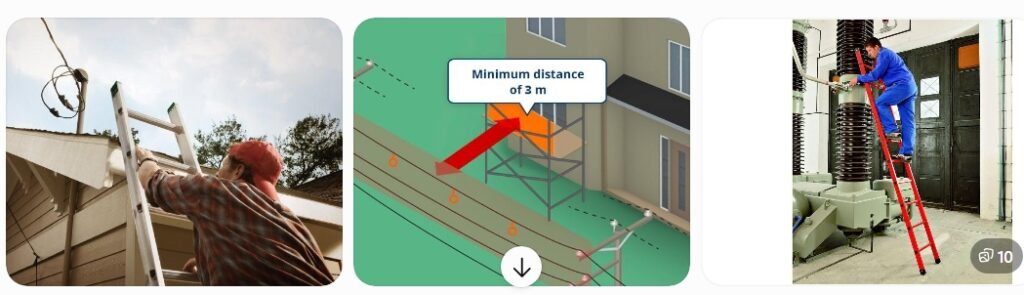
Important precautions include:
- Use non-conductive fibreglass ladders where suitable for the task.
- Inspect the work location before positioning ladders.
- Keep ladders, scaffolding and long materials outside the approved electrical exclusion zone.
- Never move an extended ladder beneath overhead electrical lines.
- Do not use scaffolding that can enter the electrical clearance zone.
- Arrange power isolation or line relocation when adequate clearance cannot be maintained.
Remember that using a fibreglass ladder does not make working near an overhead conductor automatically safe. The entire work activity must remain outside the electrical hazard zone.
10. What Should You Do If a Vehicle or Machine Contacts an Overhead Power Line?
This is one of the most important electrical emergency situations that every operator and supervisor should understand.
Suppose a crane boom, truck body or excavator accidentally contacts an energized overhead conductor.
The equipment may become energized, creating a potentially fatal situation for anyone touching it or standing nearby.
Follow these emergency precautions:
Step 1: Stay inside the vehicle or equipment if it is safe to do so.
The operator should remain in the cabin and avoid touching external metallic parts.
Step 2: Warn others to stay away.
Do not allow anyone to approach or touch the vehicle, equipment or suspended load.
Step 3: Contact the electricity utility immediately.
Ask the authorised utility personnel to isolate the electrical supply and confirm that the line is safe.
Step 4: Exit only if there is an immediate danger.
If the vehicle catches fire or remaining inside becomes impossible, jump clear without touching the vehicle and ground simultaneously.
Land with both feet together and move away using small shuffling steps or bunny hops, keeping both feet close together.
Do not run with normal walking strides because a voltage difference between your feet can result in a step-potential shock.
Step 5: Do not approach the equipment until it is confirmed safe.
Even after the line appears to have stopped arcing, it may remain energized.
Only authorised personnel should confirm electrical isolation and safety.
11. Common Myths About Safe Distance from Electric Lines
There are several misconceptions that can increase the likelihood of electrical accidents.
| Common myth | Actual safety fact |
|---|---|
| Electricity is dangerous only when wires are touched. | High-voltage electricity can arc through air. |
| Covered wires are completely safe. | Insulation may be damaged or unsuitable for contact. |
| A small electrical line cannot cause fatal injury. | Low-voltage electricity can also be fatal. |
| A crane is safe if its wheels are away from the power line. | The boom, load and entire equipment movement envelope matter. |
| Rubber shoes provide complete electrical protection. | Ordinary footwear is not a substitute for electrical isolation and safe distances. |
| A fallen wire is safe if there are no sparks. | A fallen conductor must always be treated as energized. |
| A spotter alone can prevent every electrical accident. | Engineering controls, isolation and proper exclusion zones are essential. |
Changing these misconceptions through regular toolbox talks and safety training can significantly improve workplace electrical safety awareness.
12. EHS Checklist: Working Near Overhead Electrical Lines
For EHS professionals and site safety officers, managing electrical hazards should be part of the routine risk assessment process.
The following checklist can be incorporated into a Job Safety Analysis (JSA), Permit to Work (PTW) or contractor safety inspection.
Overhead Electrical Line Safety Inspection Checklist
Use this checklist before authorising work near overhead power lines.
Inspection progress
0/12 completedAll overhead electrical lines in the work area have been identified.Voltage level and line ownership have been confirmed.Required electrical clearance and exclusion zone have been established.Electricity utility has been contacted wherever necessary.Power isolation has been arranged wherever practicable.Crane, boom, vehicle and load movement envelopes have been assessed.Physical barricades and electrical warning signs are installed.Trained spotter or signal person is assigned where required.Workers and contractors have received a safety briefing.Emergency arrangements and utility contact details are available.Weather and wind conditions have been considered.Work permit and risk assessment have been reviewed and approved.
Reset checklist
This checklist is a practical aid and does not replace a detailed electrical risk assessment or statutory compliance verification.
13. Responsibilities of Employers and EHS Professionals
Employers have an important responsibility to ensure that employees, contractors and visitors are protected from electrical hazards.
In manufacturing plants, construction projects and industrial facilities, electrical line safety should be included in the organisation’s overall EHS management system.
Key responsibilities include:
Risk assessment: Identify overhead electrical lines during workplace inspections and before non-routine activities.
Permit to Work: Include electrical proximity hazards in permits for crane operations, work at height, excavation and maintenance.
Contractor management: Ensure contractors understand electrical exclusion zones and emergency procedures.
Training and awareness: Conduct periodic training for crane operators, drivers, maintenance personnel and construction workers.
Engineering controls: Consider line relocation, underground cabling, physical restrictions and electrical isolation wherever practicable.
Inspection and monitoring: Regularly inspect overhead lines passing through or adjacent to workplaces.
Emergency preparedness: Conduct mock drills covering electrical contact incidents, fallen conductors and vehicle energisation.
An effective electrical safety programme should focus on eliminating exposure rather than depending only on PPE or employee awareness.
14. Practical Tips to Prevent Electrical Line Accidents
The following ten rules can be displayed on workplace safety noticeboards and discussed during toolbox talks.
- Always identify overhead electrical lines before starting work.
- Never assume that an electrical line is de-energised.
- Maintain the approved safe approach distance.
- Never touch or approach a fallen electrical conductor.
- Avoid operating cranes and elevated equipment near overhead lines without proper controls.
- Do not carry long metal objects vertically near electrical lines.
- Arrange electrical isolation whenever required.
- Use trained spotters and clearly marked exclusion zones.
- Stop work immediately if safe clearance cannot be maintained.
- Report damaged, sagging or dangerously positioned electrical lines to the electricity utility.
A few minutes spent checking electrical hazards before starting work can prevent a lifetime of regret.
15. Frequently Asked Questions (FAQs)
Q1. What is the minimum safe distance from an overhead electric line?
There is no single universal safe distance applicable to all overhead electrical lines. It depends on voltage, applicable regulations, work activity and equipment movement. For building clearances in India, CEA Regulations 62 and 63 specify minimum values based on voltage and installation conditions.
Q2. Can electricity jump from an overhead power line without touching it?
Yes. High-voltage electricity can travel through air under suitable electrical conditions. This is known as electrical arcing or flashover. Therefore, workers must maintain the prescribed approach distance.
Q3. What is the minimum distance between an 11 kV line and a building in India?
Under Regulation 63 of the CEA Regulations, 2023, the minimum vertical clearance above a building is 3.7 metres, while the minimum horizontal clearance is 1.2 metres for lines exceeding 650 V and up to 11 kV.
These are building clearances, not safe working distances for personnel.
Q4. Is it safe to work under overhead electrical lines?
Work should not be carried out within an electrical hazard zone without appropriate controls. Depending on the activity, the organisation may need line isolation, relocation, physical barriers and an approved safe working arrangement.
Q5. What is the safe distance for a crane working near power lines?
The distance must be determined from the applicable electrical safety requirements and a job-specific risk assessment. Consider the entire crane, boom, suspended load, rigging and movement envelope. Do not use a generic distance without confirming the voltage and applicable requirements.
Q6. Are insulated electrical wires safe to touch?
No. The presence of insulation does not mean that a conductor is safe to touch. Insulation can deteriorate, become damaged or be unsuitable for the conditions. Treat overhead conductors as energised unless their safe status has been formally confirmed.
Q7. What should I do if an electrical wire falls on the road?
Stay away, prevent others from approaching and immediately inform the electricity utility and emergency services. Do not touch the wire or attempt to move it. Keep vehicles and pedestrians away from the affected area.
Q8. Who is responsible for maintaining electrical clearance from buildings?
The electricity supplier, line owner, building owner and other responsible parties have duties under applicable regulations. Any construction or modification near an existing electrical line must be coordinated with the authorised electricity utility and relevant authorities.
Q9. Does rain increase the risk of working near overhead power lines?
Rain can introduce additional hazards through wet surfaces, reduced visibility and compromised equipment insulation. Storms and strong winds can also affect conductor movement. Outdoor work near electrical lines should be reassessed when weather conditions deteriorate.
Q10. Which Indian regulation specifies clearance from overhead electrical lines?
The Central Electricity Authority (Measures relating to Safety and Electric Supply) Regulations, 2023, particularly Regulations 60, 62 and 63, cover important requirements relating to overhead line clearances. Always check the latest applicable amendments and notifications.
Conclusion: Maintain Distance, Protect Lives
Electrical safety is not about taking chances or relying on experience. It is about identifying hazards, understanding electrical risks and maintaining the correct safety distance under all working conditions.
Whether it is a construction project, manufacturing facility, residential building or agricultural operation, overhead electrical lines must always be treated as potentially life-threatening.
For EHS professionals, the focus should be on proactive hazard identification, proper risk assessment, engineering controls, employee awareness and emergency preparedness.
Remember one important safety principle:
Never approach an overhead electrical line to find out whether it is safe. Maintain the prescribed clearance, arrange isolation wherever necessary and allow authorised electrical professionals to manage the hazard.
A safe distance today can prevent a fatal accident tomorrow.
References and further reading
- Central Electricity Authority – Measures relating to Safety and Electric Supply Regulations.
- CEA Regulations, 2023 – official notification.
- OSHA – Power line safety during equipment operations.
Disclaimer: This article is intended for general electrical safety awareness and educational purposes. It is not a substitute for statutory requirements, engineering assessment or authorised electrical work procedures. Verify applicable regulations and amendments before using any clearance value for design, construction or work authorisation.
🔁 Readers also enjoyed these blog posts:
- Safety Management’s Role: The Unsung Hero Behind Every Successful Organization
- Safety Management and Its Responsibilities: Protecting People, Preventing Hazards, and Promoting a Culture of Care
- Benchmarking for Safety Performance: A Key to Continuous Improvement
“Start Your Website Journey Today – Exclusive Hostinger Discounts!”