 by
by Introduction: Why Electricity Becomes Dangerous to the Human Body
Electricity is an essential part of almost every workplace, industry, and modern home. From power distribution systems and electrical panels to portable tools and machinery, electrical energy makes our daily activities possible.
But the same electricity that powers equipment can become life-threatening when it passes through the human body.
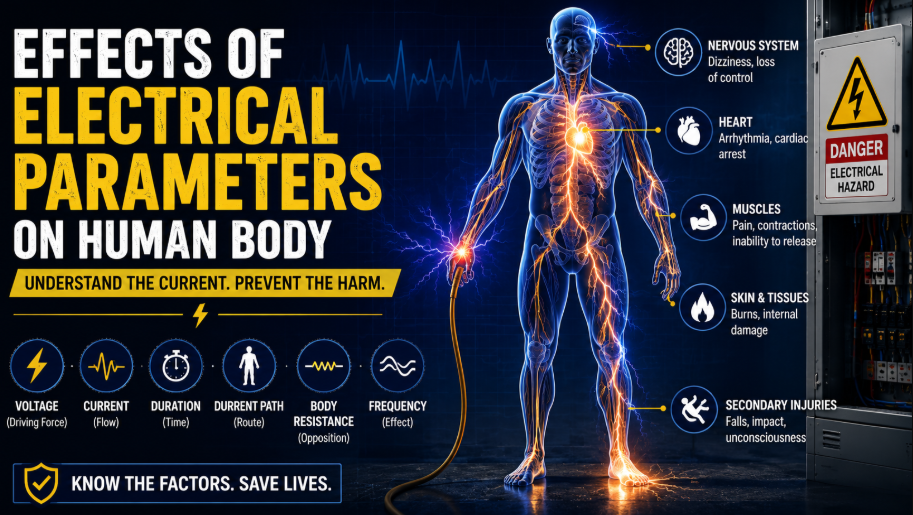
One of the most important things to understand about electrical safety is that the danger is not determined by voltage alone. Several electrical and human factors work together to determine the severity of an electrical injury.
The amount of current flowing through the body, the voltage driving that current, the duration of contact, the path taken by the current, the frequency of the supply, and the body’s resistance can all influence the outcome.
Two people exposed to apparently similar electrical conditions may not necessarily experience identical injuries.
For EHS professionals, electrical workers, supervisors, and anyone working around electrical equipment, understanding these parameters is fundamental to preventing incidents.
So, what exactly happens when electricity enters the human body?
Let’s break it down.
What Happens When Electrical Current Passes Through the Human Body?
The human body is not a perfect conductor. However, it contains water, dissolved salts, and electrolytes, which allow electrical current to flow.
When a person comes into contact with an energized source and simultaneously provides a path to another electrical potential—such as ground—current may flow through the body.
This can interfere with normal biological functions.
Depending on the circumstances, electrical exposure can result in:
- A mild tingling sensation
- Painful muscle contractions
- Inability to release an energized conductor
- Breathing difficulties
- Burns
- Nerve and tissue damage
- Loss of consciousness
- Abnormal heart rhythms
- Cardiac arrest
- Secondary injuries from falls or involuntary movements
- Death
The severity depends heavily on how much current flows, where it flows, and for how long.
This is why electrical safety cannot be reduced to simply asking, “How many volts is the system?”
1. Electrical Current: The Most Important Parameter
When discussing the effects of electricity on the human body, current is one of the most critical parameters.
Current is measured in amperes (A), commonly expressed in milliamperes (mA) when discussing relatively small currents through the human body.
The body’s physiological response generally becomes more severe as the current increases.
Very small currents may produce little or no noticeable sensation, while increasing current can cause painful muscle contractions and other physiological effects.
At sufficiently high levels, electrical current can interfere with the muscles responsible for breathing and can disturb the heart’s normal electrical activity.
Why current matters
Consider a simple relationship:
I = V / R
Where:
- I = current
- V = voltage
- R = resistance
This relationship illustrates why voltage and resistance matter: the voltage provides the electrical potential, while resistance influences how much current actually flows.
However, real-world human exposure is more complicated than a simple calculation because body resistance can change significantly during an incident.
For example, wet skin generally offers less resistance than dry skin. A larger contact area can also change the characteristics of the contact.
Current and physiological effects
The exact response varies from person to person, but increasing current can progressively produce:
Perception → painful sensation → muscular contraction → difficulty releasing → respiratory effects → cardiac effects → severe injury
These should not be treated as rigid boundaries. Individual responses vary, and exposure conditions can significantly change the outcome.
2. Voltage: The Driving Force Behind Current
Voltage is measured in volts (V) and represents the electrical potential difference between two points.
Voltage itself does not tell the complete story of how severe an electric shock will be. Instead, voltage acts as a driving force that can cause current to flow through the body when a suitable conductive path exists.
A higher voltage can potentially drive more current through a given resistance.
This is why even relatively high-resistance conditions should never be assumed to make an electrical source safe.
Low voltage does not automatically mean no danger
One of the common misconceptions in workplace electrical safety is:
“It’s only low voltage, so it can’t hurt me.”
That assumption can be dangerous.
Certain low-voltage electrical systems can still cause serious injury under unfavorable conditions, particularly when the body has a low-resistance path or when the current travels through the chest.
At higher voltages, additional hazards such as electrical arcing, severe burns, and arc-flash events can become significant concerns.
Therefore, electrical risk assessments should consider the entire electrical system rather than voltage alone.
3. Duration of Contact: Every Second Matters
Another critical factor is how long the body remains exposed to electrical current.
In general, longer exposure can increase the severity of injury.
A short exposure and a prolonged exposure at the same electrical conditions may produce very different outcomes.
This is particularly important because electrical current can cause involuntary muscle contractions.
A person may touch an energized conductor and experience a muscular contraction that prevents them from voluntarily releasing it.
This can prolong the exposure.
Why protective devices matter
Electrical protection systems such as:
- Circuit breakers
- Fuses
- Residual-current protection devices
- Ground-fault protection
- Emergency isolation systems
can help reduce the duration of certain electrical faults by disconnecting power.
However, protective devices must be properly selected, installed, maintained, and tested. Their operation depends on the type and characteristics of the fault.
A protection device should therefore never be considered a substitute for safe work practices.
4. Current Path Through the Body
The path electrical current takes through the body is one of the most important factors affecting injury severity.
A current path involving the chest is particularly concerning because the heart and respiratory muscles are located in this region.
For example, a pathway from:
Hand → Chest → Foot
may expose the heart and other vital organs to current.
Other pathways can involve:
- Hand to hand
- Hand to foot
- Head to foot
- Hand to elbow
- Foot to foot
The exact risk depends on the electrical conditions and the person’s contact circumstances.
Why one-handed work practices can matter
In appropriate electrical work situations, procedures may be designed to minimize the possibility of creating a current path across the chest.
However, “one-hand rule” concepts should not be misunderstood as making energized work safe. The safest approach is generally to de-energize equipment, isolate the energy source, verify absence of voltage, and prevent unexpected re-energization whenever the work permits.
5. Body Resistance: The Human Body Is Not a Fixed Resistor
The electrical resistance of the human body is not constant.
It can vary substantially depending on several factors, including:
- Skin condition
- Moisture
- Contact area
- Contact pressure
- Contact duration
- Current path
- Environmental conditions
- Condition of the skin
Dry skin vs. wet skin
Dry, intact skin can provide considerable resistance.
But moisture can reduce skin resistance, potentially allowing more current to flow.
This is one reason electrical work around:
- Water
- Wet floors
- Rain
- Humid environments
- Wet hands
- Conductive surfaces
requires particular caution.
A worker wearing wet gloves or standing in a wet environment may face a very different electrical exposure than someone working under dry conditions.
This is also why electrical equipment should be appropriately rated for its environment.
6. AC vs. DC: Does Frequency Matter?
The type of electrical current also matters.
Alternating current (AC) periodically changes direction, while direct current (DC) generally flows in one direction.
For many workplace electrical systems, AC is commonly encountered at power frequencies such as 50 Hz or 60 Hz, depending on the electrical system.
Frequency can influence how electrical current interacts with the body’s nervous system and muscles.
Power-frequency AC is particularly important in electric-shock safety because it can cause sustained muscle contraction and may interfere with normal cardiac electrical activity.
DC can produce different physiological responses and may cause a strong muscular reaction when contact is established or interrupted.
The comparison should therefore not be reduced to “AC is dangerous and DC is safe” or vice versa.
Both AC and DC can cause serious or fatal injuries.
7. Frequency and Its Effect on the Human Body
Frequency is measured in hertz (Hz), representing the number of cycles per second.
The body’s response to electrical current changes with frequency.
At commonly encountered power frequencies, electrical current can affect muscles and the heart in ways that make electric shock particularly dangerous.
At substantially higher frequencies, the body’s response can be different, with heating and tissue effects becoming increasingly important.
This is why electrical safety considerations for:
- Power distribution
- Welding equipment
- Radio-frequency systems
- Industrial heating
- Medical electrical equipment
may differ.
Understanding the electrical system’s frequency is therefore important when assessing electrical hazards.
8. Contact Area and Pressure
The size and nature of the contact area can influence the electrical exposure.
A larger contact area can alter the distribution of current and the resistance of the contact.
Similarly, pressure can affect the quality of electrical contact.
This is one reason electrical accidents can become particularly serious when a person is firmly gripping an energized component.
A simple touch may become a sustained contact if the person cannot withdraw their hand.
Electrical safety should therefore focus not only on the source but also on how a person could physically interact with it.
9. Skin Condition and Environmental Factors
The electrical resistance of the outer skin layer plays a significant role in many electrical exposures.
Cuts, abrasions, burns, perspiration, water, and other conditions can alter the body’s electrical characteristics.
Environmental conditions can also increase risk.
For example, workplaces containing conductive materials, wet surfaces, confined spaces, or metallic structures can create additional pathways for electrical current.
This is why electrical risk assessments should consider the actual working environment rather than relying exclusively on equipment specifications.
10. Electrical Shock vs. Electrical Burns
Electrical injuries are not limited to electric shock.
A person may suffer electrical burns when electrical energy is converted into heat as current passes through tissue.
Burns may occur at contact points and potentially along internal current pathways.
High-energy electrical incidents can also produce severe thermal injuries.
Another major hazard is arc flash.
An arc flash can release intense heat, light, pressure, and molten material. A person does not necessarily have to touch an energized conductor for an arc-flash injury to occur.
This distinction is important:
Electric shock primarily involves current passing through the body.
Arc flash involves an electrical arc releasing energy into the surrounding environment.
Both hazards require appropriate controls.
11. Why the Heart Is Especially Vulnerable
The heart operates through its own electrical signaling system.
External electrical current can interfere with these signals.
Under sufficiently hazardous conditions, electrical exposure can cause abnormal heart rhythms, including potentially life-threatening arrhythmias.
This is one reason current pathways involving the chest are treated with particular concern.
It is also why an electrical incident should not be considered harmless simply because there are no obvious external burns.
Internal injury may not always be immediately visible.
Anyone experiencing a significant electrical shock should receive appropriate medical evaluation, particularly when there has been loss of consciousness, chest symptoms, burns, breathing difficulty, abnormal heart sensations, or other concerning symptoms.
12. Why “Voltage Alone” Is a Poor Way to Judge Electrical Risk
A common mistake in electrical safety is to evaluate a hazard using only the voltage rating.
A more useful way to think about electrical exposure is:
Voltage → drives current
Resistance → limits current
Current → produces physiological effects
Duration → influences exposure severity
Path → determines which tissues and organs may be affected
Frequency/waveform → influences the body’s response
These parameters interact with one another.
For this reason, electrical risk assessment should consider the complete scenario.
13. Practical Example: Why Wet Conditions Increase Risk
Imagine a worker handling electrical equipment.
In one situation, the worker has dry hands and is working in a dry environment.
In another situation, the worker has sweaty or wet hands and is standing on a damp surface.
The electrical source may be identical in both situations.
But the conditions affecting the electrical path through the body can be very different.
The second scenario may create a substantially more hazardous exposure pathway.
This is why seemingly simple environmental controls—such as keeping work areas dry, maintaining suitable insulation, using appropriate protective equipment, and preventing contact with energized parts—can have a major role in electrical safety.
14. How EHS Professionals Can Reduce Electrical Risk
Understanding electrical parameters is valuable, but the ultimate objective is prevention.
A strong electrical safety program should prioritize controls such as:
1. De-energization
Whenever feasible, disconnect electrical equipment from its energy source before work begins.
2. Lockout/Tagout
Use appropriate energy-isolation procedures to prevent unexpected energization during maintenance and servicing.
3. Verification
Do not simply assume that equipment is de-energized. Appropriate procedures should verify the absence of hazardous electrical energy before work proceeds.
4. Guarding and Enclosures
Prevent accidental contact with energized components through suitable barriers, covers, and enclosures.
5. Grounding and Bonding
Proper grounding and bonding can help manage fault conditions and reduce electrical hazards.
6. Protective Devices
Use correctly selected and maintained protective devices appropriate to the electrical installation.
7. Inspection and Maintenance
Damaged cables, plugs, insulation, electrical panels, and tools should be identified and addressed promptly.
8. Competency and Training
Only appropriately trained and authorized personnel should perform electrical tasks requiring specialized knowledge or qualifications.
9. Appropriate PPE
Where electrical hazards remain after other controls, appropriate PPE and equipment should be selected based on the specific hazard and applicable standards.
10. Emergency Preparedness
Workers should know how to respond to electrical emergencies without creating another casualty—for example, avoiding direct contact with a person who may still be energized until the electrical source has been safely isolated.
Electrical Safety: The Key Takeaway
Electricity becomes dangerous when electrical energy finds a path through the human body.
But the severity of an electrical injury is not determined by one parameter alone.
The major factors include:
- Current: determines the intensity of electrical exposure.
- Voltage: provides the potential that can drive current.
- Resistance: influences how much current can flow.
- Duration: longer exposure can increase injury severity.
- Current path: determines which parts of the body are exposed.
- Frequency: influences physiological response.
- Contact conditions: moisture, pressure, area, and skin condition can change the exposure.
- Environment: wet or conductive surroundings can create additional hazards.
Understanding these factors helps EHS professionals move beyond simplistic ideas such as “high voltage equals danger” and develop more effective electrical safety controls.
Ultimately, the best electrical incident is the one that never happens.
Electrical safety is therefore not just about knowing how electricity behaves. It is about designing workplaces, procedures, equipment, and behaviors so that people do not become part of the electrical circuit in the first place.
Final Thoughts
Every electrical hazard presents a combination of energy, exposure, and human interaction.
A technician opening a panel, an operator using a power tool, a maintenance worker troubleshooting equipment, or a person working near electrical infrastructure may encounter very different electrical risks.
That is why effective EHS management requires a systematic approach.
Identify the electrical energy. Understand the possible exposure. Assess the current path. Control the source. Isolate whenever possible. Verify before touching.
When these principles become part of everyday workplace culture, electrical safety moves from being a checklist activity to becoming a fundamental part of how work is performed.
Respect electricity. Understand its behavior. Control the hazard before the hazard controls the outcome.
🔁 Readers also enjoyed these blog posts:
- Safety Management’s Role: The Unsung Hero Behind Every Successful Organization
- Safety Management and Its Responsibilities: Protecting People, Preventing Hazards, and Promoting a Culture of Care
- Benchmarking for Safety Performance: A Key to Continuous Improvement
“Start Your Website Journey Today – Exclusive Hostinger Discounts!”