 by
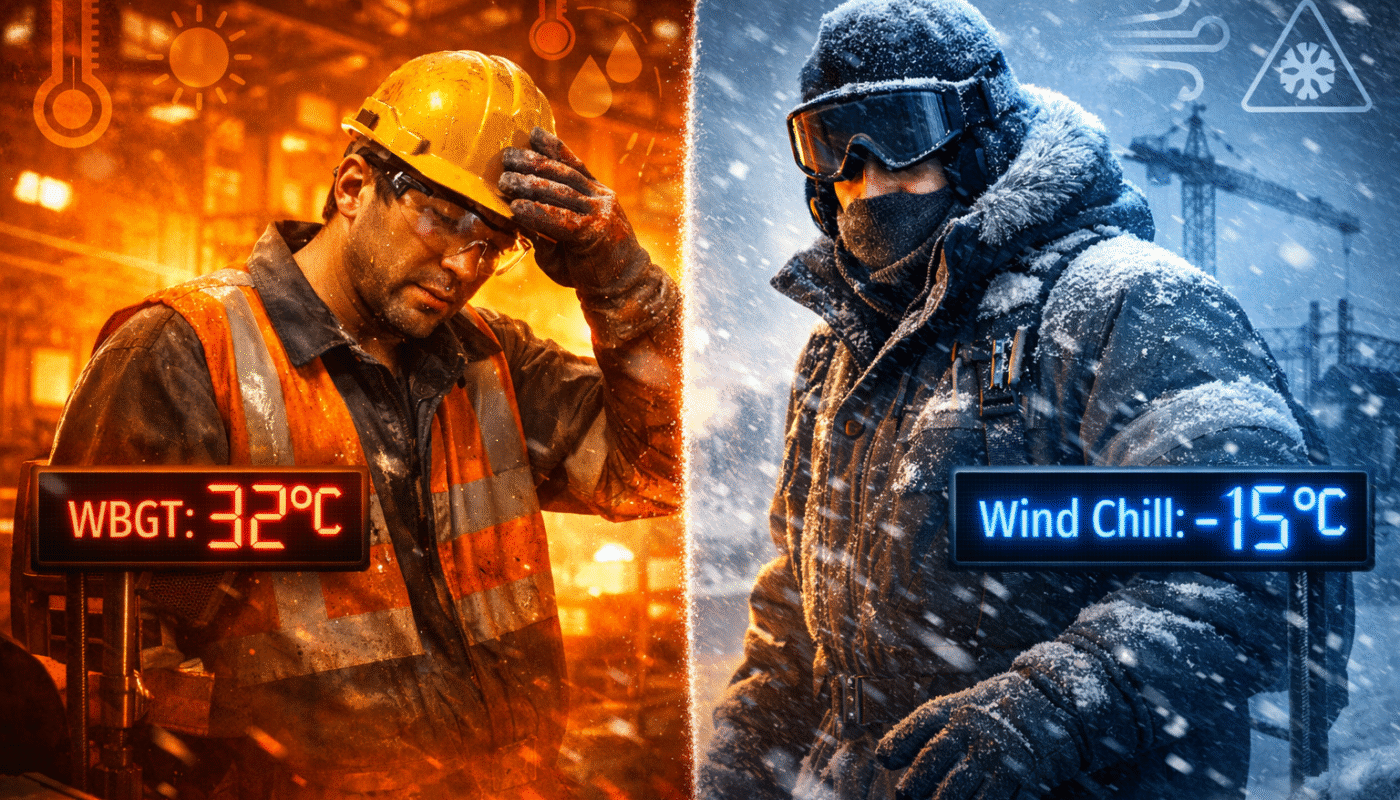
by Indices for Heat and Cold Stresses
Imagine stepping into a factory floor in peak summer where the air feels thick and suffocating. Now imagine working in a cold storage warehouse where your fingers go numb within minutes.
Both situations are dangerous — not because of machinery, but because of temperature.
Heat and cold stresses are silent threats in workplaces and outdoor environments. They don’t make noise. They don’t flash warning lights. But they can seriously impact health, productivity, and even survival.
So how do safety professionals measure these invisible dangers?
The answer lies in thermal stress indices.
In this detailed guide, we will explore the most important indices for heat and cold stresses, how they are calculated, why they matter, and how safety professionals use them to protect workers.
🌡️ Understanding Heat Stress Indices
Heat stress occurs when the body cannot cool itself effectively. When internal temperature rises, the consequences can include:
- Heat cramps
- Heat exhaustion
- Heat stroke
- Organ failure
- Death
To prevent this, safety experts use specific heat stress indices to assess risk levels.
1️⃣ Wet Bulb Globe Temperature (WBGT)
The Wet Bulb Globe Temperature (WBGT) is the most widely used heat stress index in occupational health.
Unlike simple temperature readings, WBGT considers:
- Air temperature
- Humidity
- Radiant heat
- Air movement
Why WBGT Matters
When humidity is high, sweat doesn’t evaporate effectively. When radiant heat is high (like near furnaces), body temperature rises faster. WBGT captures these factors in a single number.
It is recommended by:
- Occupational Safety and Health Administration (OSHA)
- American Conference of Governmental Industrial Hygienists (ACGIH)
Where WBGT Is Used
- Steel plants
- Construction sites
- Power plants
- Mining operations
- Outdoor labor industries
WBGT helps determine:
- Work-rest cycles
- Hydration frequency
- Acclimatization schedules
2️⃣ Heat Index (Apparent Temperature)
The Heat Index is commonly used in weather forecasts.
It combines:
- Air temperature
- Relative humidity
It tells us how hot it “feels.”
For example:
- 35°C with low humidity feels manageable.
- 35°C with 80% humidity feels unbearable.
Weather services worldwide use Heat Index to issue warnings.
Although useful for general awareness, it is less precise than WBGT for workplace risk assessment.
3️⃣ Humidex
The Humidex is used mainly in Canada.
Developed by:
- Environment and Climate Change Canada
It measures perceived temperature by combining heat and humidity.
While helpful for public advisories, it is not typically used in industrial heat stress monitoring.
4️⃣ Predicted Heat Strain (PHS)
PHS is a more advanced model used in occupational settings.
It predicts:
- Core body temperature
- Sweat rate
- Water loss
- Safe exposure duration
PHS is commonly applied in industries with extreme heat exposure like:
- Foundries
- Glass manufacturing
- Petrochemical plants
❄️ Understanding Cold Stress Indices
Cold stress occurs when the body loses heat faster than it can produce it.
This can lead to:
- Frostbite
- Hypothermia
- Trench foot
- Reduced dexterity
- Increased accident risk
Cold environments may appear harmless — but they can be just as deadly as heat.
1️⃣ Wind Chill Index (WCI)
The Wind Chill Index measures how cold it feels when wind speed is factored in.
Developed jointly by:
- National Weather Service
- Environment Canada
Wind removes the thin layer of warm air around the body. Faster wind = faster heat loss.
For example:
- Air temperature: 0°C
- Wind speed: 30 km/h
- Feels like: -10°C
This index is critical for:
- Outdoor workers
- Oil field workers
- Road maintenance crews
- High-altitude workers
2️⃣ Cold Stress Index (CSI)
CSI is used in industrial settings to measure:
- Air temperature
- Wind velocity
- Clothing insulation
- Metabolic workload
Unlike Wind Chill, CSI also accounts for work intensity and clothing.
3️⃣ Required Clothing Insulation (IREQ)
IREQ helps determine the insulation value needed to prevent excessive body cooling.
It is particularly useful in:
- Cold storage warehouses
- Refrigerated logistics
- Arctic construction
IREQ ensures protective clothing meets thermal requirements.
🧠 Why These Indices Are Critical in Workplace Safety
Thermal stress is not just about discomfort.
It affects:
- Reaction time
- Concentration
- Judgment
- Productivity
- Accident probability
In extreme cases, it causes permanent health damage.
Many regulatory bodies worldwide recommend thermal monitoring as part of occupational safety programs.
In India, thermal stress monitoring is often incorporated into safety systems aligned with:
- Factories Act 1948
📊 Comparison Table: Heat vs Cold Stress Indices
| Parameter | Heat Stress | Cold Stress |
|---|---|---|
| Primary Index | WBGT | Wind Chill |
| Factors Considered | Temp, humidity, radiation | Temp, wind |
| Advanced Index | PHS | IREQ |
| Common Use | Industrial safety | Outdoor labor |
| Main Risk | Heat stroke | Hypothermia |
🚨 Symptoms Linked to Heat Stress Levels
| WBGT Level | Risk Level | Possible Symptoms |
|---|---|---|
| Moderate | Caution | Fatigue, heavy sweating |
| High | Dangerous | Headache, nausea |
| Very High | Extreme | Heat stroke, collapse |
🚨 Symptoms Linked to Cold Stress Levels
| Wind Chill | Risk Level | Possible Symptoms |
|---|---|---|
| Mild | Low | Shivering |
| Severe | High | Frostbite |
| Extreme | Critical | Hypothermia |
💡 Practical Control Measures
For Heat Stress
✔️ Increase ventilation
✔️ Provide cool drinking water
✔️ Schedule work-rest cycles
✔️ Use reflective shields
✔️ Conduct acclimatization training
For Cold Stress
✔️ Provide insulated clothing
✔️ Use heated rest shelters
✔️ Limit exposure duration
✔️ Provide warm beverages
✔️ Train workers to identify symptoms
🌍 Climate Change and Thermal Stress
Rising global temperatures are increasing heat exposure risks worldwide.
Organizations like:
- World Health Organization
- International Labour Organization
have warned about increased occupational heat hazards due to climate change.
Similarly, extreme cold waves are becoming more unpredictable.
Thermal indices are now more important than ever.
📈 Role of Safety Officers and Management
As a safety professional, your responsibility goes beyond compliance.
You must:
- Monitor temperature conditions regularly
- Record WBGT and Wind Chill data
- Adjust work schedules
- Ensure hydration and PPE compliance
- Conduct thermal stress training
Remember:
Management involvement is more powerful than passive support.
🎯 Final Thoughts
Heat and cold are not just environmental conditions.
They are occupational hazards.
Understanding and applying the correct indices for heat and cold stresses can prevent illness, improve productivity, and save lives.
Whether you are a safety officer, plant manager, construction supervisor, or industrial hygienist — thermal monitoring should never be optional.
Because when temperature becomes the enemy, knowledge becomes your strongest defense.
🔁 Readers also enjoyed these blog posts:
- Safety Management’s Role: The Unsung Hero Behind Every Successful Organization
- Safety Management and Its Responsibilities: Protecting People, Preventing Hazards, and Promoting a Culture of Care
- Benchmarking for Safety Performance: A Key to Continuous Improvement
“Start Your Website Journey Today – Exclusive Hostinger Discounts!”

Turn Any Idea into Viral,
Jaw-Dropping AI Videos in Seconds!