 by
by Introduction: Why Roof Design Matters More Than You Think
When we talk about factory buildings, most people immediately think about heavy machines, large sheds, production lines, and safety helmets. But very few stop to think about one crucial structural element — the roof.
The roof of a factory is not just a covering. It directly affects:
- Natural lighting
- Ventilation
- Heat control
- Worker comfort
- Energy consumption
- Production efficiency
In hot climates like India, especially industrial regions such as Ahmedabad, poor roof design can turn a factory into a furnace. On the other hand, a well-designed roof can significantly reduce electricity bills and improve worker productivity.
In this detailed guide, we will explore:
✔ Various types of factory roofs
✔ Their structural characteristics
✔ Advantages and disadvantages
✔ Methods to improve natural ventilation
✔ Simple sketches for understanding
Let’s begin.
🏗 1. Types of Roof for a Factory Building
Industrial roofs are designed based on span, ventilation requirement, lighting need, and production type. Below are the most common types used worldwide.
1️⃣ Flat Roof
Description:
A flat roof has a very small slope (1:40 to 1:60) to allow rainwater drainage.
Features:
- Simple design
- Easy to construct
- Suitable for small span factories
- Can accommodate HVAC systems and solar panels
Advantages:
✔ Low construction cost
✔ Easy maintenance
✔ Suitable for future expansion
Disadvantages:
✘ Poor natural ventilation
✘ Heat accumulation
✘ Not ideal for heavy rainfall areas
2️⃣ Sloping Roof (Pitched Roof)
Description:
This roof slopes on one or both sides. Very common in small industrial units.
Features:
- Better water drainage
- Good structural strength
- Can use trusses
Advantages:
✔ Better rainwater drainage
✔ Simple structural design
✔ Moderate ventilation improvement
Disadvantages:
✘ Limited daylight penetration
✘ Limited ventilation unless modified
3️⃣ Monitor Roof
Description:
A raised rectangular structure runs along the ridge of the roof to allow ventilation and lighting.
Features:
- Central raised section
- Louvers or ventilators provided
- Common in textile and heavy industries
Advantages:
✔ Excellent natural ventilation
✔ Good daylight
✔ Removes hot air effectively
Disadvantages:
✘ Slightly higher cost
✘ Requires proper waterproofing
4️⃣ Saw Tooth Roof (North Light Roof)
This is one of the most popular industrial roof designs.
Description:
A series of slopes where one side is vertical (glazed) and the other is sloped.
Why “North Light”?
In the Northern Hemisphere (like India), north-facing windows receive consistent diffused light without harsh sunlight.
Advantages:
✔ Excellent natural lighting
✔ Reduces electricity use
✔ Suitable for precision industries
Disadvantages:
✘ Higher construction complexity
✘ Needs careful orientation
5️⃣ Curved Roof (Barrel Roof)
Description:
A semi-circular roof structure.
Features:
- Aesthetic appeal
- Good air circulation
Advantages:
✔ Modern look
✔ Better air movement
✔ Suitable for large span
Disadvantages:
✘ Higher cost
✘ Complex fabrication
6️⃣ Trussed Roof
Used when large spans are required without internal columns.
Advantages:
✔ Large column-free space
✔ Strong structural support
Disadvantages:
✘ May require additional ventilation arrangements
🌬 Why Natural Ventilation is Critical in Factories
Before we move to ventilation methods, let’s understand why it matters.
Factories generate:
- Heat from machines
- Fumes
- Dust
- Chemical vapors
- Humidity
Poor ventilation can cause:
❌ Worker fatigue
❌ Reduced productivity
❌ Health hazards
❌ Increased accident risk
❌ Higher electricity consumption
Natural ventilation reduces dependency on artificial cooling systems and improves sustainability.
🌿 Methods to Improve Natural Ventilation in Factory Buildings
Now let’s explore practical and effective methods.
1️⃣ Ridge Ventilation
Hot air rises naturally. Providing vents at the roof ridge allows it to escape.
Benefits:
✔ Removes accumulated hot air
✔ Improves airflow
✔ Low maintenance
2️⃣ Louvers
Wall-mounted adjustable slats allow air to pass while blocking rain.
Benefits:
✔ Controlled airflow
✔ Rain protection
✔ Cost-effective
3️⃣ Roof Ventilators (Turbo Ventilators)
Wind-driven turbines installed on the roof.
Working Principle:
Wind rotates the turbine, creating suction that pulls hot air out.
Advantages:
✔ No electricity required
✔ Continuous operation
✔ Affordable solution
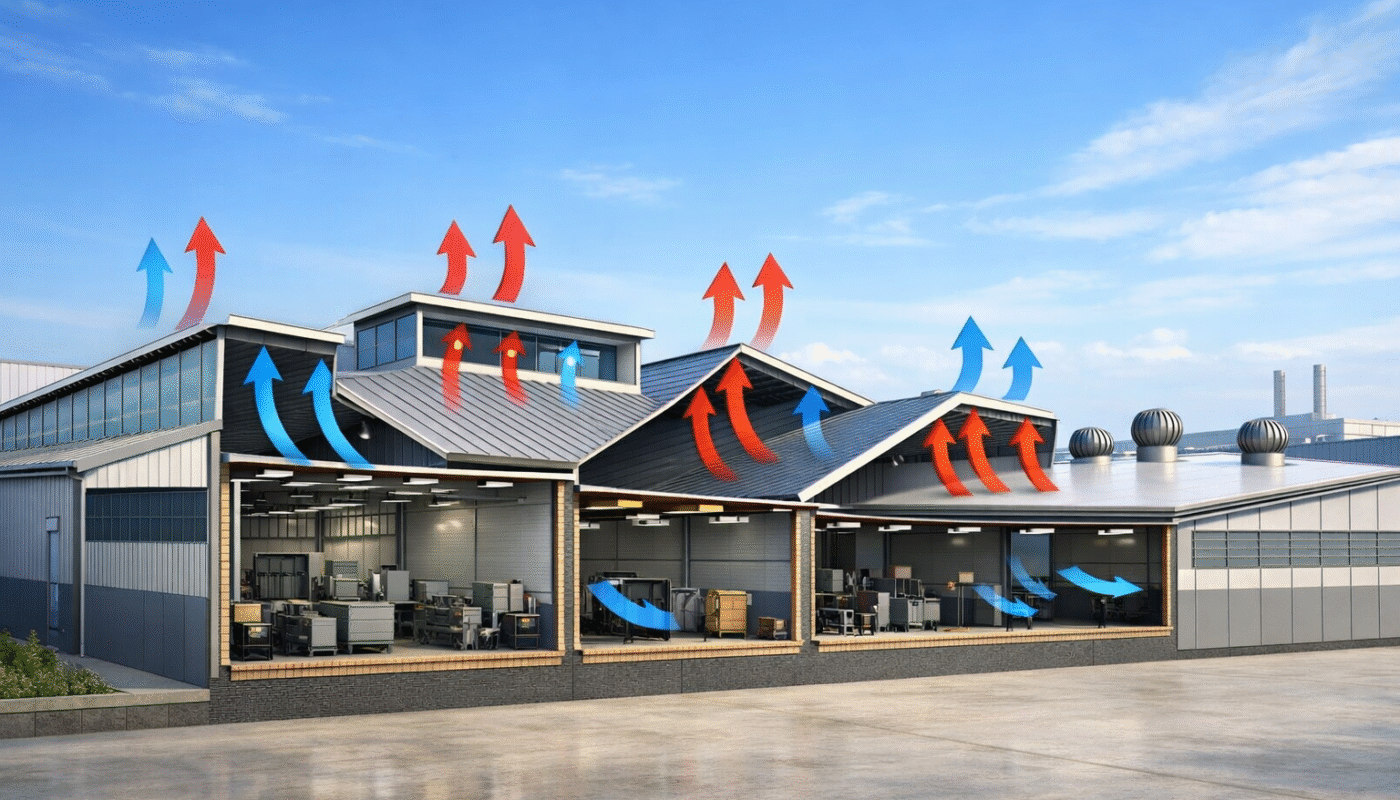
4️⃣ Monitor Roof Ventilation
As discussed earlier, monitor roofs naturally improve ventilation through central openings.
✔ Hot air escapes through top
✔ Fresh air enters from sides
5️⃣ Cross Ventilation
Provide openings on opposite walls.
Benefits:
✔ Natural air movement
✔ Reduces heat concentration
✔ Improves indoor air quality
6️⃣ Stack Effect Ventilation
Hot air rises and exits from high-level openings while cool air enters from lower openings.
This principle is widely used in saw tooth and monitor roofs.
7️⃣ Skylights with Ventilation Panels
Transparent sheets combined with operable ventilation flaps improve light and airflow simultaneously.
💡 Combining Roof Type with Ventilation Strategy
The best factory designs combine roof selection and ventilation planning.
| Roof Type | Best Ventilation Method |
|---|---|
| Flat Roof | Turbo ventilators + Louvers |
| Sloping Roof | Ridge vent + Side louvers |
| Monitor Roof | Built-in ventilation |
| Saw Tooth Roof | Stack ventilation |
| Curved Roof | Ridge + Turbine ventilators |
🔥 Practical Tips to Improve Natural Ventilation in Existing Factory Buildings
If your factory is already constructed, you can still improve ventilation:
- Install turbo ventilators
- Increase louver openings
- Add ridge vents
- Use reflective roof coating
- Install translucent ventilated skylights
- Improve internal airflow layout
- Remove obstructions near air openings
🌎 Energy Efficiency & Sustainability
Modern industrial architecture focuses on:
- Reducing HVAC dependency
- Lowering carbon footprint
- Improving indoor air quality
- Worker wellness
Natural ventilation can reduce cooling energy by 30–40% in hot climates.
That’s a huge saving in operational cost.
👷 Safety Perspective
Proper ventilation:
✔ Reduces chemical vapor concentration
✔ Prevents heat stress
✔ Complies with industrial safety regulations
✔ Improves overall workplace morale
For hazardous industries, ventilation is not optional — it is mandatory.
🏭 Real-World Application Insight
In textile factories and engineering workshops across Gujarat and Maharashtra, monitor roofs and saw tooth roofs are widely used because they:
- Allow continuous production
- Reduce electricity consumption
- Provide uniform lighting
- Improve comfort in summer
📌 Conclusion: The Roof is the Heart of Industrial Climate Control
A factory roof is much more than a structural cover.
It influences:
- Ventilation
- Lighting
- Safety
- Productivity
- Energy cost
Choosing the right roof type combined with intelligent natural ventilation methods can transform a factory from a heat-trapping shed into a comfortable, efficient workspace.
Whether you are designing a new industrial building or upgrading an existing one, always consider:
✔ Climate
✔ Industry type
✔ Span requirement
✔ Budget
✔ Energy goals
Because in industrial architecture — the roof silently controls everything.
🚀 Final Thoughts for Engineers & Safety Professionals
If you are involved in:
- Factory design
- Industrial safety
- Construction planning
- EHS management
- Facility upgrades
Understanding roof types and ventilation methods gives you a serious advantage.
Smart ventilation is not just about air.
It’s about health, productivity, and long-term savings.
🔁 Readers also enjoyed these blog posts:
- Safety Management’s Role: The Unsung Hero Behind Every Successful Organization
- Safety Management and Its Responsibilities: Protecting People, Preventing Hazards, and Promoting a Culture of Care
- Benchmarking for Safety Performance: A Key to Continuous Improvement
“Start Your Website Journey Today – Exclusive Hostinger Discounts!”

Turn Any Idea into Viral,
Jaw-Dropping AI Videos in Seconds!